
Cincinnati Greatest Hits
Volume 1

Dylan in Cincinnati will be published next month by the University Press of Mississippi. From the start, Shadow Chasing has been my laboratory for experimenting on this project and my display case for sharing first drafts. I’ve benefitted enormously from readers’ encouragement and feedback throughout the process. This feels like a shared accomplishment—thank you!
Counting down to the book launch, I thought it would be fun to compile a Cincinnati Greatest Hits package. A lot of Dylan fans love lists and rankings. Admittedly, that’s not normally my thing, but hey, you’ve earned a reward for your patience and loyalty, so here you go. One rule I’ve set for myself is no repetitions of songs. If Dylan had multiple memorable performances of the same song, I’ll only include what I personally rate as the very best.
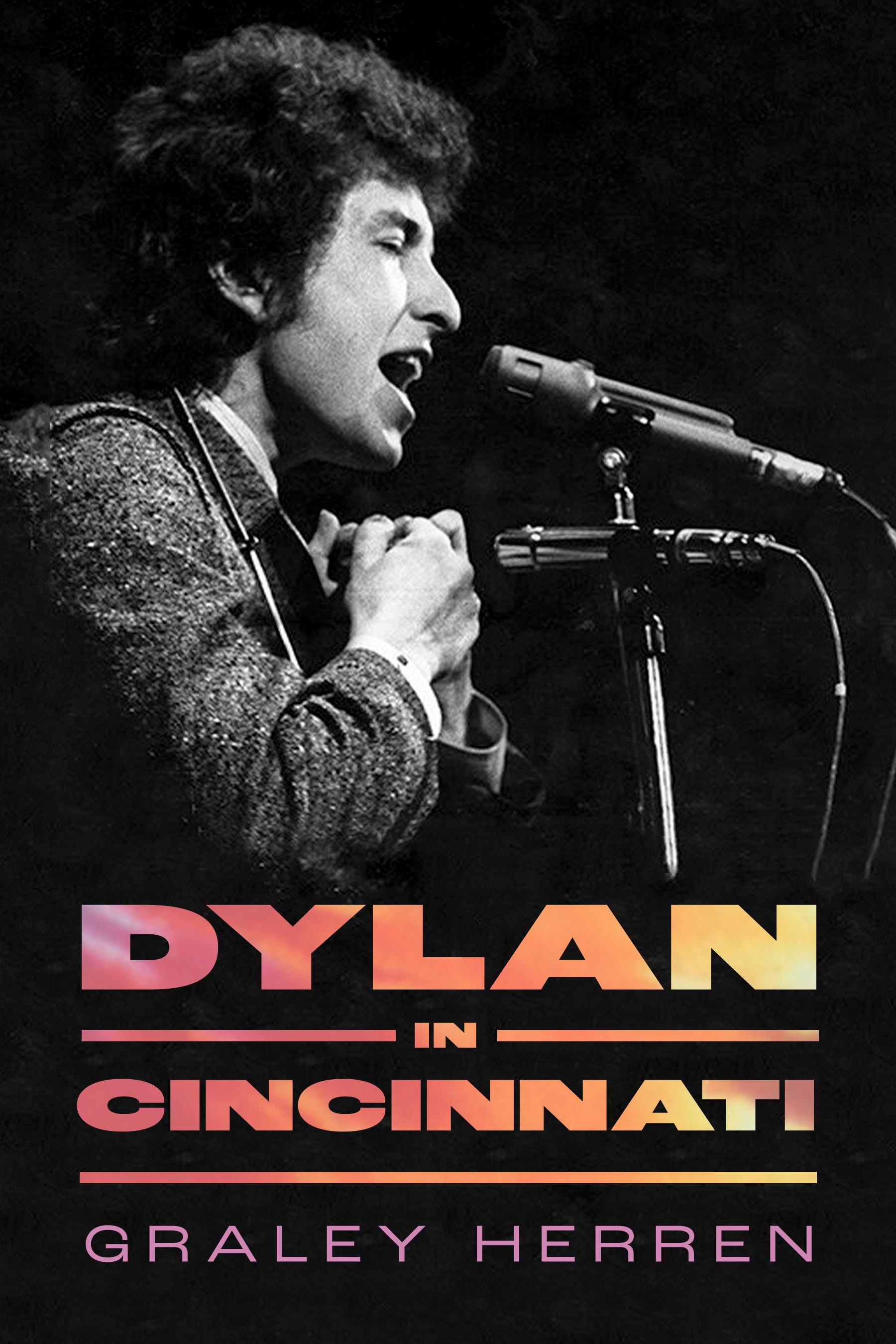
This first volume spans #11-25 of Dylan’s best performances in Cincinnati of his own songs. The second volume will spotlight the Top Ten. Then we’ll savor a dozen amazing covers in the third volume. I’ll arrange them all in Casey Kasem countdown style. I’m keeping the liner notes relatively brief, at least by my verbose standards. If you want the full treatment, please consider purchasing this little book coming out soon:
#25: “Like a Rolling Stone” (1981)
Dylan’s most played songs in Cincinnati track pretty faithfully with his overall concert stats. There is a tie between “All Along the Watchtower” and “Like a Rolling Stone” for the most played songs in Cincinnati, both performed here eleven times. It’s probably surprising that my only entry on this famous song is ranked so low. If you want to hear a kick-ass “Rolling Stone,” you should go to Manchester in 1966, not Cincinnati, where his performances of this classic have sometimes felt like discharging a duty rather than expressing a vital need.
I think the best version is from the first night at Music Hall in 1981. I especially like the way Dylan interweaves his vocals with the Queens of Rhythm on the chorus. Honestly, my favorite part isn’t even from the song itself. Keep listening after the applause, and you’ll hear Dylan share a curious local memory with the audience: “I want to thank you, Cincinnati. Was there a place in Cincinnati called . . . what was it called? Ollie’s Trolley? Something like that? Do they still have that here? I wrote a song there one time, sitting in Ollie’s Trolley. Can’t remember exactly when. But I do remember where. It was in Ollie’s Trolley.”
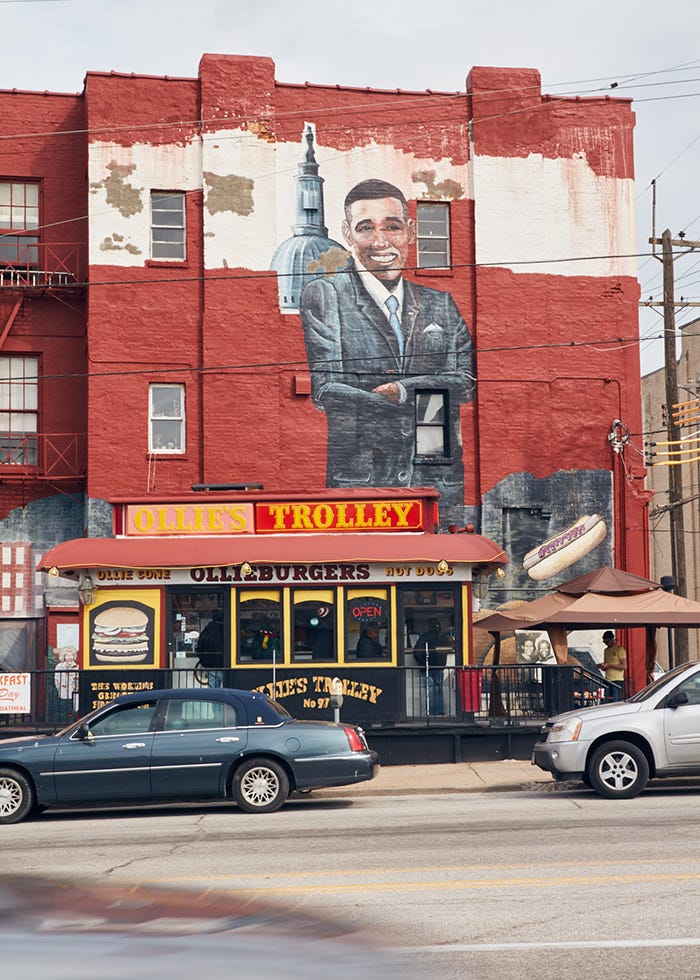
Before Laura Tenschert coaxed me into starting my own site, Ray Padgett generously offered me a guest spot on his Substack flagship Flagging Down the Double E’s for my piece on “Slow Trolley Coming,” where I speculate that “Slow Train Coming” is the song Dylan was working on. Thanks for the persuasive nudge, Laura, and thanks for hosting my debutante ball on Dylan in Cincinnati, Ray!
#24: “When I Paint My Masterpiece” (2026)
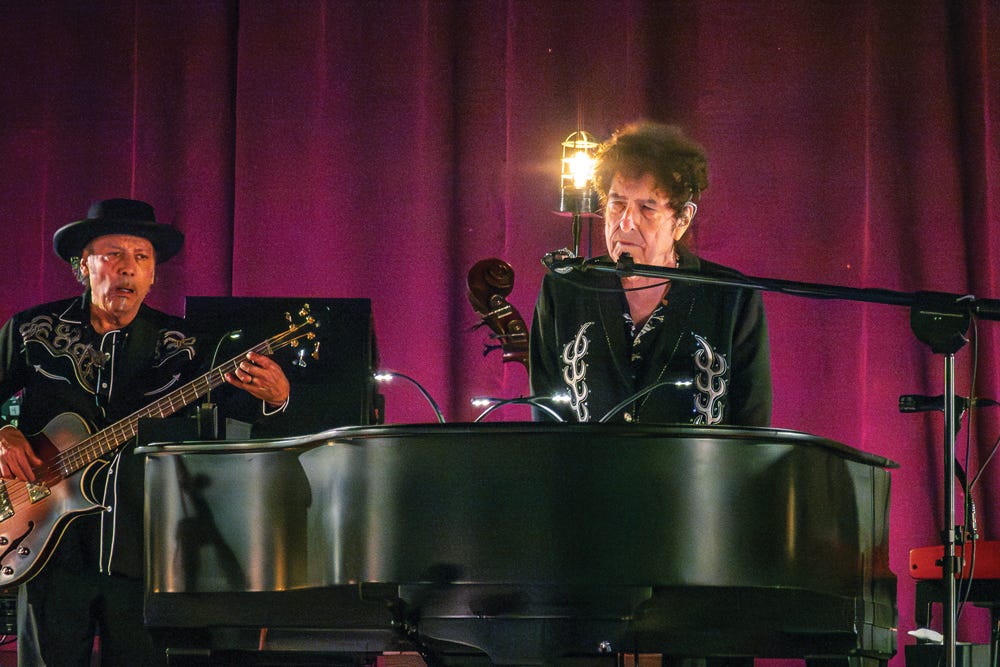
I adore Dylan’s arrangement of “When I Paint My Masterpiece” performed in 2023 downtown at the Andrew J. Brady Music Center. But that concert is going to get a lot of love elsewhere on the Greatest Hits, so I’m focusing instead on the song’s most recent reincarnation at PNC Pavilion this summer. You’ll instantly recognize the melody, not from the famous recording of “Masterpiece” produced by Leon Russell, but from Irving Berlin’s “Puttin’ on the Ritz.” That odd echo is enough to make this performance interesting, but what really catapults it into the Top 25 is the sparkling guitar of Joel Paterson.
Most Shadow Chasing readers are familiar with the drama surrounding Dylan’s revolving lineup of guitarists in 2026, after the abrupt departures of Doug Lancio and Bob Britt in the middle of the Long Hot Summer Tour. It was a shame to see Doug and Bob go, especially under a cloud of acrimony after years of dedicated service. But the musical reset has also been refreshing, and it was heartening to see Dylan’s buoyant reactions on stage to jazz prodigy Julian Lage, then Joel Paterson and Jad Tariq, and finally his old friend Jimmie Vaughan. Joel’s stylish interplay with Dylan’s keyboards make this “Masterpiece” twinkle and glow. They are ably supported by newcomer Jad Tariq, who made his debut in Dylan’s band on this balmy night in Cincinnati. Alas, I was out of town at a conference and so missed out on this concert. But you can read two excellent reviews from the trenches by Nat Tracey-Miller and Adam Selzer, and you can watch video of the entire concert posted by John Waters.
#23: “I Shall Be Released” (1978)
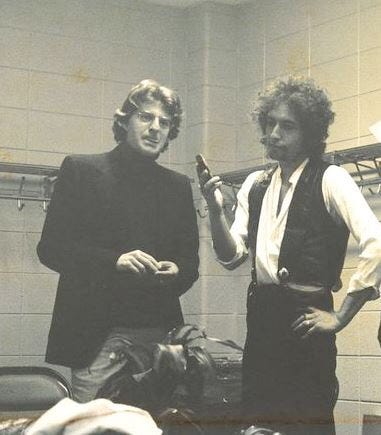
I’ve come up empty in my search for bootlegs of Dylan’s first two concerts in the city: solo acoustic at Taft Theatre in March 1965, and plugged in with The Hawks (later The Band) at Music Hall in November 1965. The first available recording of Dylan in Cincinnati is the sold-out 1978 extravaganza at Riverfront Coliseum. The arena was packed with nearly 17,000 attendees, by far the biggest audience for any of his Cincinnati concerts. The stage was crowded, too, with a dozen performers in the largest band he ever brought to town. Meanwhile backstage, Dylan received the key to the city from our dashing young mayor Jerry Springer:
“I Shall Be Released” was one of the standout performances. Even on this somewhat muffled bootleg, you get a feel for the enormous size of the audience from the cheers at the beginning (they’re still roaring from the previous song, “Like a Rolling Stone”). Some fans find the 1978 tour too glitzy, as if Dylan were trying to replicate Elvis in Vegas. That was basically my first reaction to “I Shall Be Released.” But I listened some more and it has grown on me over time. The vocal amplitude provided by the Queens of Rhythm challenges Dylan to ramp up his intensity. The cumulative effect serves the song well, giving me the sense of a prisoner bursting out of his cage and soaring on the wings of angels.
#22: “I’ll Be Your Baby Tonight” (2023)
This is the first of four songs from Brady ’23 in the Top 25, more than any other single concert. As much as I love Dylan’s duet with the celestial Clydie King at Music Hall ’81, this version of “Baby Tonight” emerges as the most interesting Dylan has blessed us with in Cincinnati. The new arrangement is really like three songs in one: 1) a slow moaner, like a hound dog baying in the moonlight; 2) a honkytonk blowout, like Annie Oakley just shot the piano player with amphetamines; 3) a slinky and lurid prowl, like Jelly Roll Morton ripped off his mask to reveal Jack the Ripper.
This song often comes across in concert like a seduction of the audience. “I’ll Be Your Baby Tonight”: in other words, “Take me, I’m yours—until tomorrow night, when I’ll belong to another audience down the road.” The creepy vibe at the end of this Brady ’23 rendition sends very different signals, however, transforming “Baby Tonight” from a torch song into a murder ballad. “You don’t have to be afraid”? Sounds to me like you should be very afraid!
#21: “Song to Woody” (2000)
We move from a sinister threat to a sincere tribute, the achingly tender “Song to Woody.” Dylan’s vocal exudes humility, sincerity, respect, and love, and his acoustic guitar, accompanied by Larry Campbell on mandolin, couldn’t be more exquisite. I love the discerning crowd reaction at Riverbend Music Center. They know what a rare treat it is to hear this 59-year-old troubadour singing a psalm of gratitude written when he was only 19. Back in 1962, when he wrote “The very last thing that I’d want to do / Is to say I’ve been hittin’ some hard travellin’ too,” the lines were largely aspirational. However, by the time he sang the song in 2000, he had fully lived them. By now, Dylan has toured more years that Woody lived (he died at age 55). And yet, Dylan has been quite sparing in his performances of this homage. According to bobserve, he has only played it 59 times, and Riverbend ’00 marked his only Cincinnati performance.
It’s also worth noting that this was his first return to the city after the death of his beloved mother on January 25, 2000 (three days after my own late mother’s 55th birthday). In the book, I situate this concert in relation to themes of mothers and mourning. In that context, it makes sense that Dylan would also make space to commemorate his late musical father, Woody Guthrie.
#20: “Ballad of a Thin Man” (1988)
To find a local show without Tony Garnier as Dylan’s bassist, you have to go all the way back to June 22, 1988. Cincinnati was only the tenth concert of the Never Ending Tour, featuring a lean four-man lineup, with G. E. Smith on electric and acoustic guitars, Chris Parker on drums, and Kenny Aaronson on bass. Their size was small but their sound was mighty. For proof, just listen to this ferocious “Ballad of a Thin Man.” Hellfire and damnation—they’re smokin’ hot!
One of my favorite moments in Martin Scorsese’s No Direction Home is the scene where Dylan plays an incendiary “Ballad of a Thin Man” to a heckling crowd in England in May 1966, convulsing on the piano bench like he’s just been struck by lightning. “Don’t boo me anymore!” he yells back at the mob while he speeds away in his getaway car. I assure you that no one was booing at Riverbend in 1988. I never thought I’d get to hear a version of “Ballad of a Thin Man” that rivals the 1966 intensity in my hometown, but Riverbend ’88 comes close. Dylan tears into this song like he’s the geek and Mr. Jones is the chicken.
#19: “False Prophet” (2021)
If we’re playing the ranking game, we could have a lively debate over Dylan’s best overall concert in Cincinnati. Excluding the 1965 shows (since we have no bootlegs to judge by), I’d be willing to defend any of the Dylan’s turn-of-the-century shows: Bogart’s ’99, Riverbend ’00, or Xavier ’01 —I refer to them in the book as the Cincinnati Trilogy. Two other shows already mentioned deserve to be part of that conversation, too: Music Hall ’81 and Brady ’23.
But if we adjust the criteria to consider Dylan’s most important concert in the city, there’s only one contender for me: Aronoff ’21. This was Dylan’s first return after Covid had radically changed our lives. During those dark days and endless nights of lockdown, when we lost so much and so many, we never knew if we’d see Dylan (or anybody else) in concert again, or when we’d be able to gather in a room with strangers without putting our lives in jeopardy. The first leg of the Rough and Rowdy Ways World Wide Tour mattered on a different scale of magnitude than concerts before or since. It wasn’t just Dylan live; it was Dylan the life-giver and the rejuvenator, as well as Dylan the mourner-in-chief.
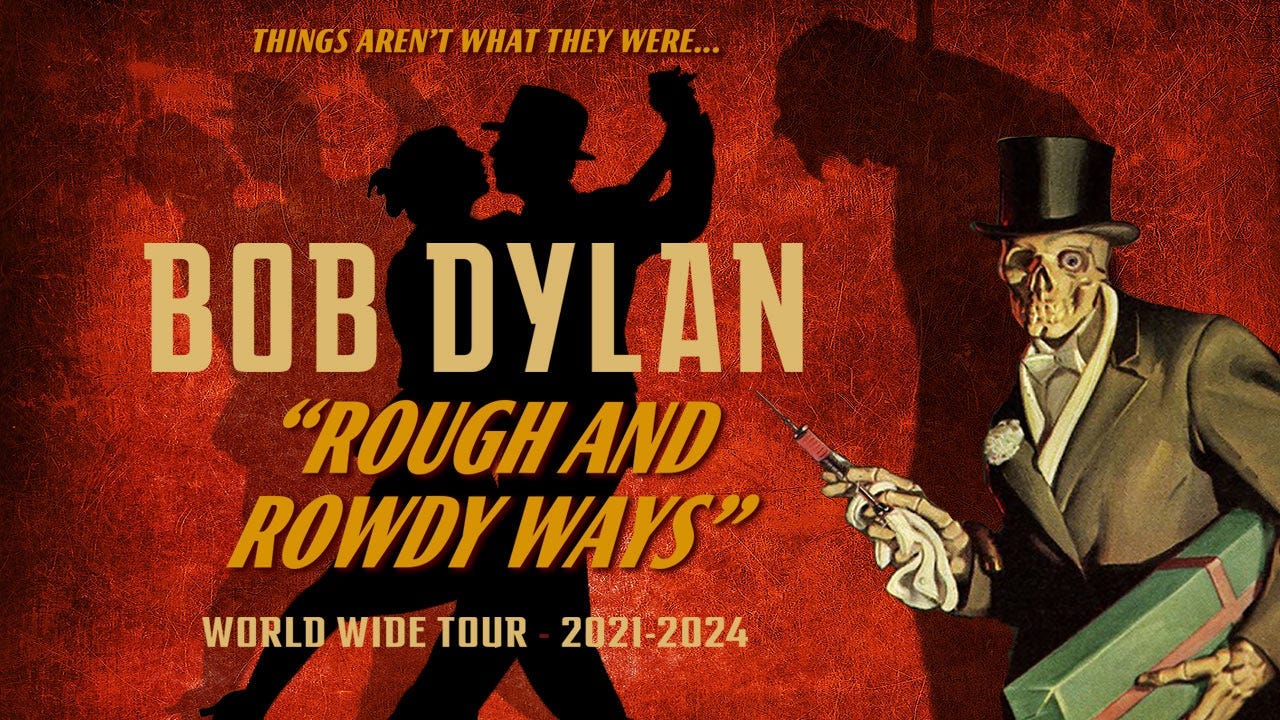
Unfortunately, Dylan’s first song from the Rough and Rowdy Ways album was a botched job at the Aronoff Center. He accidentally kicked the plug out of his microphone during “I Contain Multitudes,” leading him to lose his place and skip over multiple lines. Great song but jinxed performance. Thankfully, he followed it up with “False Prophet,” and his aim was true. Dylan’s powerful vocals are front and center, and the band is totally locked in. I remember them all bobbing their heads in unison to the spellbinding groove. I already loved the album, but the Aronoff ’21 “False Prophet” was direct proof of concept for an entire tour built around RARW.
#18: “Can’t Wait” (1998)
If you’ve followed my work at all, you know I’m a huge fan of Time Out of Mind. [For much more on that topic, check out my book Dreams and Dialogues in Dylan’s Time Out of Mind.] Dylan’s first local concert after releasing the record was at the Cincinnati Gardens in 1998, and six days later he won the Grammy for Album of the Year. These songs have featured prominently in Dylan’s setlists since 1997. As the Gardens show demonstrates, TOOM has proven remarkably versatile in its evolving afterlives on stage.
My favorite example from this concert is “Can’t Wait.” Here is a grainy video from an anonymous bootlegger:
Musically, this “Can’t Wait” sounds nothing like the yearning demo version released on Tell Tale Signs, and it scarcely resembles the menacing official release on Time Out of Mind. By 1998, Dylan and mates had reinvented the song with an enthralling new guitar hook. The lyrics and vocals still give off a stalker vibe, but here the predator trades in his penknife for a hypnotist’s watch. He’s biding his time and can’t wait much longer to pounce. The Gardens show didn’t make it into my book, but this song is too alluring to leave out of the Top 25.
#17: “Girl from the North Country” (1999)
Bogart’s! This is Dylan’s most legendary Cincinnati show. After a scheduling snafu at Riverbend forced him and Paul Simon to cancel their show, Dylan’s team hastily assembled a show at the grunge bar Bogart’s. I’ll be writing about a couple memorable covers from this concert in the third volume, but the original song I want to highlight is “Girl from the North Country.” Take a look at this bootleg video of the performance:
This has always been Dylan’s gentlest love song. The audience was generally rough and rowdy at Bogart’s, but most of us had the good sense to shut up and listen to Dylan’s hushed and heartbreaking vocals, complemented by Larry Campbell’s pristine finger-picking on acoustic guitar. The frontman sticks his oar in the water with a (sort of) guitar solo near the end. Just look at him flirting with his enraptured fans, smirking and wiggling and unabashedly enjoying the up-close attention. Here’s lookin’ at you, Bob!
#16: “Lenny Bruce” (2019)
I managed to worm my way pretty close to the stage at Bogart’s ’99, but the only time I actually had front-row seats to a Dylan concert was twenty years later, across the river at Northern Kentucky University. You’ll be hearing more from this concert in the second volume. But first let’s admire Dylan burnishing the legend of Lenny Bruce.
For many fans, “Lenny Bruce” holds the dubious distinction as one of the worst songs Dylan ever wrote. Harry Hew rescued the song’s lyrics for me with his brilliant paper at the World of Bob Dylan Conference in 2023, arguing that Dylan intentionally used Lenny-style humor in his portrait of the renegade comic. But Dylan had already made me a believer with his stunning vocal performance in 2019. Nobody around me was laughing at the song that night, accompanied by Dylan’s sensitive piano and Donnie Herron’s melancholy violin. The song’s majesty is undeniable and the singer’s mastery is above reproach at NKU ’19. You could just about convince yourself that Dylan is meditating on his own legacy and mortality through this dirge, turning “Lenny Bruce” into a moving self-elegy.
#15: “Forever Young” (1978)
Now let’s go back four decades and shift from eulogy for the dead to prayer for a newborn. Dylan prefaces the song by telling the huge crowd, “Thank you! We’re gonna go now. We’re gonna play one last song. I wrote this a few years ago on an album with The Band called Planet Waves. I wrote it for one of my babies at the time.”
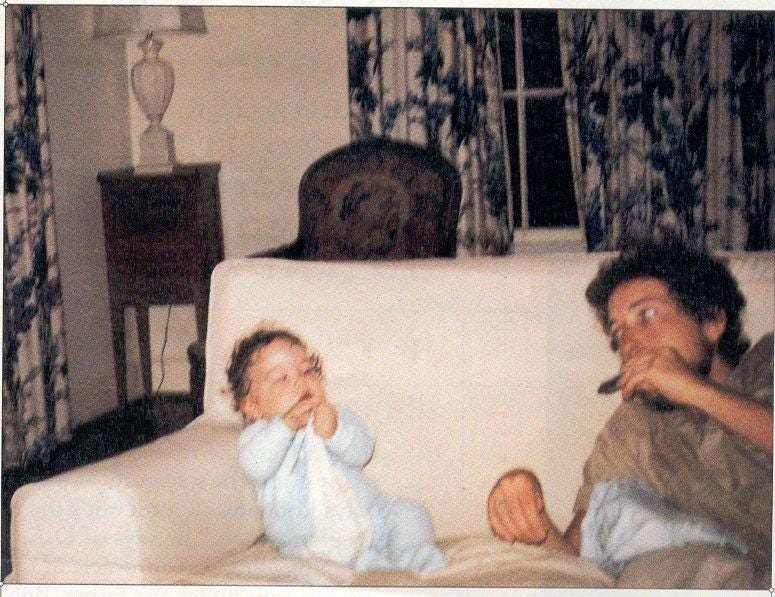
There have always been mixed reactions to the Queens of Rhythm among Dylan fans. As I discuss in the book, the backing vocalists received dismissive coverage in the Cincinnati Enquirer. I can’t fathom how anyone could listen to Helena Springs, Jo Ann Harris, and Carolyn Dennis in this rendition of “Forever Young” and not find them gloriously uplifting.
If you keep playing the track through to the end, you’ll hear a spike in the crowd’s cheers. I had assumed that this was an enthusiastic send-off for Dylan as he left the stage ahead of the final encore. However, according to Cincinnati Post music critic James Chute, the fans were responding to a more specific prompt: “A hand-lettered poster with a giant peace-sign read ‘Dylan is Hip—only the date has changed.’ Dylan liked it, and in a rare gesture, he plucked the poster out of the audience and handed it backstage.” “May you stay forever young”: maybe Dylan was partially singing to himself on this one, too.
#14: “Crossing the Rubicon” (2023)
The two RARW setlists in Cincinnati (2021 & 2023) were fairly stable, with a couple of notable exceptions. The first change was switching out “Early Roman Kings” for “Crossing the Rubicon”—a major upgrade. Dylan takes his time sauntering through this slow-burn blues, and the band lays down a sultry ambience, transforming classical Rome into a bordello barroom. The song moves like Stella slinking down the stairs to Stanley in A Streetcar Named Desire.
At the midpoint, just as we’re getting lulled into a musical trance, Dylan launches into a breakneck flourish on piano. It’s possible that he just wants to startle us out of the spell he has cast. But I find it more likely that he’s replicating the splashing water as his army passes the central threshold of the song. In other words, I think this is the sound of Dylan and his soldiers crossing the Rubicon. This effect elevates the song from ultra-cool to extra-special, earning its spot in the Top 25.
#13: “The Lonesome Death of Hattie Carroll” (1988)
Some of the most memorable moments from the early NET years came in the acoustic set. This section often featured old traditional songs, unpredictably shuffled from night to night, and lovingly performed by Dylan and G. E. Smith on acoustic guitars. We’ll be listening to some gorgeous examples in Cincinnati Greatest Hits, Volume 3. But these sets also regularly included one or two of Dylan’s own songs, resurrecting the “voice of his generation” mystique from a quarter-century earlier.
For a wonderful example, check out “The Lonesome Death of Hattie Carroll” from the very first NET show in Cincinnati. It is breathtaking, and I mean that literally. One of the secrets to Dylan’s prowess as a singer is breath control. For such a little guy, it’s remarkable how much lung power he could muster in belting out songs in the sixties, seventies, and eighties. But it’s not just a matter of force. At his best, Dylan the singer is “a column of air,” to borrow Allen Ginsburg’s description. He summons the creative spirit, serves as its medium, modulates inspiration into outward expression, and exhales it as song.
Wondering what the hell I’m talking about? Listen to the Riverbend ’88 “Hattie Carroll” and hear for yourself. Dylan builds suspense and increasing anxiety, not just through his verbal descriptions of the murder and rigged trial, but also through his panting delivery. By the final verse, as the volume rises and the vocals become more clipped and frantic, he’s practically hyperventilating. However, what we’re hearing isn’t the loss of breath control but the opposite. This is a vocalist who has mastered his instrument, viscerally communicating his outrage and sorrow through every breath he takes.
#12: “A Hard Rain’s A-Gonna Fall” (2024)
Dylan has played this masterpiece five times in Cincinnati, and they’ve all been strong performances. I love the Riverbend ’00 “Hard Rain,” where Patti Smith was spotted in the audience. It wasn’t part of his setlist rotation at the time, so I like to think he played it as a gift for Patti. She returned the favor sixteen years later by singing “Hard Rain” at the Nobel Prize ceremony in Stockholm. I also love Dylan’s moving rendition from 2013, which I witnessed alongside my son Dylan (named after you know who).
The most magisterial performance, however, took place at Riverbend in 2024 as part of the Outlaw Music Festival. This “Hard Rain” isn’t a song so much as an oration. Dylan is the prophet handing down holy writ from the mountaintop. The musical accompaniment is minimal but effective, particularly the percussion parts inserted between lines by legendary drummer Jim Keltner. The primary power source of this “Hard Rain” is Dylan’s voice. Rather than rushing through the refrain, he pauses over each repetition of the word “hard,” examining years’ worth of accumulated suffering compressed into black diamonds. Stunning.
#11: “When He Returns” (1981)
Let’s end the first volume of Cincinnati Greatest Hits where we began, at Music Hall in 1981. By the time Dylan arrived for his first shows in town since 1978, he had passed the zealous zenith of his born-again period. His setlists still included several Christian songs, but more and more of them were being replaced with pre-conversion material. One of the songs that got bumped out of the setlist during this transitional period was “When He Returns.” Dylan’s searing solos on piano were a nightly highlight during the gospel tours of 1979 and 1980. But by 1981, this apocalyptic warning, focused on sinners in the hands of an angry god on judgment day, had seemingly completed its mission. After Dylan played it upstate in Akron in May 1980, it disappeared from his concerts. This graph from bobserve says it all:
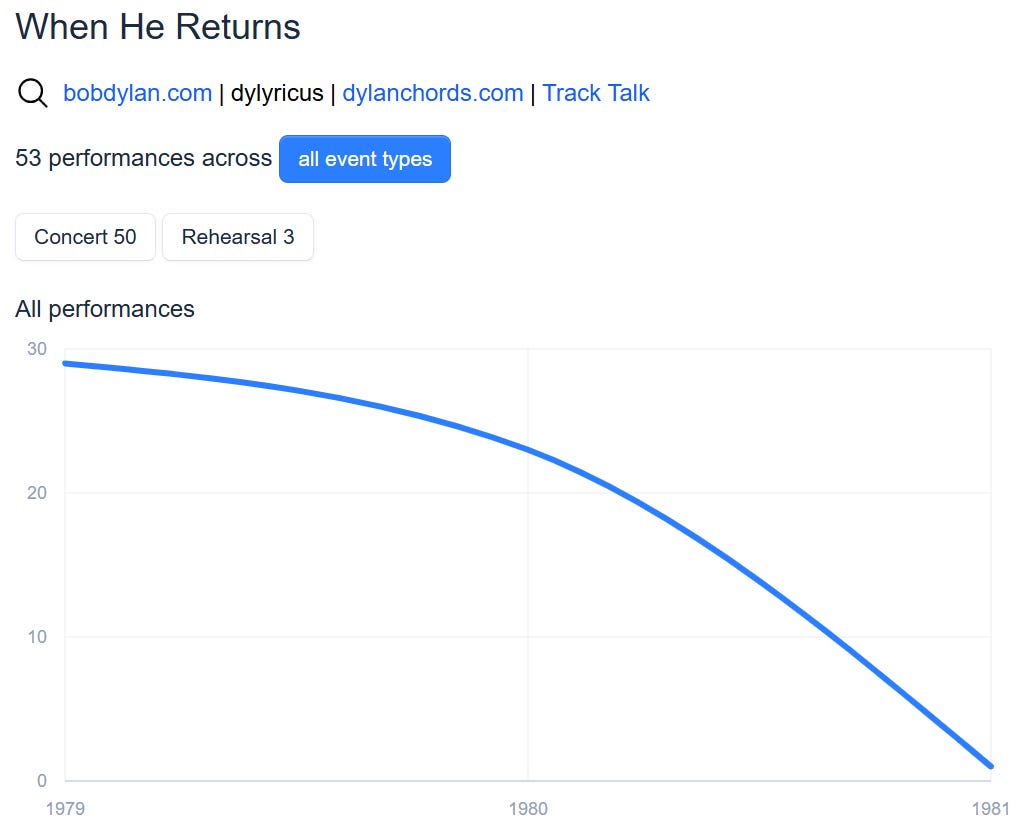
So it came as quite a surprise eighteen months later when he resurrected “When He Returns” for one final performance on November 4, 1981, in Cincinnati. It sounds like no one was more surprised than Dylan’s bandmates. If they had rehearsed the song, you sure can’t tell from their tardy entry into the mix, guided by Dylan’s guitar (not piano) and his half-remembered lyrics. It’s shambolic—and, to my ear, it’s a work of genius. This is how music gets made spontaneously in the moment by artists dedicated to listening to each other and responding.
The image I get is of a captain whose ship has sunk, drifting alone on a lifeboat, lost at sea. He calls out for help from the lonely darkness. Dylan’s bandmates are the rescue crew, and it takes them awhile to pick up on the distress signal. But eventually they tune into the right frequency. The musicians reply with increasingly assertive messages of reassurance. Eventually the captain and his crew are reunited, playing together again, and they haul the song successfully on shore. Dylan let’s us know they made it back home by repeating the phrase “When He Returns” four times. And then he never repeats those lines again, in Cincinnati or anywhere else. Mission accomplished. It is finished.
That’s it for Cincinnati Greatest Hits, Volume 1. In a couple weeks I’ll post my Top Ten in Volume 2. Thanks again for your support of Dylan in Cincinnati!
Looking forward to checking out the new book. Congratulations on completion.
Keep on truckin', Graley.