

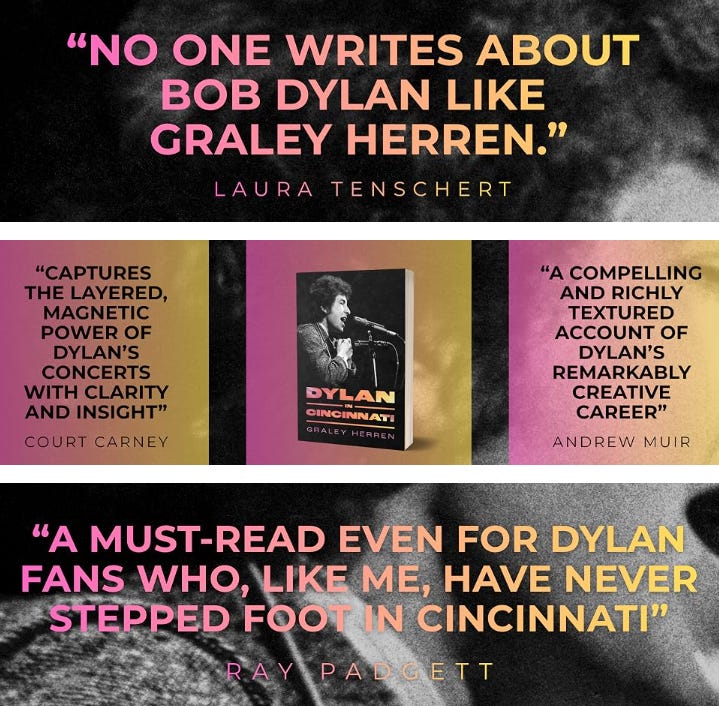
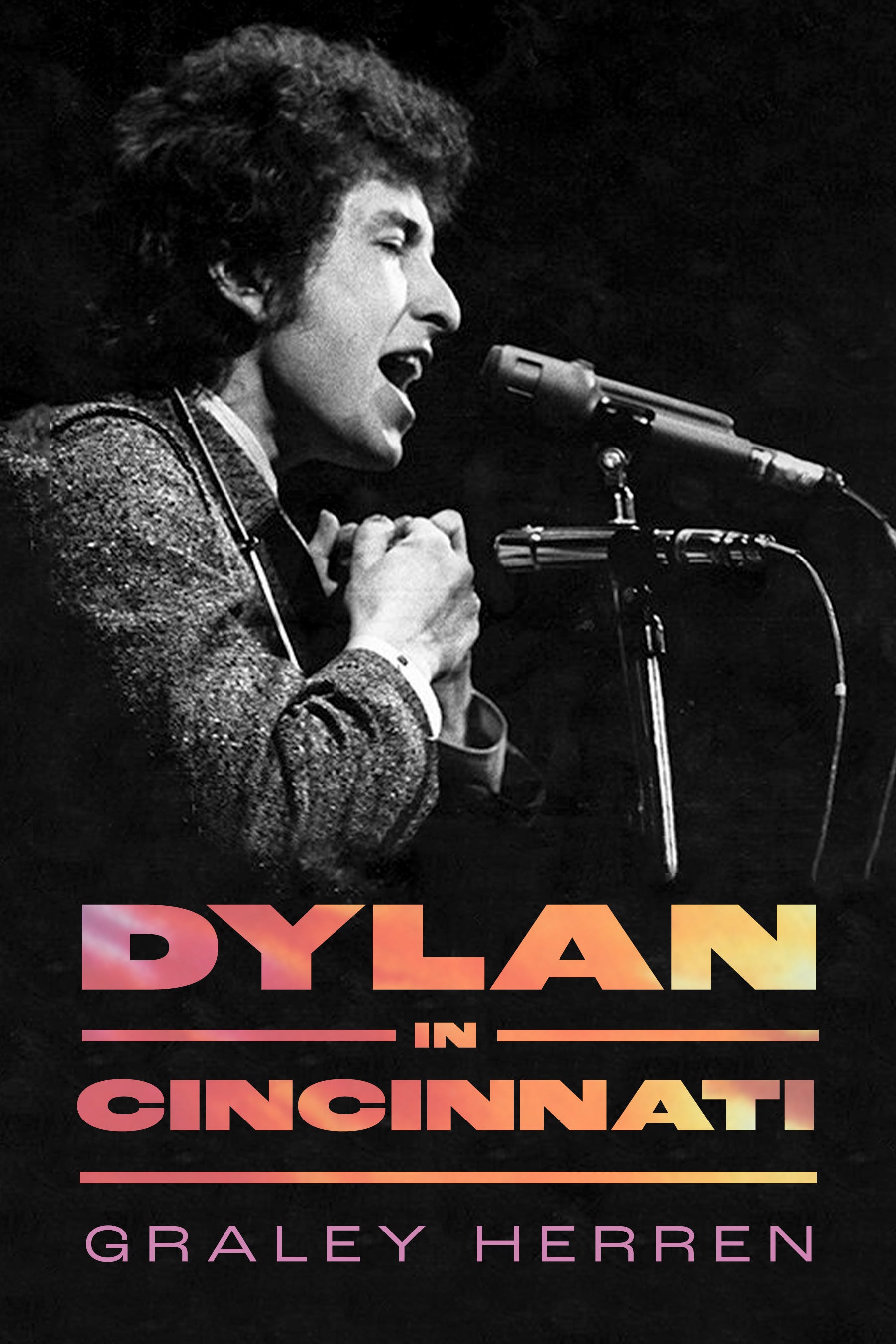
Dylan in Cincinnati is now available wherever you get your books. I’m very grateful to those who contributed blurbs: Laura Tenschert, Ray Padgett, Court Carney, and the NET maestro Andrew Muir. I also want to thank Erin Callahan for making the trip to Cincinnati to interview me for her wonderful podcast Infinity Goes Up on Trial. I especially want to thank readers of Shadow Chasing for your generous support as I’ve workshopped the chapters which eventually turned into this book.
I really appreciate those who have already bought the book. Soon I will have announcements about public promotional events in the Cincinnati area where you can meet me in person and get your book signed. If you don’t have it already, consider taking advantage of the University Press of Mississippi’s Back to School Sale. On the UPM website you can buy Dylan in Cincinnati for 50% off through September 18, 2026:
I hope you enjoyed Volume 1 and Volume 2 of Dylan’s best local performances of his own songs. In this final volume, I want to shine a spotlight on a dozen great covers.
#12: “I’m Ready” (1978)
Since no recordings survive from Dylan’s 1965 Cincinnati concerts, the first document of his local performances is the bootleg of the 1978 concert at Riverfront Coliseum. The opening tune is a wordless instrumental version of “My Back Pages.” That makes “I’m Ready” the very first recording we have of Dylan in Cincinnati. He fires the perfect opening shot:
I’m ready as I can be
I’m ready as I can be
I’m ready for you
I hope you’re ready for me!
The big band is blaring, and Dylan revs the engine with the Queens of Rhythm at his side. Oh, we’re ready—bring it on, Bob!
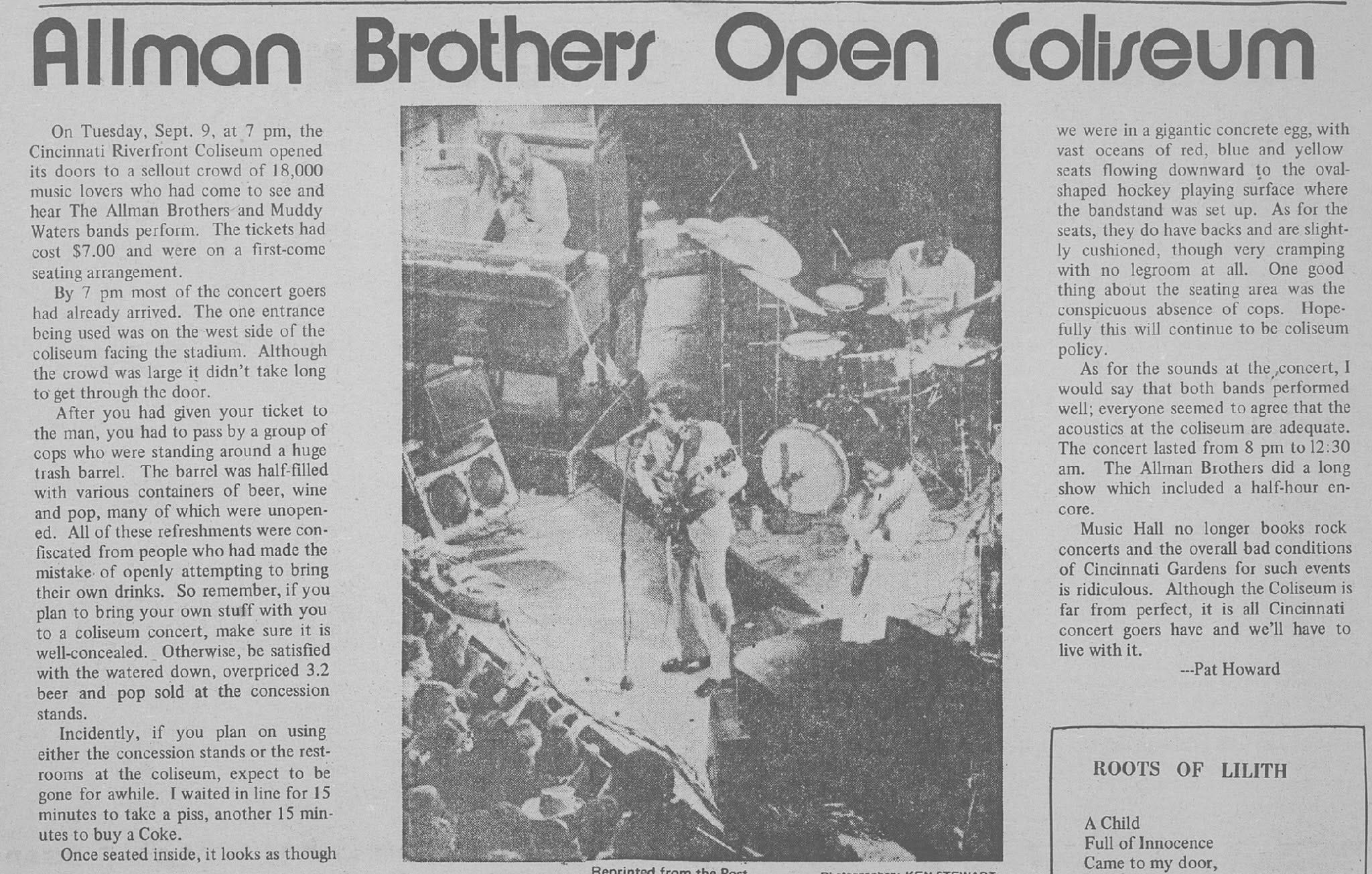
This song was written by Willie Dixon, and the best-known version is by Muddy Waters. I wonder if Dylan was aware that the very first performer to grace the stage at Riverfront Coliseum was Muddy Waters, who opened for the Allman Brothers on September 9, 1975.
#11: “I’m in the Mood for Love” (1989)
The early days of the Never Ending Tour were famous for evolving and eclectic setlists, but even by Dylan standards this is a big curveball. “I’m in the Mood for Love”? Dylan had been in the mood for this song for a few days: Cincinnati was the third concert in a row he played it. With some practice under their belts, the band really delivers on this romantic ballad, and Dylan stops crooning long enough to jolt the crowd with a brief harmonica blast.
His vocal is . . . playful? You can hear some laughs from the crowd at first, not sure if this is Dylan’s idea of a joke or not. But by the end they respond warmly, persuaded to accept the song on its own terms and have fun with it. If Dylan is in the mood tonight, then what else can we do but requite his love?
The mood left him as suddenly as it arrived. According to bobserve, he only played “I’m in the Mood for Love” live four times total, and the Cincinnati performance is the last one ever.
#10: “Wait for the Light to Shine” (2001)
Dylan often selected covers to kick off concerts and set a specific mood for the evening. Four of the twelve songs in this list were concert openers. Another brilliant example is “Wait for the Light to Shine,” which batted leadoff at Xavier University’s Cintas Center in 2001. The song was written by Fred Rose and first recorded by Roy Acuff. But the version closest to Dylan’s heart, and closest to his arrangement at Xavier, was by Hank Williams:
These were dark days in the city and the country, after the so-called Cincinnati Riots in April 2001 and the 9/11 attacks in September. This pervasive anxiety was represented by multiple songs in the Xavier ’01 setlist. For the opener, however, Dylan wanted to send more hopeful signals of faith and resilience:
Wait for the light to shine
Wait for the light to shine
Pull yourself together
Keep looking for the sign
And wait for the light to shine
It’s not light yet, but it’s gettin’ there?
#9: “Cocaine Blues” (1998)
This song was one of Dylan’s favorites in his early folk days, as we can hear way back on the 1961 Minnesota Hotel Tapes. It’s an ideal vehicle for Dylan to shed his skin and inhabit a character, in this case a strung-out cokehead scrounging for his next fix.
“Cocaine Blues” was regularly featured in Dylan’s late nineties acoustic sets, including the Cincinnati Gardens show in 1998, performed six days before Time Out of Mind won the Grammy for Album of the Year. There is a grainy video bootleg from this concert. The audio isn’t quite in sync with the video, but it’s still worth a look and listen:
This bootleg was obviously a two-camera operation. We begin with a wide establishing shot of the stage party, and then at the 50-second mark we transition to a remarkably close profile of Dylan. From this intimate perspective, we can really appreciate the interplay between Dylan and Campbell. Look at Larry staring down at Dylan’s fretboard, trying to figure out where the boss is going next. Listen to the singer and we know where he’s headed: down the alley to score.
#8: “Somebody Touched Me” (1999)
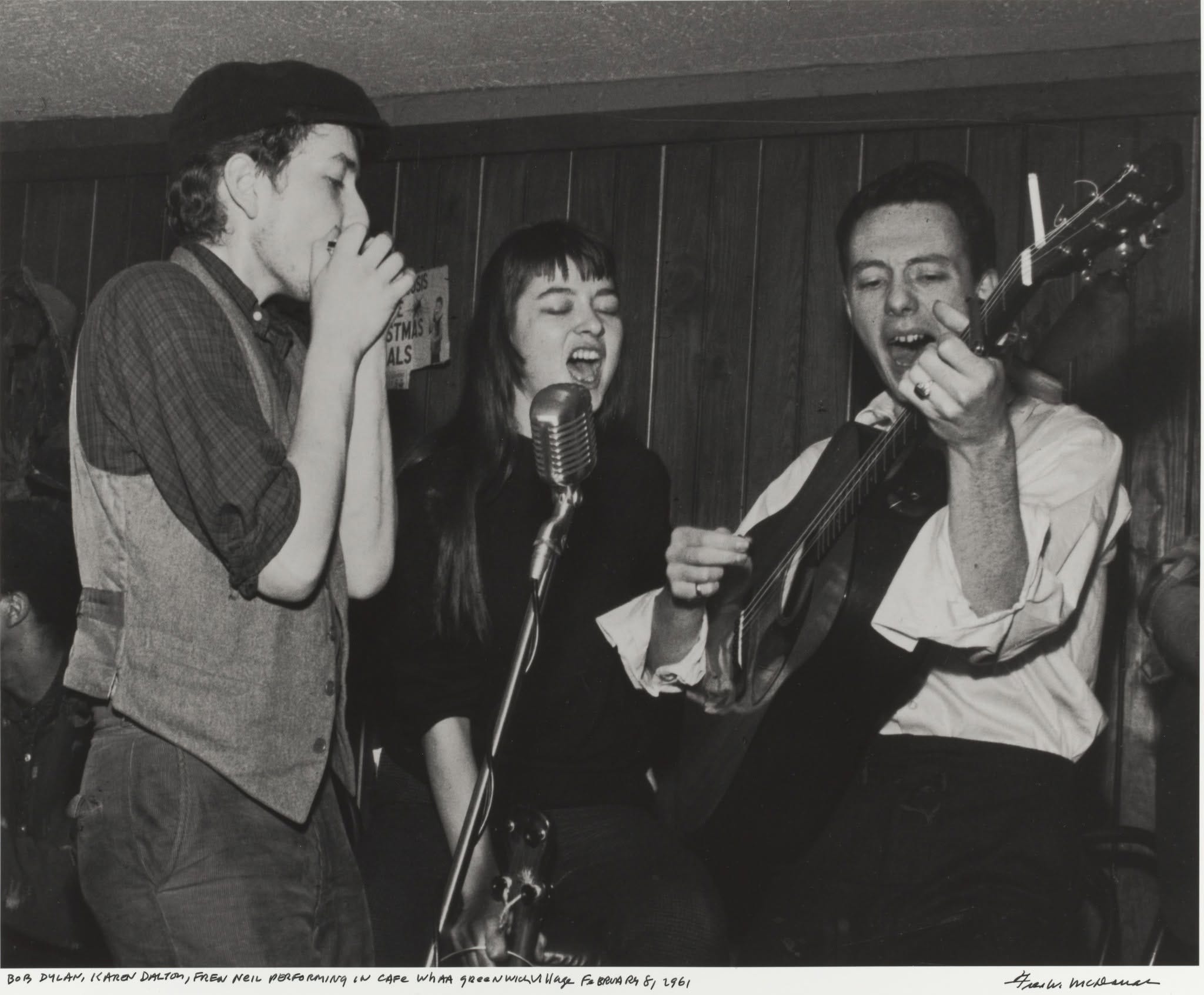
Where and when a performance takes place matters. That’s my guiding principle throughout Dylan in Cincinnati. Consider “Somebody Touched Me” as proof of concept. It was the first song at the legendary Bogart’s club show in 1999. Now let me take you back in time. On February 8, 1961, baby-faced Bob Dylan, newly arrived in the Village, played at Café Wha? with Karen Dalton and Fred Neil. The moment was captured in a cool photo by Fred McDarrah:
Meanwhile, on that exact same day, the Stanley Brothers recorded “Somebody Touched Me” at Cincinnati’s King Studios. The song was released the following year on Old Time Camp Meeting (King Records, 1962):
Was Dylan aware of this delightful coincidence? Probably not. But I guarantee he was aware of King Records and the Stanley Brothers because he has regularly praised and covered both over the years.
Dylan played “Somebody Touched Me” thirty times in concert between 1999 and 2001. The first performance was on July 10 in Maryland Heights, Missouri, but I’m convinced this was just a warm-up for Cincinnati the following night. No offense, Maryland Heights, but “It was on a Sunday / Somebody touched me / Must have been the hand of the Lord.” Sure enough, the Bogart’s show was on Sunday night, not some God forsaken Saturday night in Missouri. With this uplifting opener, accompanied by Larry Campbell and Charlie Sexton on soaring backup vocals, Dylan brought “Somebody Touched Me” back home to its birthplace in Cincinnati.
#7: “Barbara Allen” (1988)
If you want to hear Dylan’s deep love of traditional music, listen to this spellbinding performance of “Barbara Allen” from Riverbend ’88. He takes his time telling the story, slowing down the pace like we’re following a funeral cortege to the grave where Sweet William and Barbara Allen are buried in the old churchyard, reaching out from beyond the grave to tie a lovers’ knot.
It’s a sensitive, heart-piercing, flawless performance. Many of Dylan’s peers in the sixties included this song in their repertoire, but most of them began with “’Twas in the merry month of May….” Dylan instead opens and closes with “In Scarlet Town where I was born….” In retrospect, we can detect the seed of Dylan’s later song “Scarlet Town,” a sharp briar growing out of the red rose of “Barbara Allen.” Of all the many versions I’ve heard of “Barbara Allen,” the Riverbend ’88 version reminds me most of Pete Seeger’s arrangement from 1957. This a cappella performance is the best vocal I’ve ever heard from Pete. Them’s got ears, let ’em hear:
#6: “Duncan and Brady” (2000)
In 1890, two white St. Louis police officers chased the Duncan brothers into a saloon in the predominantly Black St. Louis neighborhood of Deep Morgan. Officer James Brady was shot and killed, and Harrison Duncan was eventually convicted of his murder and executed. “Duncan and Brady” was first popularized by Lead Belly. It’s a murder ballad, but the lyrics are slyly subversive. “King Brady” is depicted as a tyrant who terrorized the neighborhood for years. While the lyrics stop short of blatantly celebrating the policeman’s death, it’s clear that the citizens of Deep Morgan were relieved that this dirty cop’s reign of terror was over: “He been on the job too long.”
Dylan opened his Riverbend ’00 concert with this cover. The performance is jubilant, buoyed up by the backing vocals of Larry and Charlie. “Duncan and Brady” is also prescient in a Cincinnati context. Nine months after this concert, the city was roiled by several days of unrest after Officer Stephen Roach fatally shot a Black teen, Timothy Thomas, in an alley in Over the Rhine. Thomas was the fifteenth Black man to die in confrontations with the Cincinnati police since 1995. Civil protests at times turned violent and destructive, and Mayor Charlie Luken called for city-wide curfews.
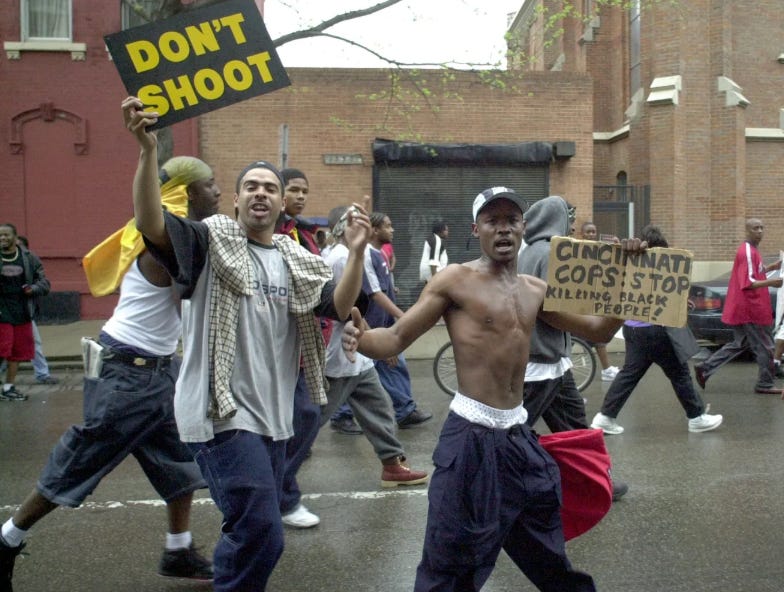
I’m not suggesting that Dylan had a crystal ball and prophetically foresaw the Cincinnati Riots. He was simply singing a murder ballad he loved because he thought it would set an energetic mood for his concert. But where and when a performance takes place matters, and so does the time and place where the listener encounters the song. For a Cincinnatian encountering “Duncan and Brady” post-2001, there is no divorcing this murder ballad about a police shooting from the turbulent events that shook the city the following spring.
#5: “Stella Blue” (2024)
One cannot overstate the importance of the Grateful Dead to Bob Dylan. He toured with the Dead in July 1987, and apparently he even petitioned to join the band but was politely refused. The live album that resulted from their tour is disappointing, but Dylan nevertheless credits the Dead, and particularly Jerry Garcia, with restoring his connection to his old songs and renewing his commitment to touring. It’s no coincidence that the Never Ending Tour began the following summer. Dylan also collaborated several times with Dead lyricist Robert Hunter, including most of the songs on the album Together Through Life (2009). In recent years, Dylan has covered multiple Dead and Dead-adjacent songs in concert. Among these, my favorite is “Stella Blue,” which I was fortunate to witness when the Outlaw Music Festival rolled into Riverbend in 2024.
Like Dylan, the Dead has a cadre of devoted bootleggers who document every concert. There are some fabulous recordings of “Stella Blue” out there, but the most sublime version I’ve heard is from San Francisco’s Winterland on October 21, 1978 (the same week that Dylan played Riverfront Coliseum in Cincinnati):
Jerry sings and plays like a resplendent angel in 1978. By comparison, Bob sounds like a broken angel in 2024. But that’s precisely what the song calls for:
All the years combine
And they melt into a dream
A broken angel sings
From a guitar
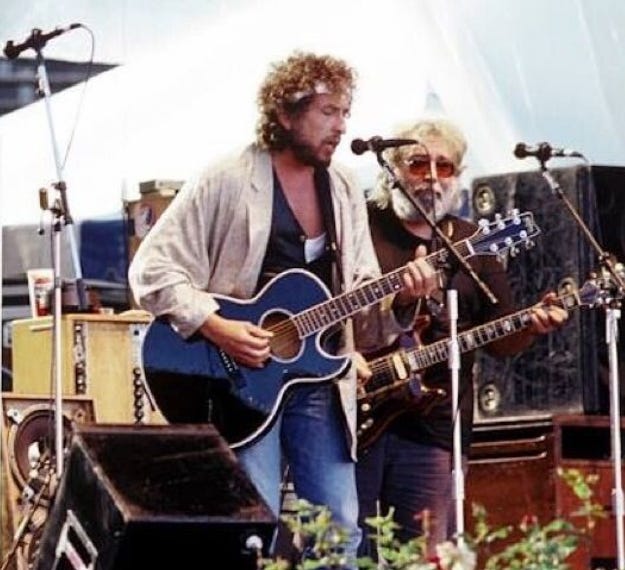
Dylan’s ragged voice swells with love and pathos for his Dead (and dead) brothers Garcia and Hunter. It also comes across as self-elegy, as if he’s anticipating a day when this song will keep alive the spirit of a singer whose mortal body has gone the way of all flesh. When the roll is called up yonder, Dylan will join his celestial comrades. Back here on earth, those of us who remain behind can still conjure them up by listening to bootlegs of “Stella Blue.”
When you hear that song
Come crying like the wind
Seems like all this life
Was just a dream
Stella Blue
#4: “Not Fade Away” (1999)
Bob Dylan and Jerry Garcia bonded over their shared musical tastes, and one of their mutual idols was Buddy Holly. The Dead covered “Not Fade Away” well over 500 times in concert. According to bobserve, Dylan has played it live only 147 times to date, but you can bet he enjoyed every damn one of them. Exhibit A: Bogart’s ’99. We can judge with both our eyes and ears from this video bootleg:
Look how much fun they’re having! Dylan is channeling Bobby Zimmerman at the Winter Dance Party in 1959. Hell, if his 58-year-old knees could’ve handled it, he’d probably bust out a Chuck Berry duckwalk. His vocals are pretty mush-mouthed at this late point in the concert at a sweltering venue—but who cares? The appeal of this performance isn’t virtuosity. This is garage rock at its finest, burning hot with a passion that won’t fade away.
#3: “Searching for a Soldier’s Grave” (2000)
The only time I saw Dylan play “Searching for a Soldier’s Grave” live was at Xavier ’01. The song packed a punch in the aftermath of 9/11 and the early days of war in Afghanistan. The first American soldier had yet to die in the military conflict, but the flag-draped caskets eventually came. “Searching for a Soldier’s Grave” simultaneously looked back to World War II and forward to the inevitable consequences of the Bush administration’s “War on Terror.”
You might assume that Dylan chose the song intentionally as a commentary on the war. However, he actually began playing “Searching for a Soldier’s Grave” regularly in 2000, more than a year before the September 11th attacks. He even played it in Cincinnati that summer, but I was out of town and had to miss the concert. He would’ve been familiar with memorable renditions by Roy Acuff, the Stanley Brothers, Hank Williams, and Kitty Wells.
I have theories about why Dylan made this song a fixture of his setlists in 2000. His beloved mother Beatty died in January of that year. After a European leg of the NET in the spring, and before returning to Europe in the fall, Dylan played several summer shows in the U.S. The first was in Portland, and that’s where he debuted “Searching for a Soldier’s Grave.” It was June 15, 2000, just two days after what would’ve been Beatty’s birthday. I think Dylan turned to this song as an indirect but deeply moving tribute to his mother. It’s a gesture of mourning. He finds a musical vehicle to carry his grief and take it on the road.
You ask me, stranger, why I made this journey
Why I’ve crossed three thousand miles of rolling waves
Like so many others my love was killed in action
So I’m here, I’m searching for his grave
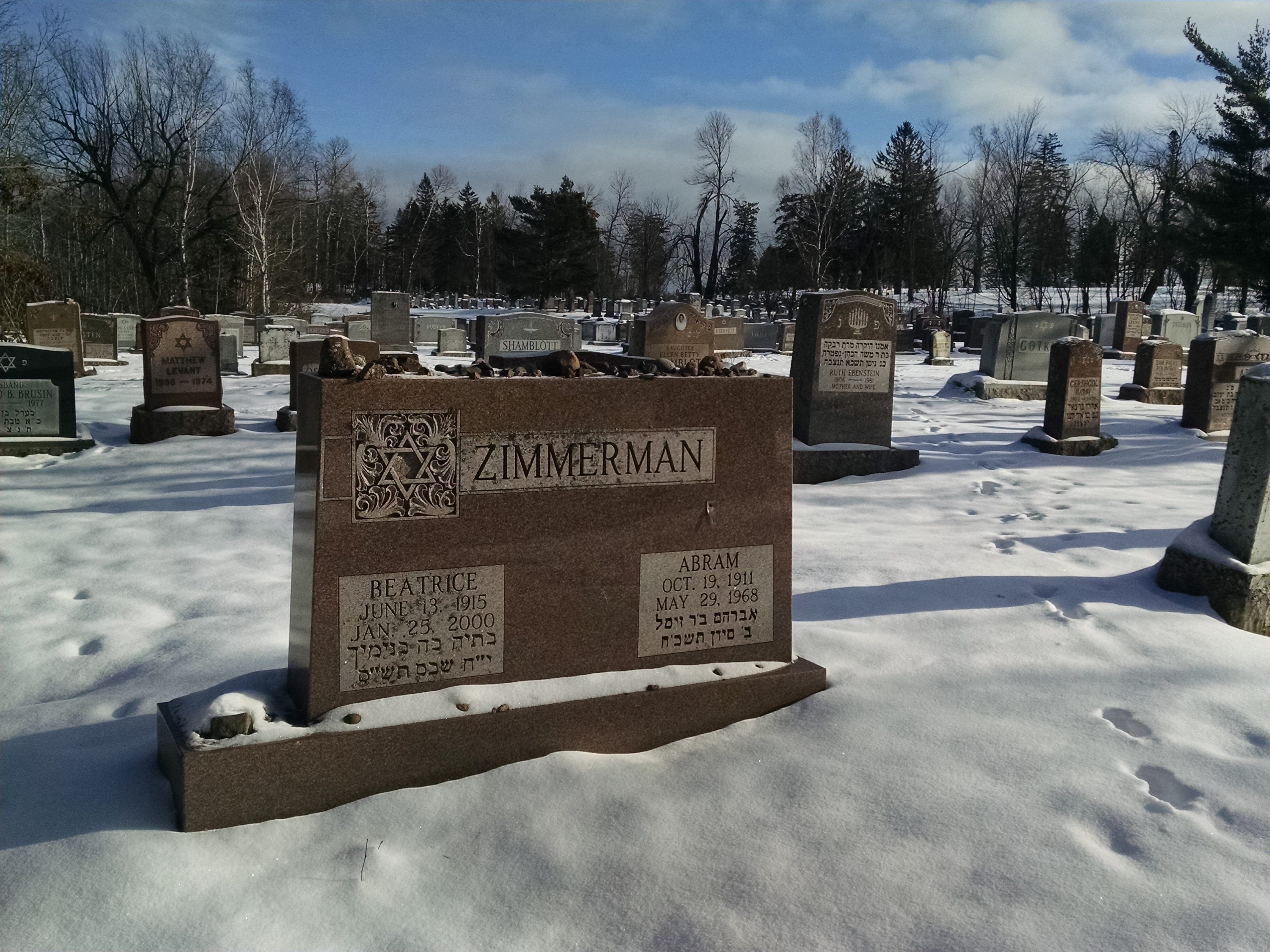
Dylan keens with Larry and Charlie, traveling thousands of miles to gather with strangers, singing a dirge for the dead. The roles of mother and son are reversed, and the trans-Atlantic journey moves in the opposite direction. But the emotions remain the same: the singer and listener use this song to reconnect with lost loved ones and enact the work of mourning.
#2: “Wild Mountain Thyme” (1988)
During the first verse of Dylan’s achingly beautiful “Wild Mountain Thyme” at Riverbend ’88, a woman near the taper suddenly realizes what she’s hearing: “That’s a Joan Baez song!” Well, that’s true, Joan did play the song frequently and gorgeously. But this beloved Scots-Irish ballad predates the 1960s folk revival by at least a couple hundred years.
My personal associations with the song are rooted in the west of Ireland. For several years, I traveled with my friend and colleague Tim White to teach in Xavier’s summer study abroad program in Ireland. We always spent time in Galway with Gerry Joyce. He can do it all: thatcher, architect, naturalist, gardener, raconteur, and a walking encyclopedia of Irish song. Each summer we’d gather at Gerry and Mary Graham’s lovely Connemara cottage and he’d play us songs after lunch. “Wild Mountain Thyme” was a favorite, the song he sang at his daughter’s wedding. Andy Muir later told me that he chose this song for his father’s funeral, and the whole congregation sang along. Weddings, funerals—this is a very special song—Thyme Out of Mind.
And Riverbend ’88 is a very special performance. You can hear “Wild Mountain Thyme” practically anywhere in Scotland and Ireland, but you’ll rarely hear it at a Dylan show. According to bobserve, it has only surfaced at ten concerts. The first was the Isle of Wight festival in 1969. The last was in 1988 in Cincinnati.
“That’s bad as hell!” yells a fan during the acoustic guitar jam between Bob and G. E. Smith. I couldn’t agree more, my anonymous friend. I remember the tears welling up the first time I heard this bootleg of “Wild Mountain Thyme.” It was then and there I committed myself to the project that became Dylan in Cincinnati.
#1: “South of Cincinnati” (2023)
I couldn’t have imagined anything topping “Wild Mountain Thyme” for me. Not until I found myself six rows from the stage at Brady ’23 and witnessed Dylan’s first ever performance of “South of Cincinnati.”
If you ever get south of Cincinnati
Down where the dogwood trees grow
If you ever get south of the Mason Dixon
To the home you left so long ago
If you ever get south of the Ohio River
Down where Dixieland begins
If you ever get south of Cincinnati
I’ll be yours again
By this point, I was already actively working on Dylan in Cincinnati. I couldn’t believe my good fortune! There I was, standing in a venue right beside the Ohio River, listening to Dylan serenade the local crowd with a song about our fair city. What a generous gift to Cincinnati, and what a perfect capstone to my book on his many great performances here.
I must admit that I didn’t know the song, and I couldn’t look it up on my pouched phone until after the show. The lyrical imagery made me wonder if it was an old Stephen Foster tune, but of course it turned out to be from Dwight Yoakam. Dylan said so from the stage after the song, but I couldn’t make out his mumbled words at the time.
Yoakam hails from Pikeville, Kentucky, but his family moved north for work in Columbus, Ohio, when Dwight was just a kid. The song’s story is fictional, but the Yoakams knew the border-crossing journey described in “South of Cincinnati” all too well. Coincidentally (or not?), just a couple months before Dylan covered it, Yoakam himself brought the song home in his concert at PNC Pavilion:
I had already submitted my book manuscript before Dylan wrote the liner notes for Yoakam’s 2025 vinyl box set. In that fascinating verbal riff, Dylan recalls seeing Yoakam act in a play:
Took me a second to realize that Dwight might be a Method actor, that he got so deep into a role that he forgot who he was, that he wouldn’t know the streets of Bakersfield even after, let alone Cincinnati. He drank his character’s thoughts like cheap gin, dressed up, and forgot his name at the bus stop.
As with much of his best writing about other artist’s work, he seems to be looking in the mirror as much as he’s looking at Yoakam. The power of Dylan’s “South of Cincinnati” performance resides in his ability, like a Method actor, to draw deeply from his personal reservoir of emotional truth while simultaneously losing himself in a character study. On one hand, Dylan is opening his heart to Cincinnati and letting the Brady audience come in. On the other hand, he is escaping personality to inhabit the voice of a lonely Kentucky woman pining for her lost love, stuck inside of Chicago with the Pikeville blues again. This is the art of playing other people’s songs.: you have to live inside them so fully and persuasively that you make them your own, as Dylan does in these dozen amazing covers.
This concludes Cincinnati Greatest Hits, my free gift to Shadow Chasing readers in appreciation for your interest and support throughout my Dylan in Cincinnati project. If you’re interested enough to learn more, please consider buying the book or coming to see me at an upcoming promotional event in the area. Thank you!
Thank you for these words Graley -with such great recordings. And thanks also for one! book. I will enjoy reading it even without your signature ha ha . I too was lucky to hear Dylan sing " Stella Blue " in Barcelona in the summer 2023. I could never decribe the beauly of it. All the best from DK