
Joni Mitchell's "Coyote"
The Road Trip Within

On December 2, 1975—25 years to the day before my 25-year-old son Dylan was born—Bob Dylan and friends gathered for a party at Gordon Lightfoot’s house. The Rolling Thunder Revue was in Toronto for a couple shows. Fellow Canadian singer-songwriter Joni Mitchell made the trip to Gord’s place, where she played her new song “Coyote,” a work in progress she began writing a week earlier. The performance captured on film stands out as one of the best scenes from Martin Scorsese’s RTR film. Sit back, boys, and let her show you how it’s done!
In her book Traveling: On the Path of Joni Mitchell, Ann Powers hesitates to apply labels like “genius” to her subject. But the glass slipper of greatness fits fo this rendition of “Coyote”:
Performances like this one make me put aside all doubts about Joni’s exceptional status. From the deftness of her fingers on the fretboard to the absolutely casual, slightly shy air with which she shares the song’s loving and acerbic lyrics—inspired by the tour’s official chronicler, the playwright Sam Shepard, as the boys clearly knew—it’s a rare chance to witness a woman’s spontaneous and total ownership of a room full of sheepishly awestruck men. (26)
It’s hard to watch this 1975 footage without having flashbacks of another party a decade earlier at London’s Savoy Hotel and conclude that Dylan just got Donovan’d.
Many readers of Shadow Chasing will already be familiar with certain sordid details behind this song. Playwright Sam Shepard was invited by Dylan to assist with the film Renaldo and Clara. He left his wife and son back home at his California ranch and hopped aboard the Rolling Thunder Revue. Almost immediately he began sleeping with tour manager Chris O’Dell. Joni Mitchell joined the tour at New Haven on November 13, 1975, and a couple nights later she fell for Shepard’s charms. About a week later, she began writing a song inspired by their affair.
She first sang a two-verse version of “Coyote” during her RTR set in Augusta, on November 26. As the tour crossed into Canada, she continued to workshop the song. By Toronto (December 1 & 2) it had three verses, and by Montreal (December 4) her creature had all four legs. She eventually gave “Coyote” pride of place as the opening track on Hejira (1976), which is my personal favorite Joni Mitchell album.
“Coyote” is a great song about fucking—but more importantly it’s a fucking great song. Sexual confession is actually only a small part of its grandeur. “Coyote” is about sex about as much as “Mr. Tambourine Man” is about drugs. Yes, that’s part of it, but ultimately the least interesting part. As Shepard writes in Rolling Thunder Logbook, “The purpose of this book isn’t to reveal a plodding blow-by-blow account of the sequence of events or to play peekaboo with the private lives of the stars but just to give the reader a taste of the whole experience. If that happens, the book is alive” (1). The same holds true for “Coyote.” Sure, the song is fueled by lots of sex and drugs, no question about it. But its real animating force, what gives it life, is the spirit of artistic inspiration and collaboration. In Shepard’s words:
I found myself in the midst of all these traveling people as a collaborator in a whirlpool of images and shifting ideas. All of us working together for the same purpose—to try to live in a constant movement on the road for six weeks, traveling by land, putting on music, filming this music in the surroundings of broken American history in small New England towns in the dead of winter. Whatever the reasons were behind this reason doesn’t seem to matter. All that matters is that it happened. (1)
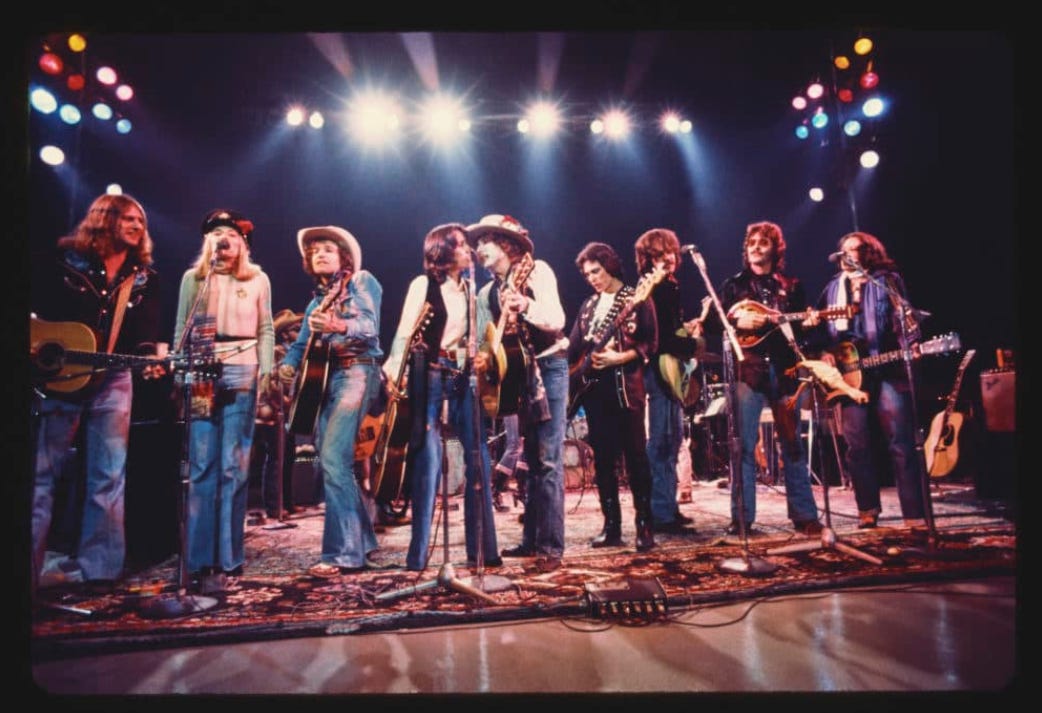
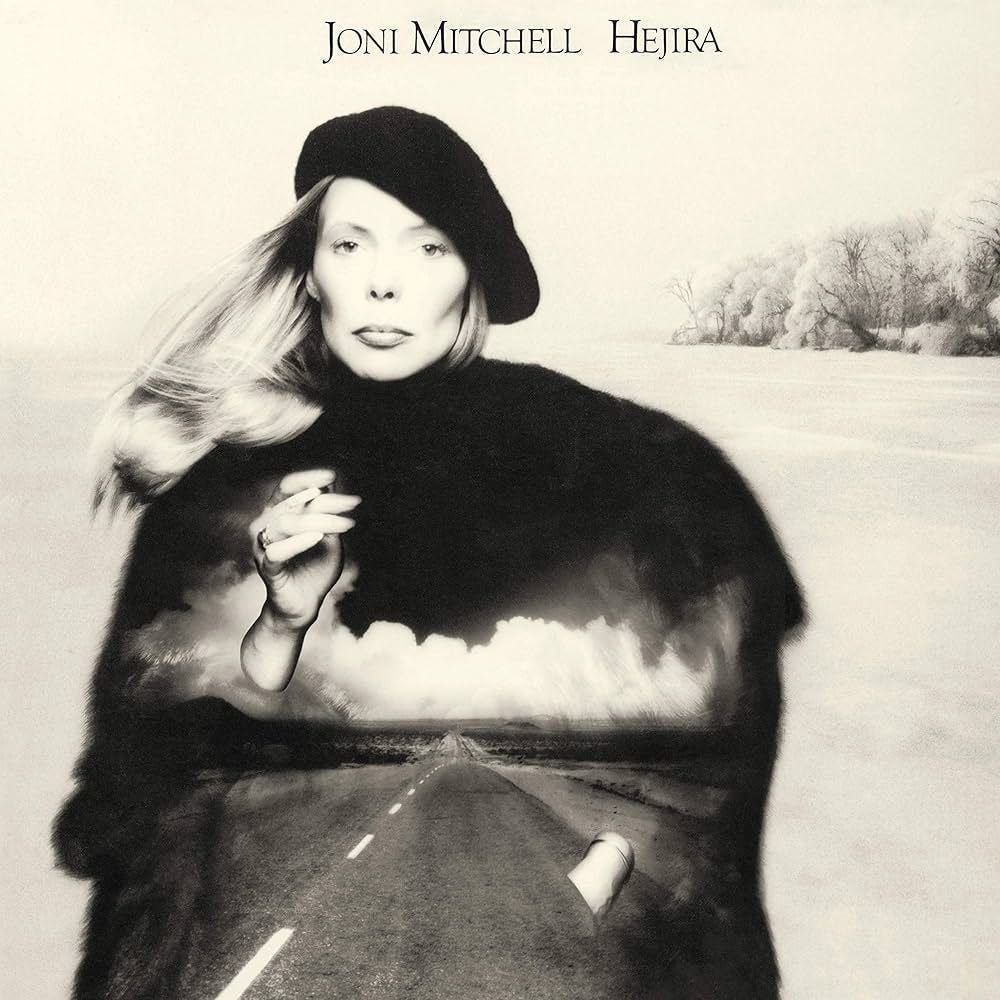
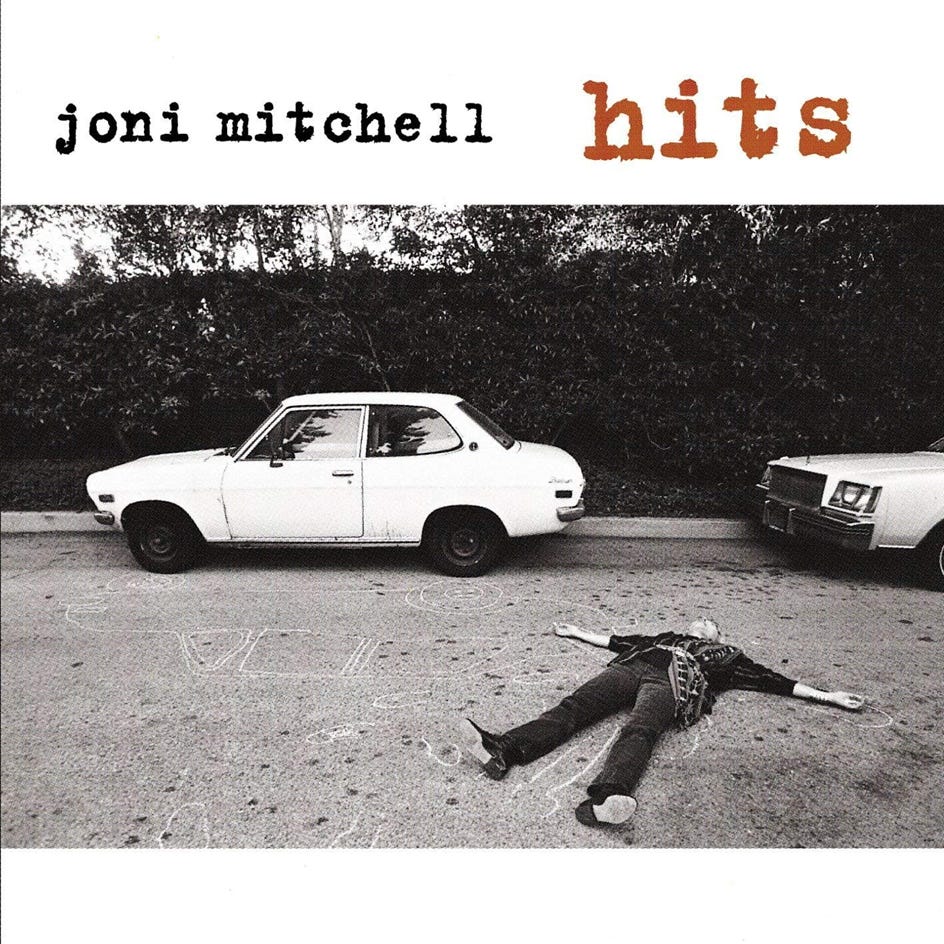
“Coyote” may have started as a song about a fling, but it quickly developed into much more. Mitchell uses her tryst as spur for a meditation upon wanderlust, self-destructive cycles, archetypal conflicts, personal emancipation, musical experimentation, empathic identification, and the world-shaping powers of art. She starts with the raw materials for a conventional road song but then spins straw into gold. “Coyote” depicts a road trip within, perfectly encapsulated by the cover art for Hejira depicting a freeway leading into the dark heart of the artist.
Prelude: Cowboy Mouth
In order to appreciate what Mitchell was getting herself into, it’s helpful to first consider Shepard’s encounter four years earlier with Patti Smith, another affair that proved highly inspirational artistically. As she recounts in Just Kids, Smith first met Sam Shepard when Todd Rundgren took her to a Holy Modal Rounders show in the basement of the Village Gate. Shepard was drummer for the band. By the early seventies he had won multiple Obies (the Off-Broadway Theater Awards) as a playwright. Smith knew none of this when she met him after his set. He introduced himself by the alias Slim Shadow.
She didn’t need his résumé to know how he made her feel: “I fixed on the drummer, who seemed as if he was on the lam and had slid behind the drums while the cops looked elsewhere. Toward the end of their set he sang a song called ‘Blind Rage,’ and as he slammed the drums, I thought, This guy truly embodies the heart and soul of rock and roll. He had beauty, energy, animal magnetism” (171). As it turns out, that animal was a coyote.
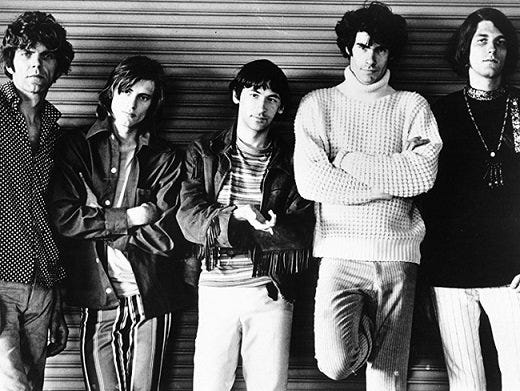
During their first encounter, Smith pitched the idea of writing an article about him for Crawdaddy. “Slim seemed entertained by this idea. He just nodded while I started my pitch, telling him about his potential, how ‘rock and roll needs you’” (171). They went back to her place to talk it over. “Slim was a good talker. In a happy role reversal, it was he who was the storyteller. It was possible his tales were even taller than mine. He had an infectious laugh and was rugged, smart, and intuitive. In my mind, he was the fellow with the cowboy mouth” (171).
Pretty soon they were rolling in the sheets at the Hotel Chelsea. And who could blame them? Have you ever seen a sexier couple?
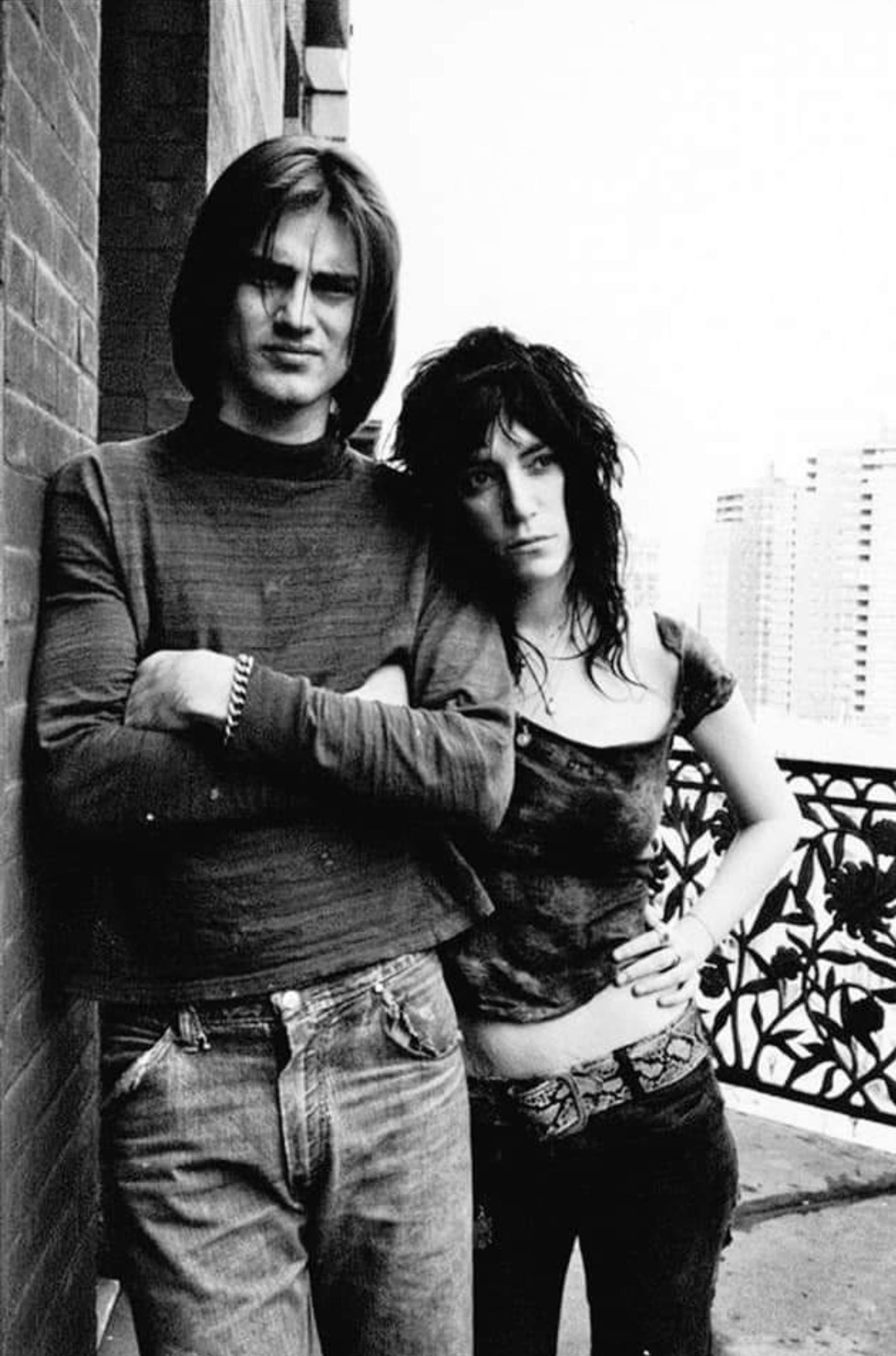
Then again, I suppose Shepard’s wife might have seen it differently. It’s much easier to crush on Sam and Patti in the picture above if you haven’t seen the picture below:
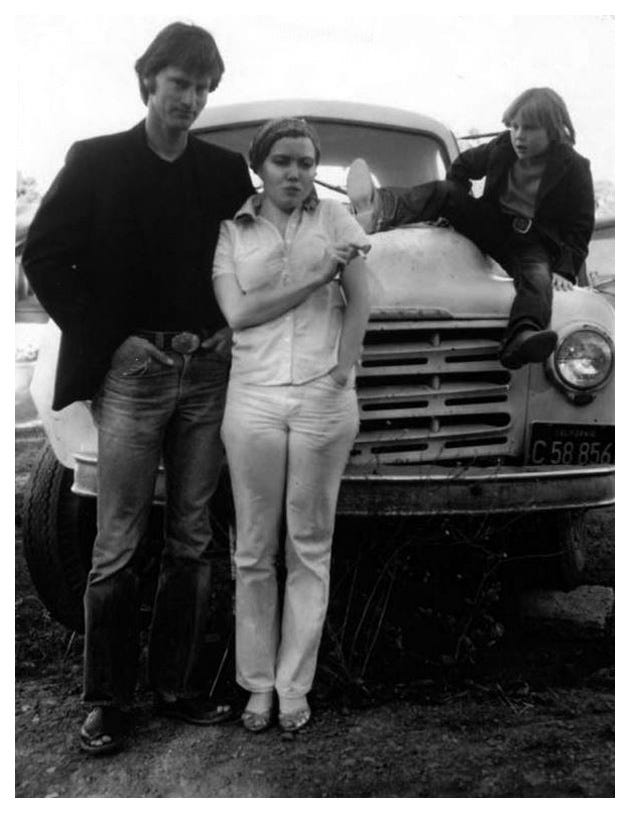
But hey, these are free-loving bohemians we’re talking about. Smith settles her accounts in Just Kids:
Sam and I had a long discussion about our life together. By then he had revealed to me that he was married and had an infant son. Perhaps it was the carelessness of youth but I was not completely cognizant of how our irresponsible ways could affect others. I met his wife, Olan, a young and gifted actress. I never expected him to leave her, and we all fell into an unspoken rhythm of coexistence. (179-80)
Let’s shift the focus to their art. Smith recalls how she and Shepard co-wrote the one-act play Cowboy Mouth in a single evening:
One night we were sitting in silence, thinking the same thing. He leapt up and brought his typewriter onto the bed.
“Let’s write a play,” he said.
“I don’t know anything about writing plays,” I answered.
“It’s easy,” he said. “I’ll start.” He described my room on Twenty-third Street: the license plates, the Hank Williams records, the toy lamb, the bed on the floor, and then introduced his own character Slim Shadow.
Then he shoved the typewriter my way and said, “You’re on, Patti Lee.” (184-85)
She named her character Cavale, after Albertine Sarrazin’s book La Cavale, “which is the French for escape” (185). It’s worth noting that Mitchell also selected a foreign term to communicate a similar theme for her 1976 album. “Hejira” is an Arabic word referring to the prophet Muhammad’s journey from Mecca to Medina. Mitchell associates the concept with escape, defining her album title as “running away with honor.”
Dylan fans will recognize the title Cowboy Mouth as an image from “Sad-Eyed Lady of the Lowlands.” Dylan is explicitly mentioned within the play when Cavale tells Slim: “I can’t be the saint people dream of now. People want a street angel. They want a saint but with a cowboy mouth. Somebody to get off on when they can’t get off on themselves. I think that’s what Mick Jagger is trying to do . . . what Bob Dylan seemed for a while” (156).
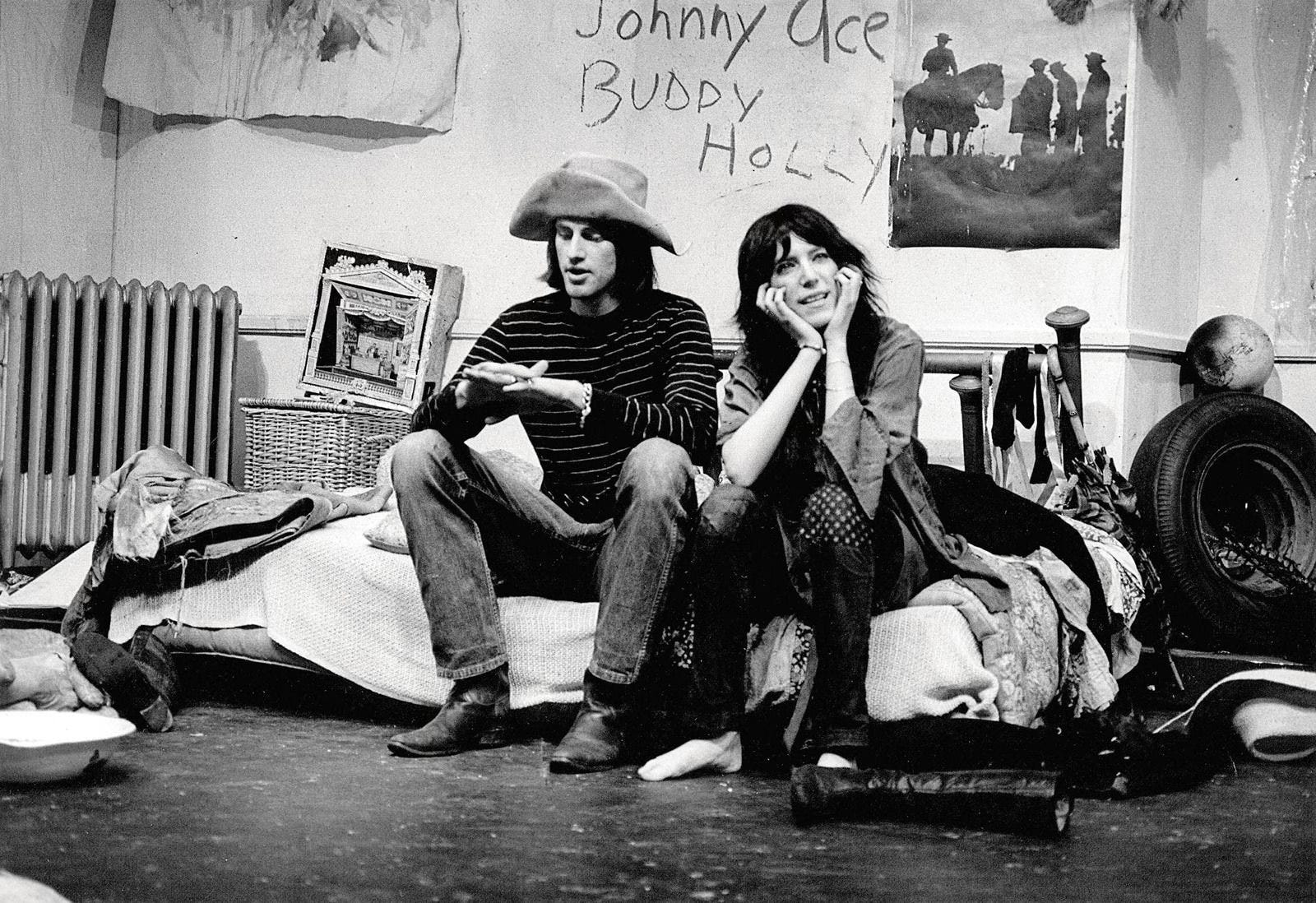
The only public performance of Cowboy Mouth took place at the American Place Theatre in Hell’s Kitchen on April 29, 1971. Shepard played his alter-ego Slim Shadow, and Smith played her avatar Cavale. In the published script, Slim is described as “a cat who looks like a coyote, dressed in scruffy red,” and Cavale is described as “a chick who looks like a crow, dressed in raggedy black” (145). Cowboy Mouth was paired on the bill with another Shepard one-act called Back Bog Beast Bait. It features a character named (of course) Slim who transforms at the end of the play into (do I even need to say it?) a coyote.
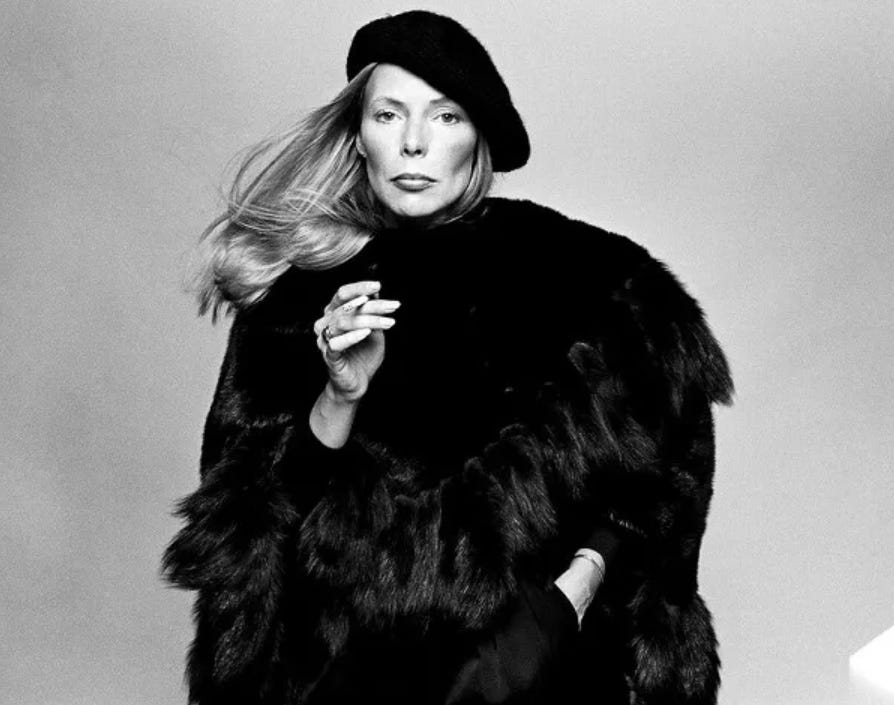
I don’t know if Mitchell knew these plays, but if not then it’s an uncanny coincidence, since she likewise identifies Shepard with a coyote and herself with a crow in “Black Crow,” both songs on Hejira. She even dresses the part for photos inside the album:
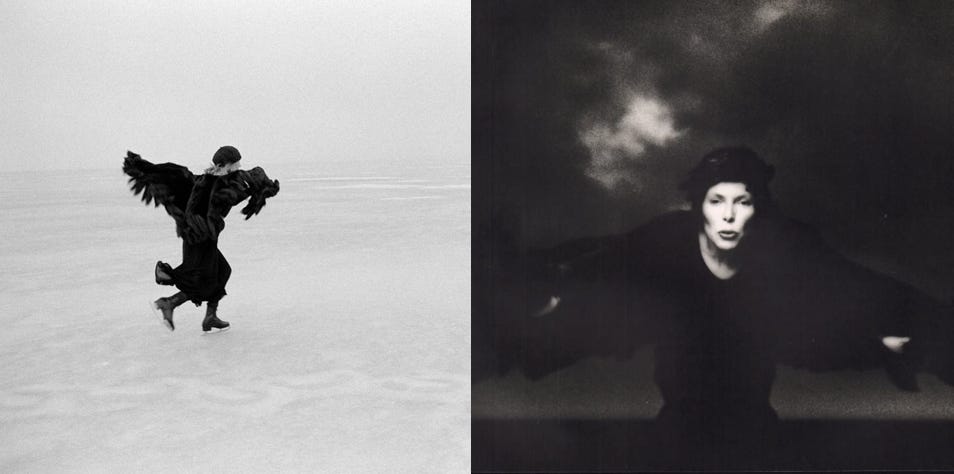
And get this: the name of Mitchell’s lyrics publishing company is Crazy Crow Music.
Patti Smith’s summary of Cowboy Mouth reveals its nakedly autobiographical sources: “In the play, Cavale tries to recreate Slim into her image of a rock and roll savior. Slim, at first intoxicated with the idea and beguiled by Cavale, finally has to tell her that he can’t realize her dream. Slim Shadow goes back into his own world, his family, his responsibilities, leaving Cavale alone, setting her free” (185).
Reflecting on the play’s composition, Smith observes, “We just told each other stories. The characters were ourselves, and we encoded our love, imagination, and indiscretions in Cowboy Mouth. Perhaps it wasn’t so much a play as a ritual. We ritualized the end of our adventure and created a portal of escape for Sam” (185). This description that applies equally well to Mitchell’s “Coyote.”
Shepard was the first to bolt, escaping first from Smith in 1971 and later from Mitchell in 1975. But neither woman expected their cornered coyote to react any other way, and both artists were able to use their experiences for artistic inspiration. “Experiencing the play taught me things about myself,” Smith writes in Just Kids. “I couldn’t imagine how Cavale’s image of a ‘rock ’n’ roll Jesus with a cowboy mouth’ could apply to anything I was doing, but as we sang, sparred, and drew each other out, I found myself at home onstage. I was no actress; I drew no lone between life and art. I was the same on- as offstage” (186). Soon she would spread her wings as a performer, putting music to her poetry and soaring as a groundbreaking rock and roll savior in her own right.
Maybe Smith couldn’t envision that future for herself yet, but apparently Shepard could. Before he left New York City for Nova Scotia (the Bay of Fundy referenced in “Coyote”), he gave Patti some money and told her, “‘You know, the dreams you had for me weren’t my dreams. Maybe those dreams are meant for you’” (186). The end of one adventure marks the beginning of another; the death of a relationship can play midwife for the birth of art. Smith bears witness to this genesis in Just Kids, and so does Mitchell in “Coyote.”
According to Patti Smith’s Substack, she is the one responsible for Sam Shepard’s involvement in the Rolling Thunder Revue. Smith turned down Dylan’s invitation to join RTR, but when she learned that he was also recruiting a film collaborator, she recommended Shepard. She even accompanied him to meet Dylan and discuss Renaldo and Clara prior to the tour.
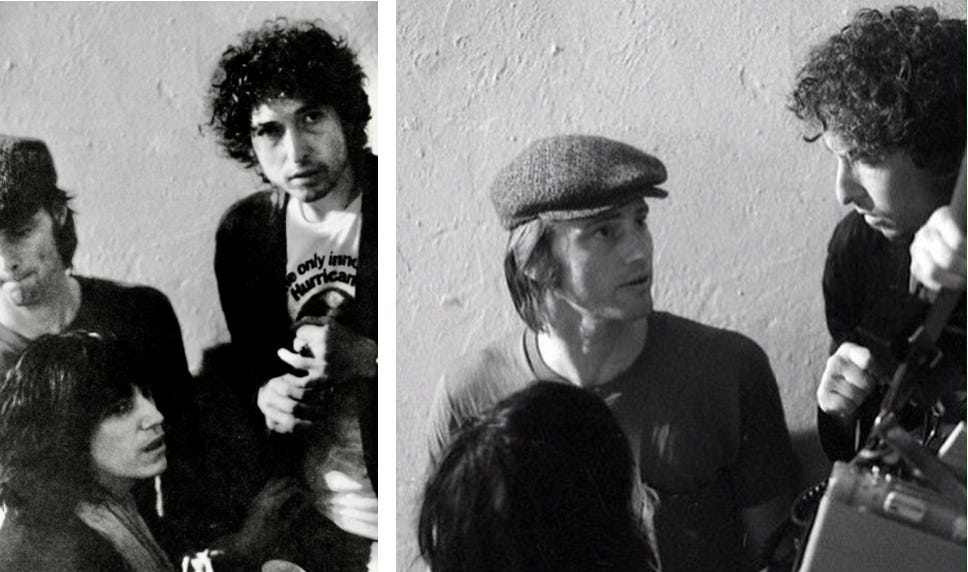
Time to pass the typewriter. You’re on, Roberta Joan.
“Coyote”: First Verse
The first few times she played it, “Coyote” only had two verses. But from the start, and in every version thereafter, it begins the same: “No regrets Coyote.” That’s a crucial point to establish at the start.
In other words, what we’re about to hear is not the sob story of a woman scorned. No recriminations, no sulking, no apologies, no moral hangovers. The singer isn’t jaded, but she’s also not naïve. These things happen on the road, when passionate, creative people are crammed together in close quarters, amped up on adrenaline, pills, and powders, away from their homes and domestic duties, eager to connect with other smart, beautiful, interesting, available partners. Mitchell will have many thoughts to share on this topic, but it’s important that the first thing she wants to get straight is that she has no regrets.
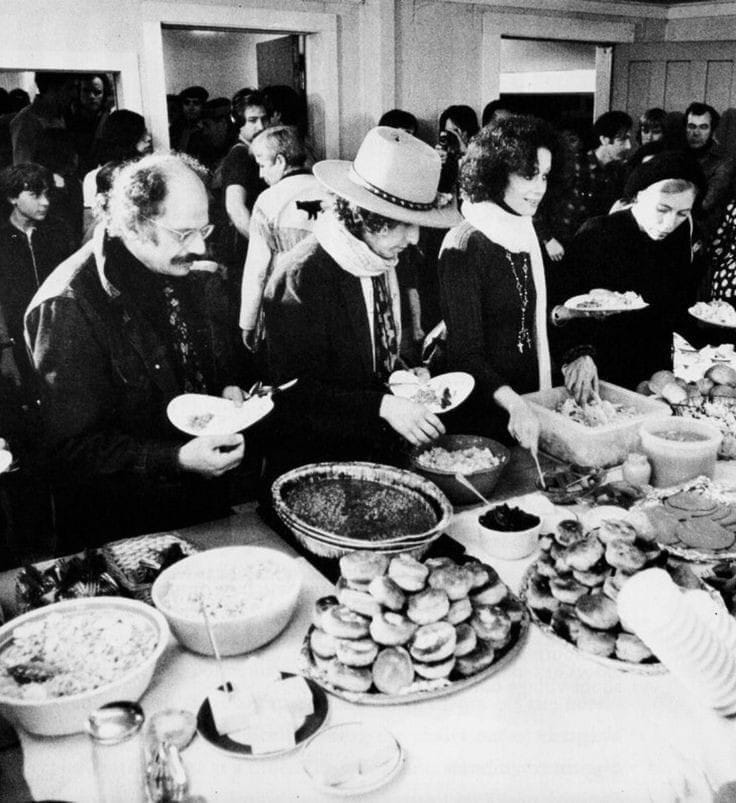
In her colorfully titled memoir Miss O’Dell: Hard Days and Long Nights with The Beatles, The Stones, Bob Dylan and Eric Clapton, and the Women They Loved, Chris O’Dell pinpoints November 15 as the precise evening that Shepard and Mitchell first hooked up. She remembers it because, after several nights in a row sharing her bed, Shepard went missing after the Niagara Falls show. What interests me most about this isn’t the sex (see above). Instead, I’m intrigued by what happened the very next day. With no concerts scheduled on November 16, the troupe took a trip to the Tuscarora Indian Reservation. You can see Joni seated at the table behind Bob when he launches into “The Ballad of Ira Hayes”:
Sam Shepard arrived on the tour already packing coyote associations. But would Mitchell have known about this baggage? Cowboy Mouth and Back Bog Beast Bait were unpublished and scarcely known beyond the New York fringe theater scene. Mitchell probably had little forewarning that Shepard would be part of the RTR ensemble, and she surely couldn’t have foreseen sleeping with him. So unless he worked coyotes into their conversation while chatting her up the night before, she must have connected him independently with the trickster figure of Coyote, rather than borrowing the idea from Shepard’s previous work.
I’m not aware of Coyote playing a prominent role in Tuscarora myth, nor do I imagine that Mitchell did advance homework on the Tuscarora Nation. However, in the U.S. and Canadian West—Shepard country, Mitchell country—Coyote is central to the lore of Native American and First Nation tribes. There is good cause to think that Mitchell was familiar with the arch trickster from those myths close to home. Could this trip to an Indian reservation have dislodged something in her memory, prompting her to link Coyote with the nomadic horndog she shagged the night before? Maybe he wasn’t the only one picking up scents. Let’s just hope she washed her hands first.
After the opening disclaimer—No regrets Coyote—the next thing Mitchell insists upon are the fundamental differences separating these star-crossed lovers:
We just come from such different sets of circumstance
I’m up all night in the studios
And you’re up early on your ranch
You’ll be brushing out a brood mare’s tail
While the sun is ascending
And I’ll just be getting home with my reel to reel
She foregrounds tension from the start, and it manifests on multiple levels: man/woman, day/night, American/Canadian, rancher/musician. But opposites attract, and there may be a Jungian anima/animus dynamic drawing these two into their fateful dance. Their relationship is one of simultaneous repulsion and attraction:
There’s no comprehending
Just how close to the bone and the skin
And the eyes and the lips you can get
And still feel so alone
And still feel related
Like stations in some relay
Despite the nocturnal collisions of their bodies, there’s an emotional distance between them that seems unbridgeable.
In the controlling metaphor of “Coyote,” Mitchell compares relationships to hitchhiking, temporarily sharing a ride with a stranger: “You just picked up a hitcher / A prisoner of the white lines of the freeway.” Such fleeting connections are expressions of free love, rejecting the bourgeois constraints of monogamy. In early drafts she sang, “He’s got a woman at home / One for the night and now he wants one for the day.” Later she refined this into more specific allusions: “Now he’s got a woman at home / He’s got another woman down the hall / he seems to want me anyway.” This exhausting game of musical beds eventually feels like yet another prison she must escape—another cavale, another hejira.
The singer describes herself as “a prisoner of the white lines of the freeway.” She is referring to her compulsive wanderlust, her constitutional inability to stay put and settle down for any length of time. But she is also referring to the captivity of drug abuse, where the white lines of the highway double for Mitchell’s escalating cocaine habit in the mid-seventies.
“Coyote”: Second Verse
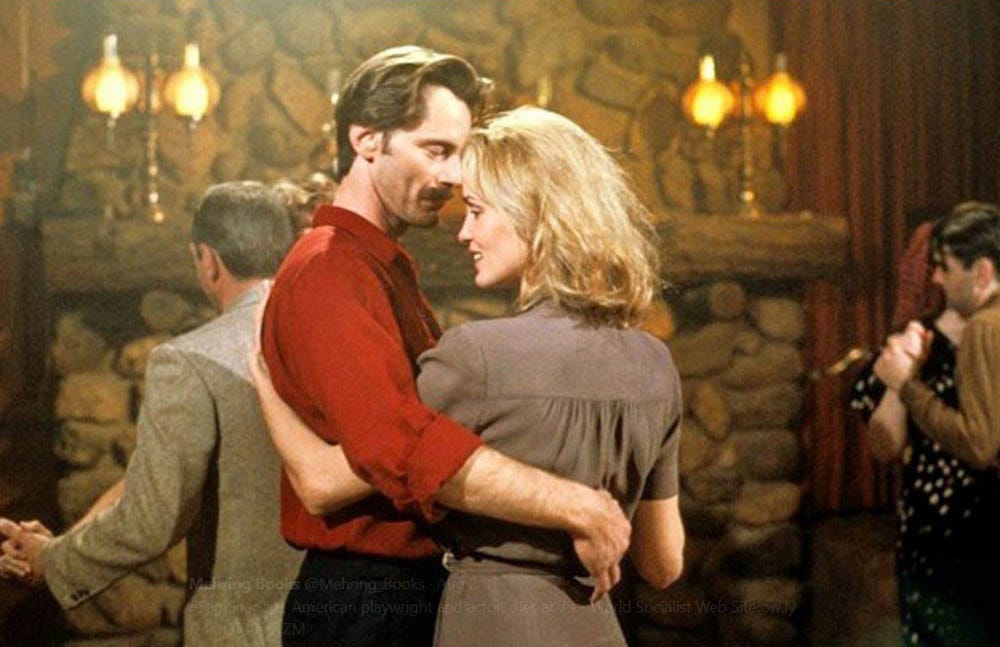
The second verse takes the story on the road. Mitchell begins with a symbolic house fire:
We saw a farmhouse burning down
In the middle of nowhere
In the middle of the night
And we rolled right past that tragedy
’Til we turned into some roadhouse lights
The burning house serves as harbinger for the fiery desire she experiences that night at the roadhouse with Coyote:
Where a local band was playing
Locals were kicking and shaking on the floor
And the next thing I know
That Coyote’s at my door
He pins me in a corner and he won’t take no
He drags me out on the dance floor
And we’re dancing close and slow
You can tell where this is leading, and she can too, but she goes along for the ride:
Why’d you have to get so drunk
And lead me on that way?
You just picked up a hitcher
A prisoner of the white lines of the freeway
Coyote can come across as a predator and the singer as his prey. Mitchell knows that it’s really more complicated than that, however. She’s knows the steps to this dance. She’s been on this trip before—and this wheel’s on fire. The flame is the torched house; the flame is runaway desire; the flame is wanderlust; the flame is ego—and all of it burns inside the singer. Eventually this endless cycle will get recycled into “Coyote,” the song spinning on her reel to reel in the first verse. Sounds like Joni chased down another great one. Makes you wonder: who is the real Coyote of this song? Maybe it’s this Crazy Crow.
Coyote: Third Verse
Mitchell only sings two verses in the filmed rendition at Lightfoot’s house, but we know that she had already written a third verse by that time because she sings it in her RTR sets in Toronto on December 1 & 2. In her intro before the second show she tells the audience, “This is a new song. It isn’t quite finished. There’s another verse to be added. It’s about a coyote.”
Coyote starts off as a representation of Shepard, but it doesn’t end there. The song has multiple layers, and Coyote wears a coat of many colors. That’s a hallmark of Mitchell’s songwriting approach, where she stages dramatic conflicts between composite characters drawn from both external experiences and internal struggles.
Reflecting on her creative process with Melody Maker in 1970, she told Jacoba Atlas, “Even if I’m writing about myself, I try to stand back and write about myself as if I were writing about another person.” She gives an example of an unnamed song about “a triangular story,” which was “written about one person and myself and still another rolled into one. To give the person more dimensions.” She admits that this creative process can feel “almost schizophrenic. You lay out a case and argue with yourself about it and with no conclusions.” For a perfect example of these songwriting dynamics at play, listen to “Coyote.”
Forget love triangle—this song is more like a love pentagram. There’s Joni & Sam, of course. Then there’s the woman at home and the woman down the hall. But I spy another shadowy figure tangled up in Coyote.
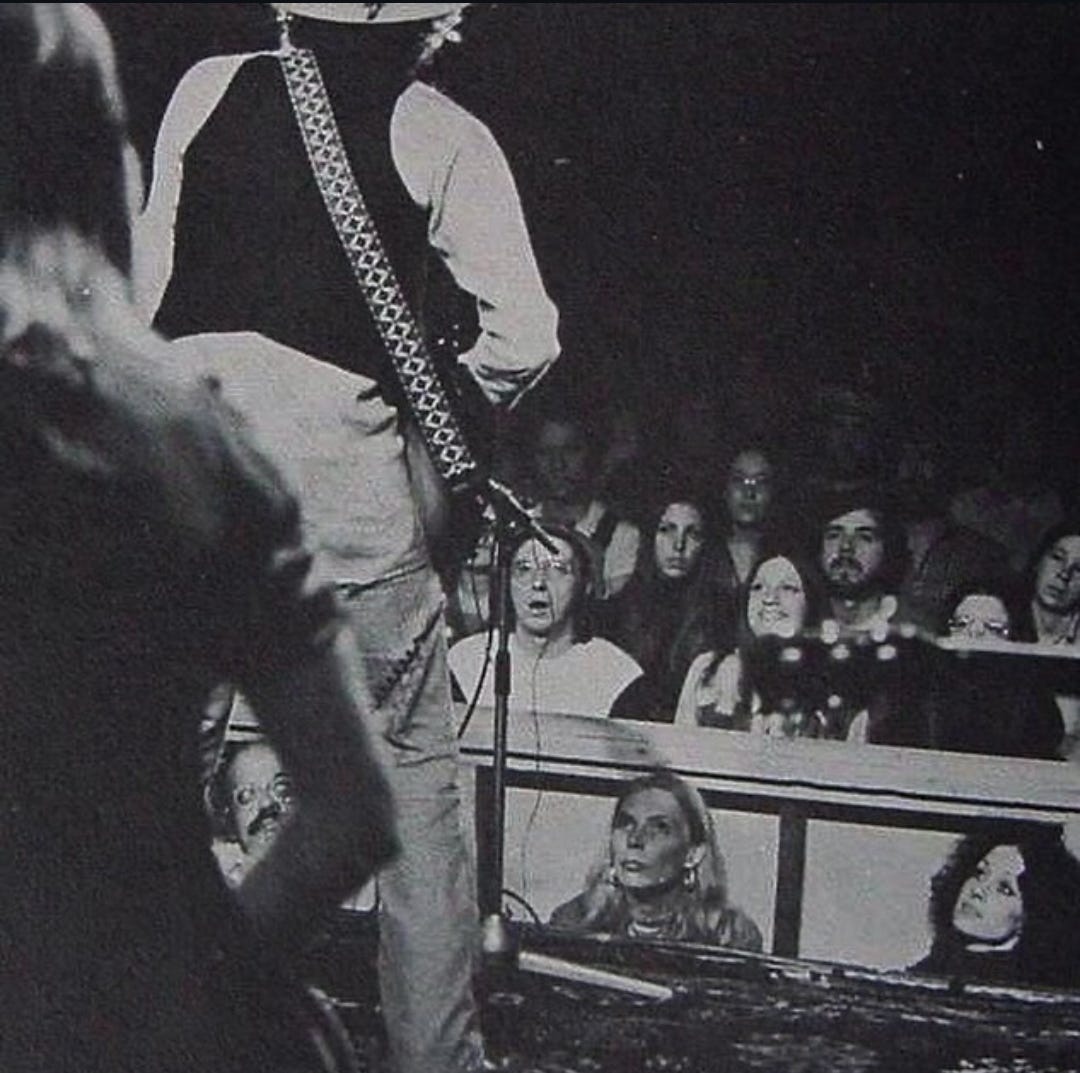
Consider the third verse. The singer sees a coyote chasing after a hawk in a Canadian field, and she recognizes something of her own situation in the encounter. The coyote is following his nature, and so is the hawk. They are both players in an endless drama with innumerable acts. In some the coyote catches the hawk, in some the hawk gets away, but always there is the dance between them, like the two lovers in the song:
I looked a coyote right in the face
On the road to Baljennie near my old hometown
He went running through the whisker wheat
Chasing some prize down
And a hawk was playing with him
Coyote was jumping straight up and making passes
He had those same eyes just like yours
Under your dark glasses
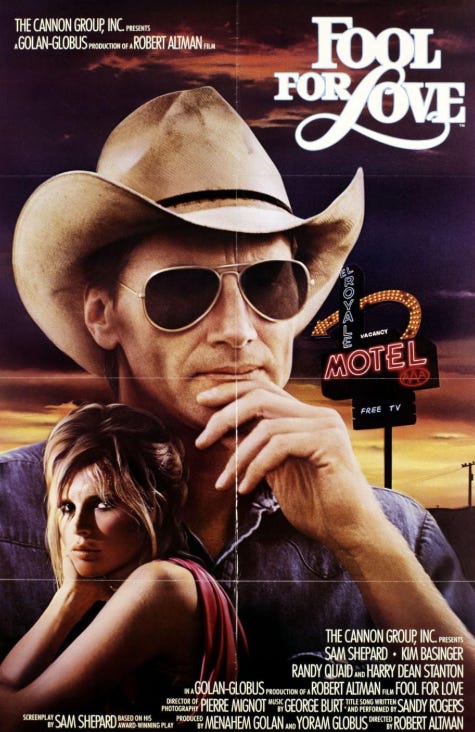
And every night, variations on the same drama play out on dance floor, tour bus, or seedy motel:
Privately probing the public rooms
And peeking thru keyholes in numbered doors
Where the players lick their wounds
And take their temporary lovers
And their pills and powders to get them through this passion play
But this is the pageant that she auditioned for, and she is only performing her part, same as him.
No regrets, Coyote
I’ll just get off up aways
You just picked up a hitcher
A prisoner of the white lines of the freeway
Remember that Shepard and Mitchell were both hitchers on someone else’s caravan, namely Dylan’s Rolling Thunder Revue. In Mitchell’s introduction to “Coyote” in Montreal, she told the audience, “I came to this tour in New Haven, and I just hitched along for the rest of the distance. It’s kind of like running away from home to join the circus.” When Shepard got the invitation, he immediately accepted. He recalls in Rolling Thunder Logbook: “That’s how it works, right? Dylan calls you and you drop everything. Like the lure of the Sirens or something. Everybody dropping their hoes in mid-furrow and racing off to the Northeast somewhere” (6).
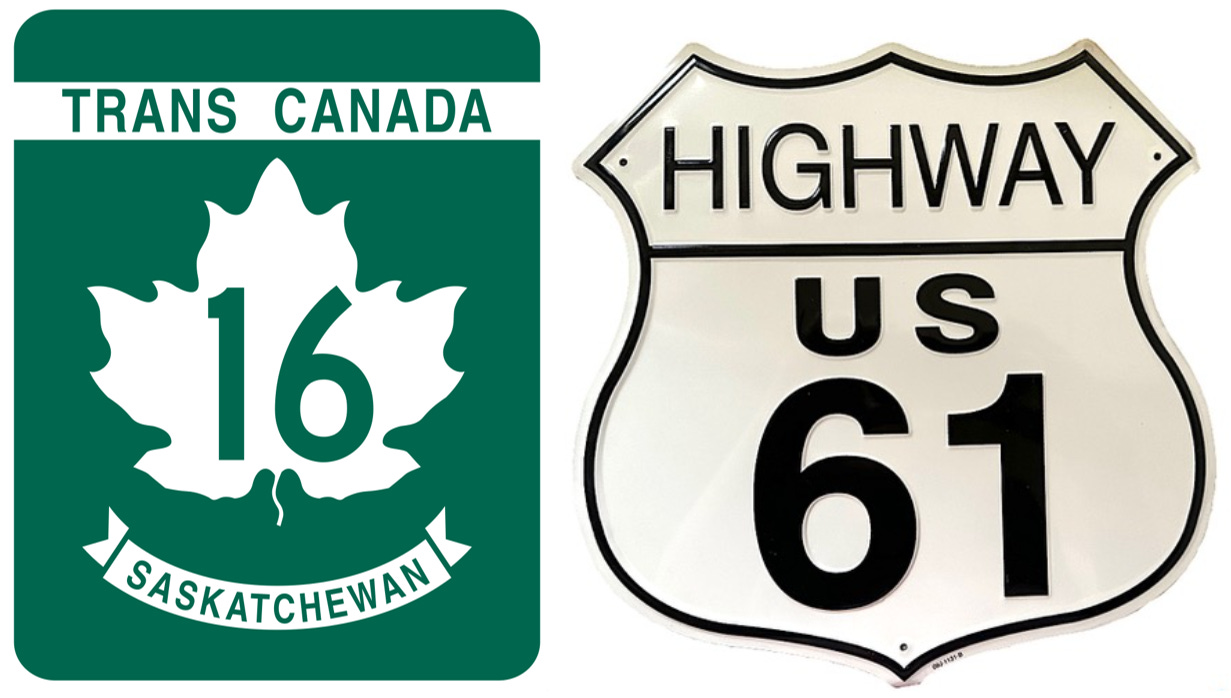
As RTR crossed the Canadian border and headed west, it’s worth asking: which freeway is the singer of “Coyote” imprisoned on? Because of my general ignorance of Canadian geography, I always assumed that “the road to Baljennie near my old hometown” referred to a highway the tour bus passed along the way. However, now that I actually bother to look it up on a map, I realize that the stops in Quebec City, Toronto, and Montreal were 2,000+ miles away from Mitchell’s hometown in Saskatoon. Therefore, the third verse must be drawn from memory, using this real-life road as a pathway into the past and into the self, much like Dylan’s use of Highway 61. Imagine my delight, then, when I discovered that the road one would take from Saskatoon to Baljennie is Highway 16! How perfect that the road which leads Mitchell back home, the road that leads within, is a mirror inversion of Dylan’s famous highway.
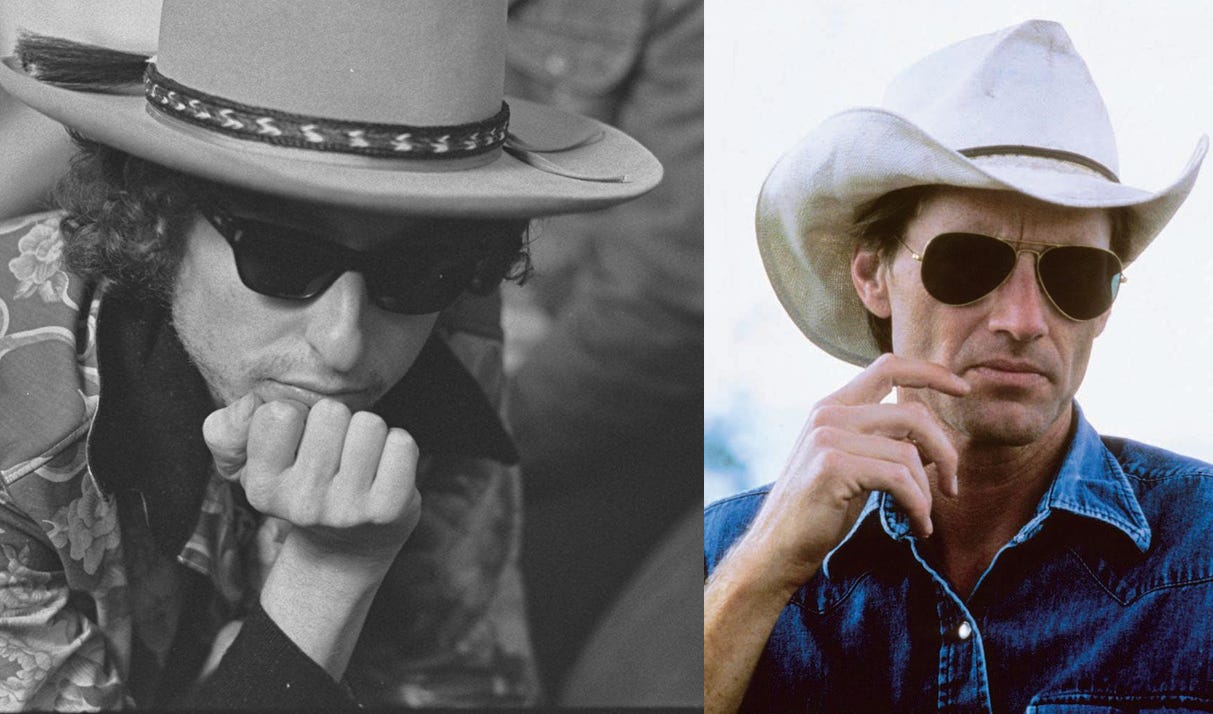
Now let’s dig deeper into the title figure. In The Coyote Reader, anthropologist William Bright subdivides his study of Coyote into chapters devoted to his dominant traits. Bright analyzes Coyote as trickster, wanderer, bricoleur, lecher, thief, outlaw, clown, horny old man, and survivor. Although some of these traits certainly apply to both Shepard and Mitchell, I must say that the person who most resembles this profile of Coyote is Bob Dylan.
If there is a “triangular story” being told here, I’m less interested in the sexual triangle—where Joni is competing with Chris and O-Lan for Sam’s affection—than the creative triangle—where Joni and Sam are both competing for Bob’s collaboration.
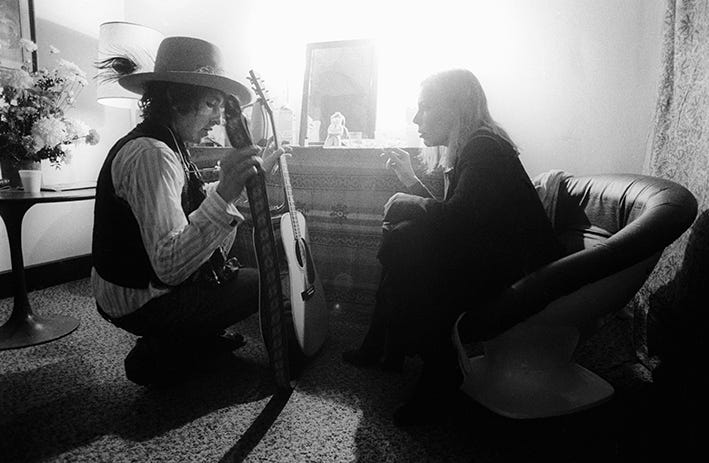
Dylan and Mitchell backstage during the 1975 leg of RTR. Photo by Ken Regan.
According to Mitchell’s biographer David Yaffe,
One of the motivations for joining the Revue […] was getting closer to Bobby. At last, a peer, someone who would understand greatness as only a great person could. […] In fact, Joni recalled only two conversations with Dylan in total for the whole tour. If you’re Joni Mitchell and you can’t have the conversation you thought you’d get, what can you do but write a song? In this case, the song was “Talk to Me,” which she would perform on her Hissing of Summer Lawns tour the following year. (202)
During her 1976 tour, she featured “Talk to Me” as part of a three-song medley including “Don Juan’s Reckless Daughter” (also inspired by Shepard) and—you guessed it—“Coyote.”
Please just talk to me
Any old theme you choose
Just come and talk to me
Mr. Mystery talk to me
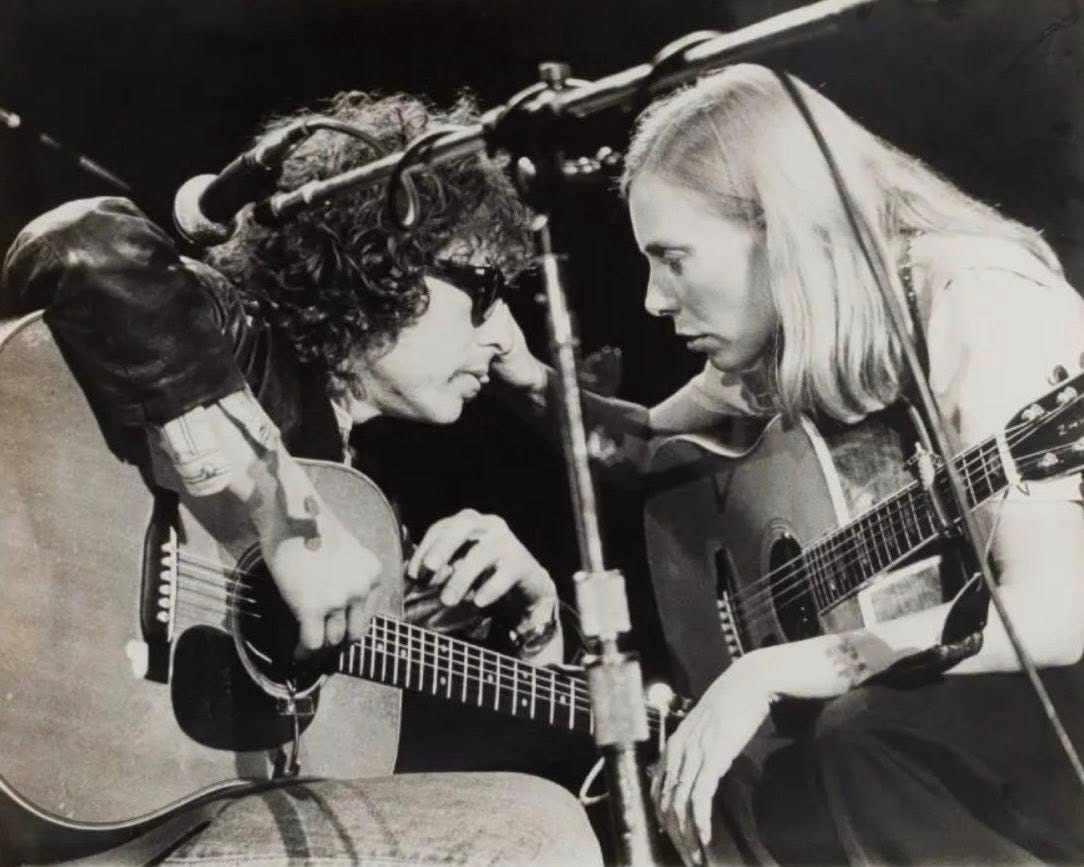
“Coyote”: Fourth Verse
Mitchell told the Montreal audience on December 4: “I’ve got a tune that has been growing. It started off with two verses, and a couple nights later I added another one. And last night I got a fourth one. I think it’s finished, but I don’t know. Maybe there’s a couple chapters to go. But it’s called ‘Coyote,’ and it goes like this….”
Check out the RTR-specific alternate ending to this version of the song:
From Louie on the balcony and the ladies in the show
And from me Coyote
The flame you typed up in an Eskimo
Me the hitcher
Me the victim
The prisoner of the fine white lines
Of the free freeway
Love that shout-out to Louie Kemp. It’s also interesting that she refers to herself as a victim here. She soon dropped that reference, and I can see why. The protagonist may have briefly felt like Coyote’s quarry. But by the time Mitchell transformed raw experience into polished art, she was certainly nobody’s victim: she was an absolute master at the top of her craft.
The fourth verse showcases Mitchell’s songwriting genius. Having depicted Coyote as an incorrigible womanizer in the second verse and an archetypal antagonist in the third verse, she now reimagines their encounter from his parallax view:
Coyote’s in the coffee shop
He’s staring a hole in his scrambled eggs
He picks up my scent on his fingers
While he’s watching the waitress’s legs
These are the most sexually explicit lines of the song, and probably in all of Mitchell’s work. Needless to say, that scent doesn’t come from fingering a guitar but a guitarist. However, the raunchiness can obscure Mitchell’s serious artistic achievement here. She has made the leap of empathy and identification. As she would later declare in the song “Hejira,” “I see something of myself in everyone.” In this fourth verse, she tries the mask of Coyote on for size. She sees through his eyes and sniffs through his snout.
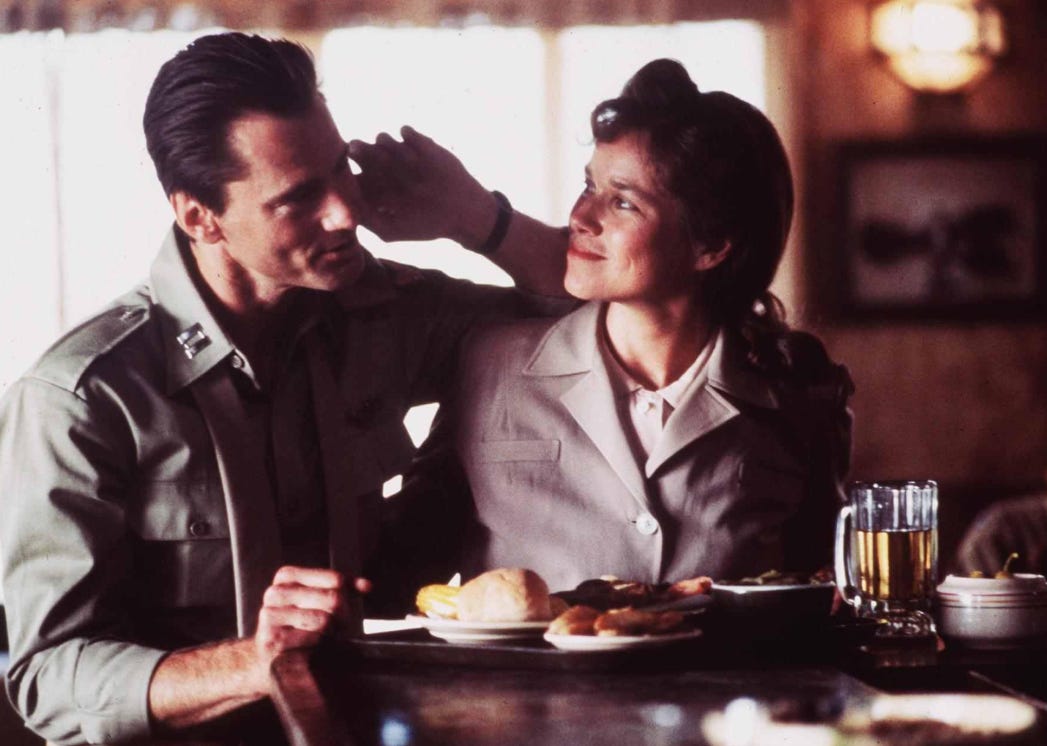
Coyote smells last night’s prize while sizing up tonight’s target. But more than anything he’s eyeing the exit and plotting his escape—another cavale, another hejira. When it comes to fight or flight, it’s in his nature to choose the latter:
He’s too far from the Bay of Fundy
From appaloosas and eagles and tides
And the air-conditioned cubicles
And carbon ribbon rides
Are spelling it out so clear
Either he’s going to have to stand and fight
Or take off out of here
Mitchell’s depiction of Coyote’s dilemma squares with Shepard’s confession of his growing frustration with the film and tour. As he vented in Rolling Thunder Logbook,
Feel myself nose diving into negativity. Just wanna go back home. Be in the mountains, Near horses. Near my woman. Back. The organization of the film has fallen into smithereens till it has no shape or sense. No way of planning a day’s shooting. Everything’s at the mercy of random energy. Ideas flying every which way but no plan. Meetings up the ass. Meetings in oval-shaped, U.N.-style conference rooms, so the sense of self-important permeates you beyond control. (132)
There’s no domesticating Coyote. Time to cut and run.
Mitchell could relate. By the time she made it to New York City for the finale at Madison Square Garden, she expressed her identification this way:
I tried to run away myself
Run away and do some work on my ego
And this flame
In this Eskimo
In this hitcher
This prisoner of the fine white lines
On the free, free, free freeway
Notice that the victim reference has already disappeared. She is now the victor, and the proof is audible on Hejira. Ann Powers nails it:
Hejira sounds like Rolling Thunder Revue, even though it also sounds like the fusion Joni was deep into mastering. Its songs spin out and drift, their wheels muddy, with no choruses anchoring them. Though she was preoccupied with the lupine Shepard and all the other men who kept her away from another failed stab at domesticity, Dylan’s vagabond aesthetic is the most audible inspiration for these songs. Rolling Thunder Revue was shaggy and grand, and so is Hejira. (244)
Let Coyote slink off back to his wife and ranch. The singer isn’t running back home, wherever that might be. She’s rushing off to the studio to lay down tracks on her reel to reel. He got the temporary lover he wanted, but she walked away with much more: a timeless masterpiece.
No regrets Coyote.
Works Cited
Atlas, Jacoba. “Joni: Let’s Make Life More Romantic.” Melody Maker (20 June 1970), https://jonimitchell.com/library/print.cfm?id=2977.
Bright, William. A Coyote Reader. University of California Press, 1993.
Mitchell, Joni. Hejira. Asylum, 1976.
O’Dell, Chris, with Katherine Ketcham. Miss O’Dell: Hard Days and Long Nights with The Beatles, The Stones, Bob Dylan and Eric Clapton, and the Women They Loved. Touchstone, 2009.
Powers, Ann. Traveling: On the Path of Joni Mitchell. Dey St., 2024.
Rolling Thunder Revue: A Bob Dylan Story by Martin Scorsese. Directed by Martin Scorsese. Netflix, 2019.
Shepard, Sam. Back Bog Beast Bait. The Unseen Hand and Other Plays. Bantam, 1986. 303-33.
---. Rolling Thunder Logbook. Sanctuary, 2004.
--- and Patti Smith. Cowboy Mouth. Fool for Love and Other Plays. Bantam, 1984. 145-65.
Smith, Patti. Just Kids. Ecco, 2010.
Yaffe, David. Reckless Daughter: A Portrait of Joni Mitchell. Farrar, Straus and Giroux, 2017.
Graley, this is fantastic, such a wonderful piece! I haven't read Just Kids in a few years, so the parallels to Patti Smith completely took me by surprise. I also love the idea that Dylan makes his way into the song. The footage from Gordon Lightfoot's party is captivating for so many reasons, but I'm also fascinated with watching Bob's face – so many emotions on his face that he's trying to keep under wraps as he's trying to learn the song, and listening to the performance. I keep wondering, is he jealous? Jealous of Joni, because everyone can tell this is a GREAT song, one for the ages, and it wasn't written by him (we know that Dylan has expressed admiration for Mitchell's ability to write so openly from a very personal place). But also, jealous of Sam? Not even (necessarily) of his affair with Joni, but because there's another man taking centre stage in what would clearly go down as maybe the greatest document of that tour. Maybe Joni wasn't the only one wrestling with her ego.
Another connection that I cannot work out whether it's a coincidence or deliberate is the verse in the diner in "Highlands" – it sounds to me like several years (decades) later, coyote, now fully embodied by Dylan, is on the prowl again. The eggs might now be hardboiled rather than scrambled, but he's still watching the waitress's legs because some things don't change.
Thank you so much for this Graley!
Brilliant, as always! Like all of your writing, this made me laugh and made me think. Thanks, Graley!