
Prodigal Sons
Chalamet's Journey to Dylan

I didn’t write about A Complete Unknown when it first came out in December 2024. I liked it a lot, mind you, but there was already enough press surrounding the film without adding my voice to the din. As you may have noticed, hot takes are not on the menu at Shadow Chasing. Cold, deliberative takes are the house specialty. The longest shadows appear later in the day, and those are the ones I prefer to chase.
Since I didn’t turn A Complete Unknown into homework back then, I mostly ignored the tidal wave of reviews and interviews that rolled out in the weeks surrounding the release. So I’m arriving very late to this party. I didn’t even get around to watching Timothée Chalamet’s excellent interview with Zane Lowe for Apple Music (November 2024) until a couple weeks ago.
I was impressed with Chalamet’s passion for his craft, and it was endearing to hear him identify as a disciple in the Church of Bob. Listening to him articulate his vision for the part, I started to notice an element of the film that I had overlooked before.
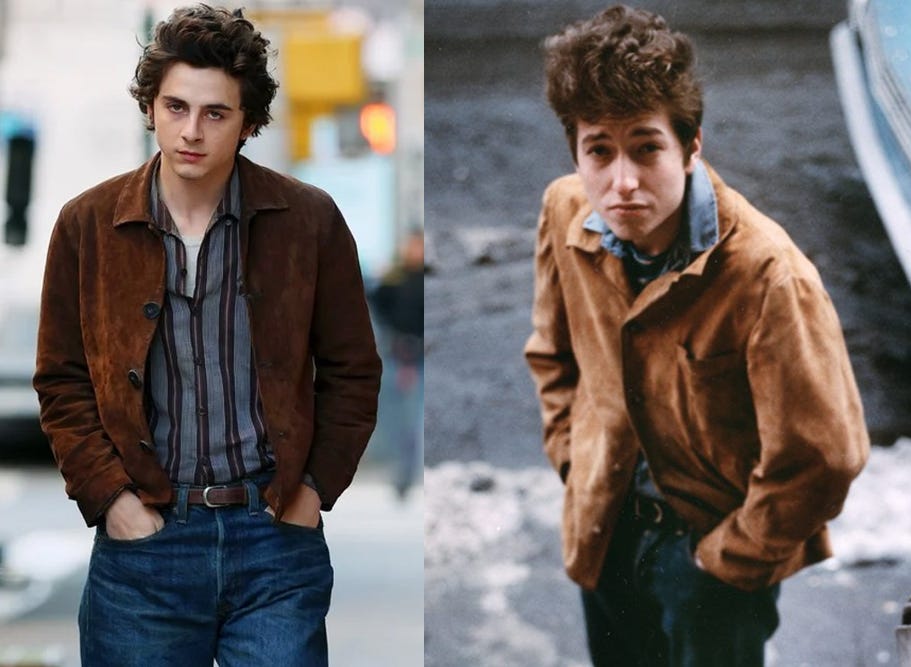
The interview was shot in the Manhattan Theatre Club. “Without this theater I don’t have an acting career,” he told Lowe. MTC was the site for Chalamet’s first major theatrical success in John Patrick Shanley’s play Prodigal Son. As he reflected on that role’s importance in his development, I began to recognize the prodigal son as a shared theme in both Chalamet and Dylan’s work. Now that I’ve studied it more carefully, I believe this parable works as a creative bridge linking the two artists, providing passage for Chalamet to cross over into the undiscovered country of Dylan.
The bridge is partly archetypal, but it’s also performative. Looking back at the basement tapes, Garth Hudson marveled at Dylan’s genius for “‘singing one song to arrive at another’” (qtd. Griffin 110). I think Chalamet displays a similar talent in A Complete Unknown. He draws upon his previous acting performances, particularly in Prodigal Son, and repurposes those experiences to arrive at his interpretation of Dylan.
Prodigal Son Parable
Jesus was a storyteller who used parables to teach moral lessons. The parable of the prodigal son appears in the gospel of Luke. A father has two sons. The younger son asks for an advance on his inheritance, which he receives and then recklessly squanders: “And not many days after the younger son gathered all together, and took his journey into a far country, and there wasted his substance with riotous living. And when he had spent all, there arose a mighty famine in that land; and he began to be in want.” (Luke 15: 13-14).
Penniless and scrounging for his next meal, the prodigal son decides to return home and throw himself on his father’s mercy:
And he arose, and came to his father. But when he was yet a great way off, his father saw him, and had compassion, and ran, and fell on his neck, and kissed him. And the son said unto him, Father, I have sinned against heaven, and in they sight, and am no more worthy to be called thy son. But the father said to his servants, Bring forth the best robe, and put it on him; and put a ring on his hand, and shoes on his feet: And bring hither the fatted calf, and kill it; and let us eat, and be merry: For this my son was dead, and is alive again; he was lost, and is found. And they began to be merry. (Luke 15:20-24)
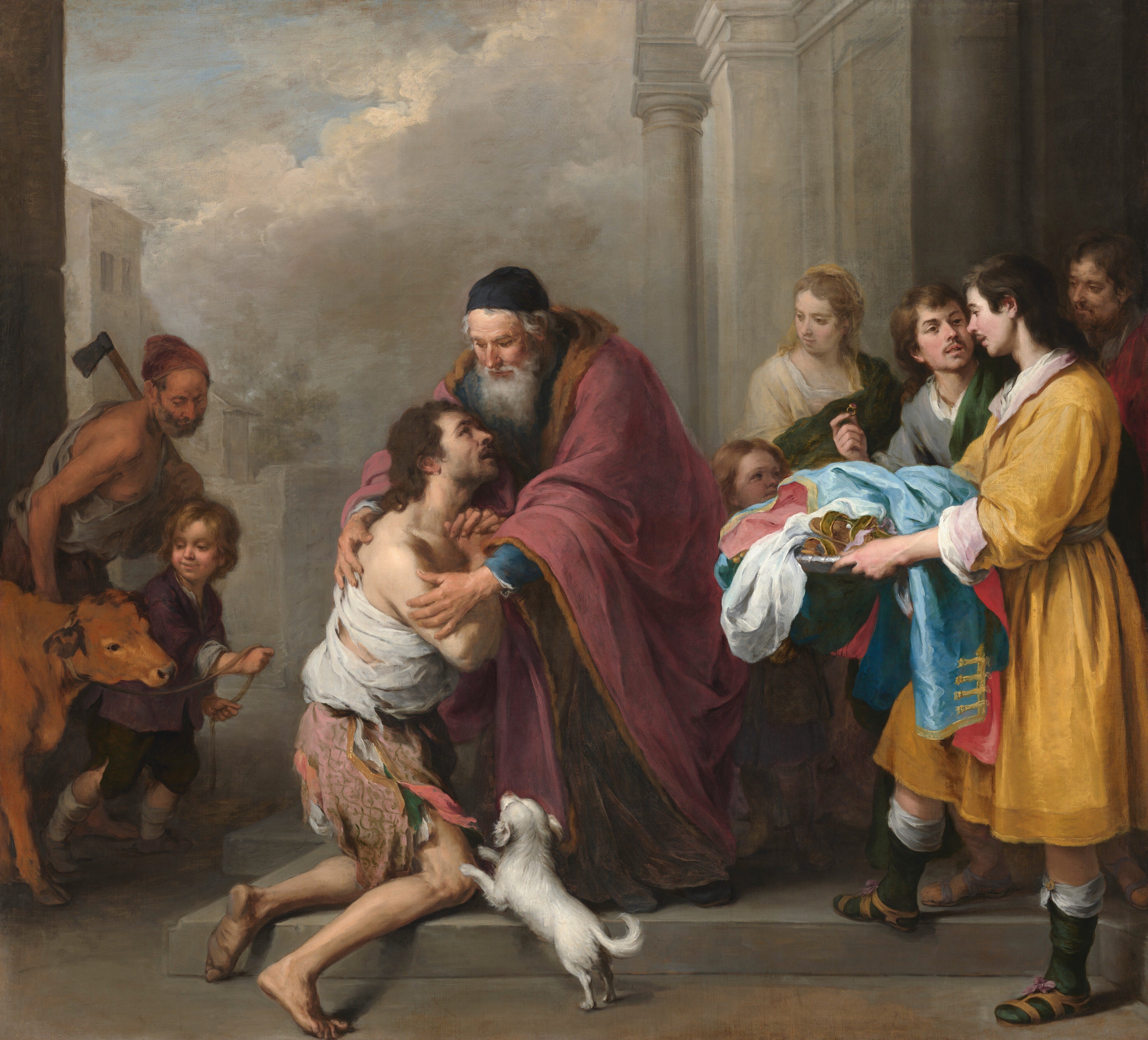
The elder brother is furious when he learns of this celebration. He feels cheated out of a fortune and underappreciated for his loyalty. He goes to his father and protests:
And he answering said to his father, Lo, these many years do I serve thee, neither transgressed I at any time thy commandment: and yet thou never gavest me a kid, that I might make merry with my friends: But as soon as this thy son was come, which hath devoured thy living with harlots, thou hast killed for him the fatted calf. (Luke 15:29-30)
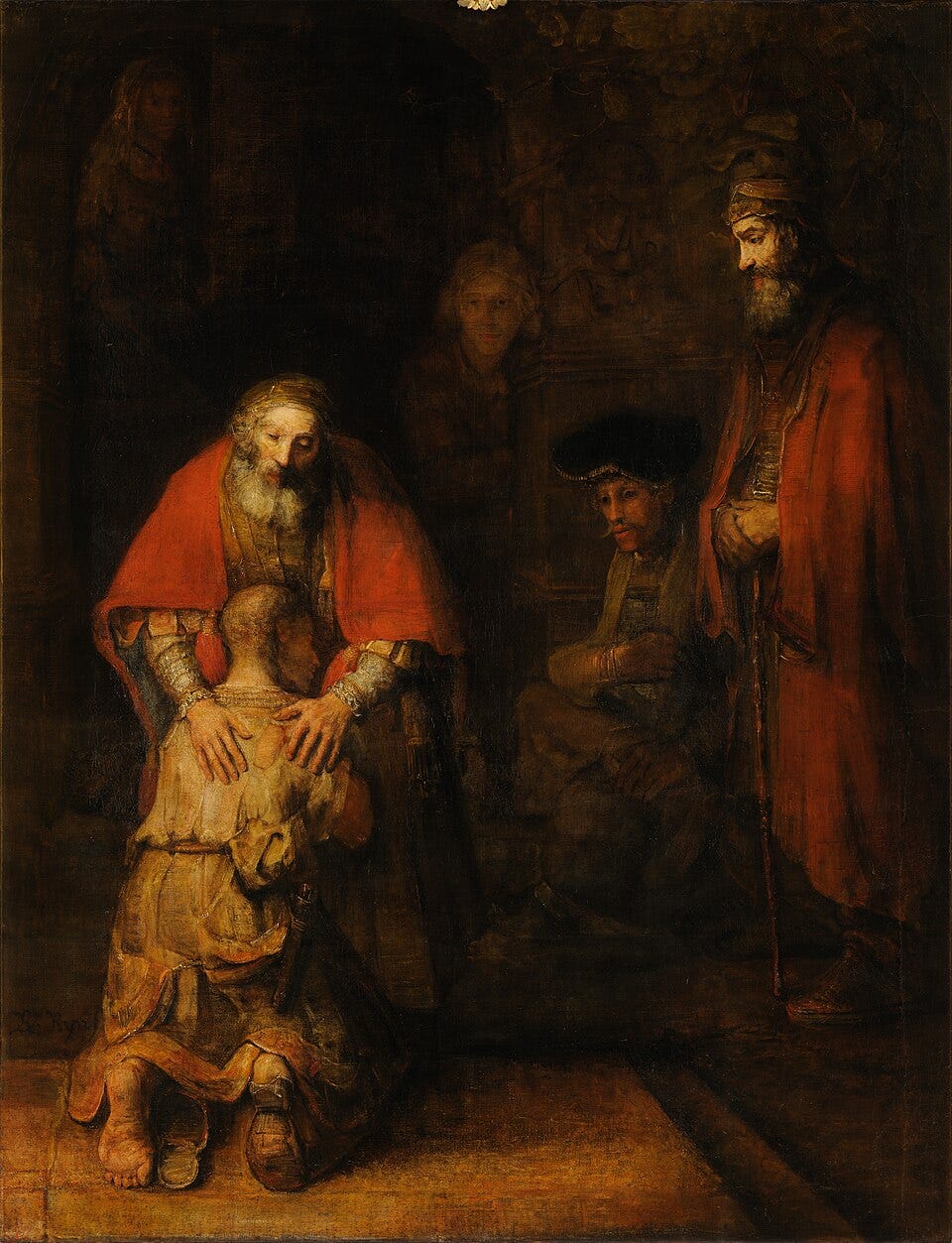
However, the father defends his decision: “And he said unto him, Son, thou art ever with me, and all that I have is thine. It was meet that we should make merry, and be glad: for this thy brother was dead, and is alive again; and was lost, and is found” (Luke 15:31-32). The moral of the tale is that God the Father will always welcome back his wayward sons and daughters if they choose to come back home to him. You can hear the allusion to the prodigal son parable in that most famous spiritual “Amazing Grace”: “Amazing grace, how sweet the sound / That saved a wretch like me / I once was lost but now I’m found / Was blind but now I see.”
Dylan’s Prodigal Sons
This parable casts a long shadow throughout Dylan’s work. His first prodigal son song is “I Was Young When I Left Home.” The first documented performance was on December 22, 1961, at the home of Bonnie Beecher (the so-called “Minnesota Hotel Tape”). Dylan had spent the year in New York City and was on his way back to Hibbing for the holidays when he stopped in Minneapolis and showcased his latest repertoire for some friends. The circumstances of his homecoming must have triggered memories of the parable and inspired this early song.
I was young when I left home
But I been out a-ramblin’ ’round
And I never wrote a letter to my home
To my home, Lord, to my home
And I never wrote a letter to my home
In A Complete Unknown, Chalamet’s Dylan makes a powerful first impression on Joan Baez and Albert Grossman with this same song:
I’m also quite partial to Marcus Mumford’s emotional cover at the 2013 Town Hall concert celebrating the music of Inside Llewyn Davis:
The acute shame of the prodigal son comes through most clearly in this verse:
I don’t like it in the wind
Wanna go back home again
But I can’t go home thisaway
Thisaway, Lord, Lord, Lord
And I can’t go home thisaway
Fans and critics have often noted how frequently Dylan invokes the theme of returning home in his work. If we read the prodigal son story literally, however, it doesn’t quite match Dylan’s own biography. He didn’t leave home to squander his father’s fortune, but rather to follow his musical vocation. By the time he returned to Minnesota in December 1961, he had signed with Columbia Records and had already recorded his debut album. He returned as a conquering hero with the wind in his sails, not as a prodigal son filled with regret and shame.
But parables aren’t meant to be read literally. The prodigal son story is an allegory about God’s boundless capacity for love and mercy. The point is that all sinners, no matter how low they have fallen or how far they have strayed far from the righteous path, can always heed the call to return home and God will forgive them.
It should come as no surprise, then, that the parable spoke most powerfully to Dylan during his fervent born-again period in the late seventies and early eighties. In particular, the album Saved sounds like a song cycle written and performed by the prodigal son. The singer repeatedly bears witness to his desperate need for divine mercy which he does not deserve. On the title track “Saved,” he testifies: “I was going down for the last time / But by His mercy I’ve been spared.” How does it feel? Let him and his sanctified choir tell you:
Saved
Saved
And I’m so glad
Yes, I’m so glad
I’m so glad
So glad
I want to thank You, Lord
I just want thank You, Lord
Thank You, Lord
The forgiveness of the prodigal son is also the central subject of “Saving Grace”:
If you find it in Your heart can I be forgiven?
Guess I owe You some kind of apology
I’ve escaped death so many times I know I’m only living
By the saving grace that’s over me
The prodigal son’s gratitude for being saved and his devotion to his savior shines through most poignantly in “What Can I Do for You?” Dylan delivers one of his most impassioned performances at Toronto’s Massey Hall in April 1980. The song is written from the lived experience of the prodigal son, which he relives before our eyes on stage:
You have given all there is to give
I know all about poison
I know all about fiery darts
I don’t care how rough the road is
Show me where it starts
Whatever pleases You
Tell it to my heart
Well, I don’t deserve it
But I sure did make it through
What can I do for you?
Dylan’s post-evangelical work doesn’t draw as intensely upon the prodigal son theme, but we can still chase its shadow in various later works. For instance, you can hear echoes in “When the Deal Goes Down” [“We learn to live and then we forgive / O’er the road we’re bound to go”] and “Mother of Muses” [“Wake me, shake me, deliver me from sin / Make me invisible like the wind / Got a mind to ramble, got a mind to roam / I’m travelin’ light and I’m slow coming home”].
One of the more interesting examples is Masked and Anonymous. Dylan’s character Jack Fate is the son of a dying dictator who rules over a collapsing dystopia. Fate has been imprisoned for years for defying his father. He has a brother named Edmund, played with creepy relish by Mickey Rourke. their sibling rivalry is clearly modeled after Edmund and Edgar from Shakespeare’s King Lear, itself deeply influenced by the prodigal son paradigm.
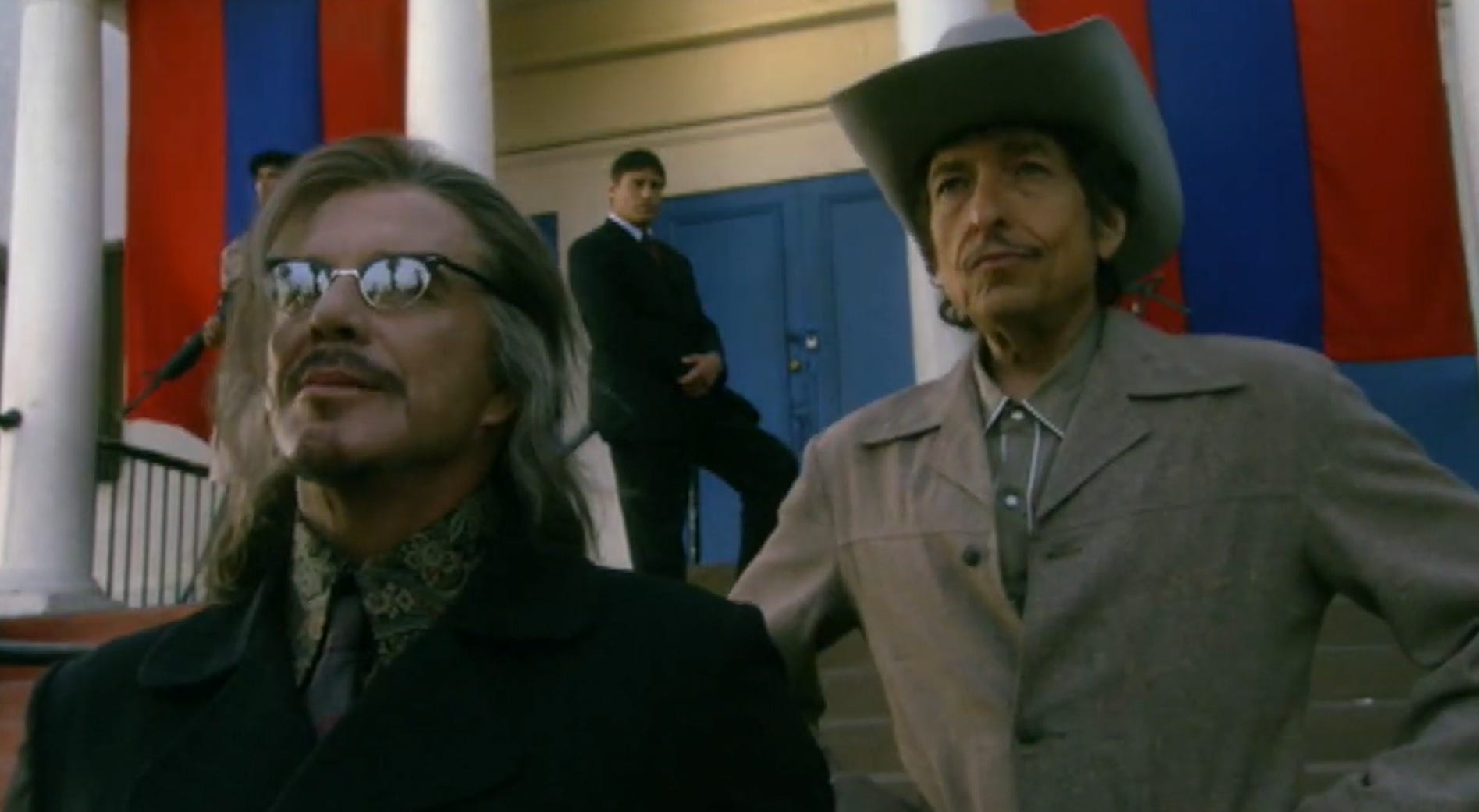
Jack visits his father on his deathbed. If either of them forgives the other, the reconciliation is never expressed in words. According to the stage directions in the screenplay,
Jack sits by the bed of his dying father, the President. They are silent. Although it is silent, it is a silence of lament, of melancholy, an elegiac silence. A silence beyond words. Silence is the only appropriate response. There are too many words unspoken to start now. Too many promises broken. Finally, Jack takes the President’s hand and he closes his eyes.
Dylan co-wrote the script, and the description above bears close resemblance to his account in Chronicles of going home for his father’s funeral: “I had gone back to the town of my early years in a way I could never have imagined—to see my father laid to rest. Now there would be no way to say what I was never capable of saying before” (107). No words are exchanged between father and son in Masked and Anonymous either, but according to the stage directions, “Jack kisses his father on the head. His father opens his eyes for a moment, a brief moment, perhaps of recognition, acknowledgement—then closes them again. Jack exits.” I wonder of Mangold had this scene in mind as a reference point for the final encounter between Bob and Woody in A Complete Unknown? Much more on that to follow.
Dylan gives pride of place to the prodigal son theme in his 2022 book The Philosophy of Modern Song. The first chapter is devoted to Bobby Bare’s “Detroit City,” and the first sentence declares: “In this song you’re the prodigal son” (1). Adopting his signature “you” pronoun, a hybrid that merges the singer with the listener, Dylan channels the prodigal son’s compulsion to return:
You want to go home, where they’ll embrace you and take you in. Nobody will ask you for an explanation. No one’s going to pepper you with relentless questions. You’re going back to where you can clear your life up, going back to people of understanding. The people who know you best. (2)
The home referred to here can’t be found on a map. It’s a spiritual home. Beginning with “Detroit City,” Dylan constructs The Philosophy of Modern Song chapter by chapter, layer upon layer, building the temple of song to which the prodigal son returns.
Chalamet’s Prodigal Sons
Now let’s walk in the footsteps of a different prodigal son, retracing Timmy’s journey to Zimmy. In proposing connections between Chalamet’s previous roles and his star turn as Dylan, I am merely following the actor’s lead. He told Zane Lowe:
Every movie I’ve done has reflected some place I’m at in my life. I’ve had this weird gift. […] The King or Dune are these roles where, they’re basically about a circumstance being too great for your youth. And I could relate deeply to that on both those projects. That was my point in relation to the Bob thing. […] That was like a new challenge, of playing a savant and a genius, how do you do that?
Admittedly, I’ve not been keeping up with the Dune franchise very closely. But I gather that Paul Atreides’s character arc bears the classical markers of the prodigal son trope. I’m much more familiar with Shakespeare’s Henry plays, the basis for David Michôd’s film adaptation The King (2019).
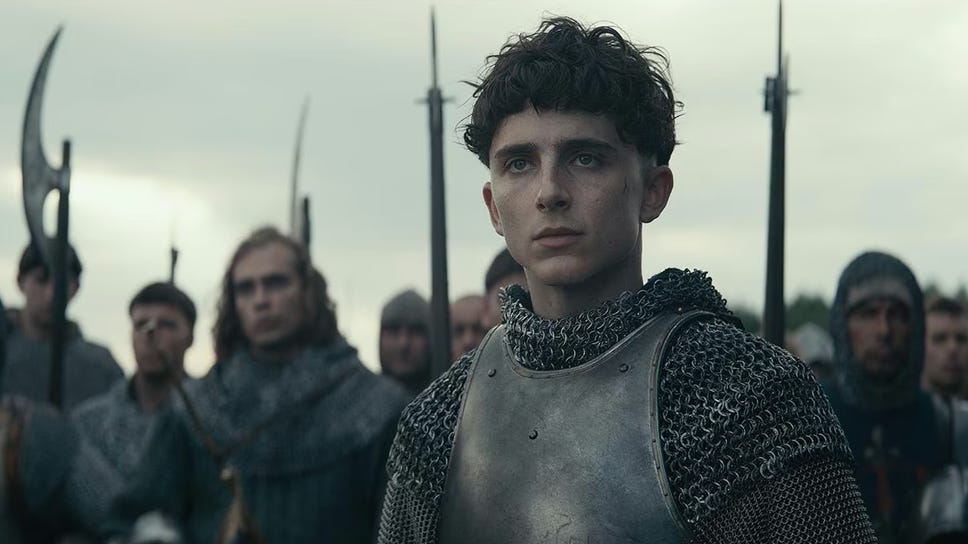
In Shakespeare After All, Marjorie Garber foregrounds the prodigal son theme in the Henry plays: “From the targeting of particular constituencies to the learning of regional languages and customs, the artful insinuations about ‘character’ and fitness for office, and the prodigal-son trajectory of the wastrel-turned-patriot-and-hero, the story of Prince Harry, or Hal, who will become the legendary Henry V, is a model of the making of a national icon” (314).
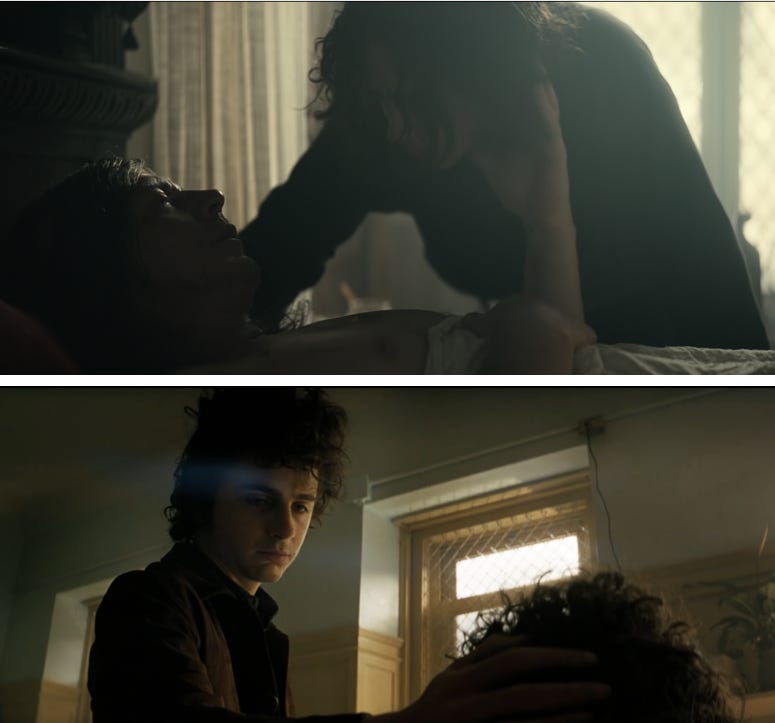
The King isn’t my main focus here, but I can see how playing Prince Hal’s transformation into King Henry V could help prepare Chalamet to play the Prince of Protest’s transformation into the King of Cool in A Complete Unknown. Viewed with the benefit of hindsight, there are even specific scenes where Chalamet might as well be rehearsing for his part as Dylan. For instance, I can no longer watch the deathbed scene between King Henry and Prince Hal without seeing foreshadows of the hairy-headed gents who ran amok in Greystone.
The performance I want to explore in depth is Chalamet’s starring role in John Patrick Shanley’s Prodigal Son. The same year that 75-year-old Bob Dylan won the Nobel Prize in Literature, 20-year-old Timothée Chalamet won the 2016 Lucille Lortel Award for Outstanding Lead Actor in a Play.
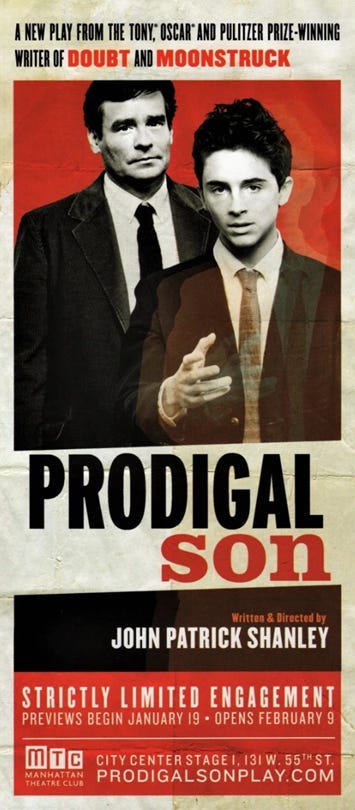
As Shanley makes clear in his preface to the published script, Prodigal Son is autobiographical:
In 1965 I arrived, a very troubled youth, at a private school in New Hampshire called Thomas More Preparatory School. Fifty-five boys were sequestered on a five-hundred-acre reservation on a mountaintop, for the purpose of education. I was from the Bronx, rather violent, a bit delusional, hungry for all kinds of things, and wild-eyed as a rescue dog. (v)
I’ve found no evidence that the playwright was influenced directly by Dylan. However, if you gaze at the world through Dylan-tinted shades (looking at you, Shadow Chasing readers!), then there are many intriguing resemblances between the 2024 biopic and the 2016 bioplay.
Prodigal Son is a portrait of the artist as a young man, focusing on a rebel in 1965-68. Shanley gives his alter ego the name Jim Quinn, which will instantly remind my readers of Jude Quinn, Cate Blanchett’s unforgettable avatar of 1965-66 Dylan in Todd Haynes’s I’m Not There.
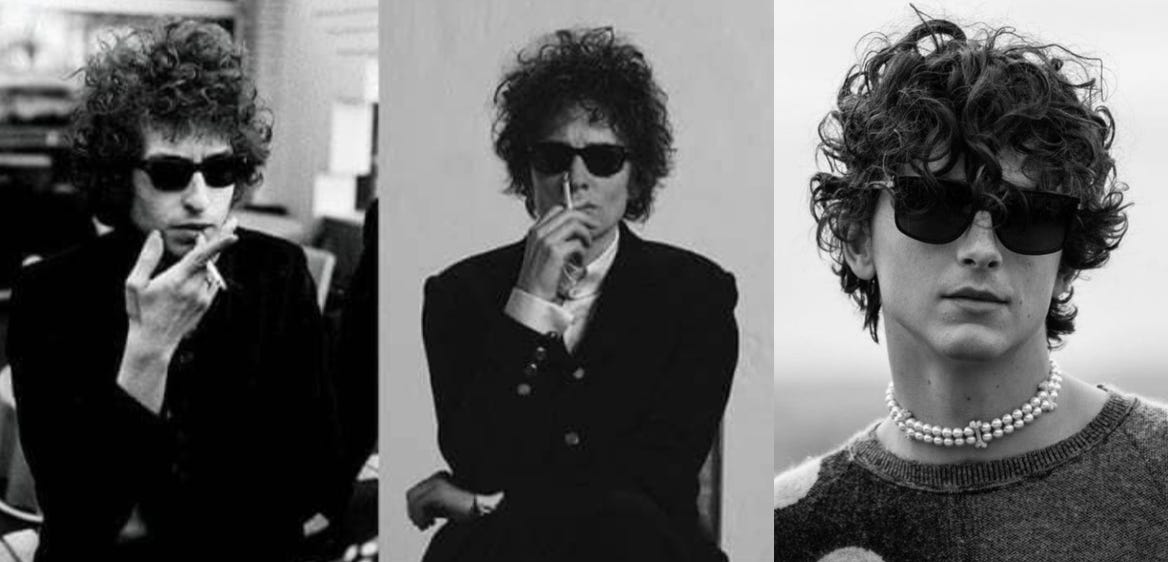
Jim Quinn isn’t Bob Dylan, but he is distinctly Dylanesque. His anti-authoritarian streak makes him a poor student in the Bronx, but he shows flashes of genius. Carl Schmitt, the headmaster at Thomas More in New Hampshire, sees potential in this young ruffian and offers him a scholarship. If you’re thinking John Hammond and Columbia Records, you’re not far off.
Jim makes an immediate impression upon arrival. To his peers, he comes across as an arrogant bully. Among his teachers, he distinguishes himself as intellectually brilliant but erratic, contrarian, and undependable. English teacher Alan Hoffman takes a special interest in Jim, whom he considers “the most interesting mess we have this year” (18).
Jim is a poet. He recites a poem he is particularly proud of, first to his roommate Austin (the headmaster’s nephew), and later to his teacher Louise Schmitt (the headmaster’s wife). Like Dylan, Jim combines interests in history and religion with a brash flair for the provocative:
The German drew back his knife.
He saw the Jew Man’s strife.
He asked, Where is your God now, Jew?
The Jew replied, He’s in your knife
Which is about to run me through. (22, 34)
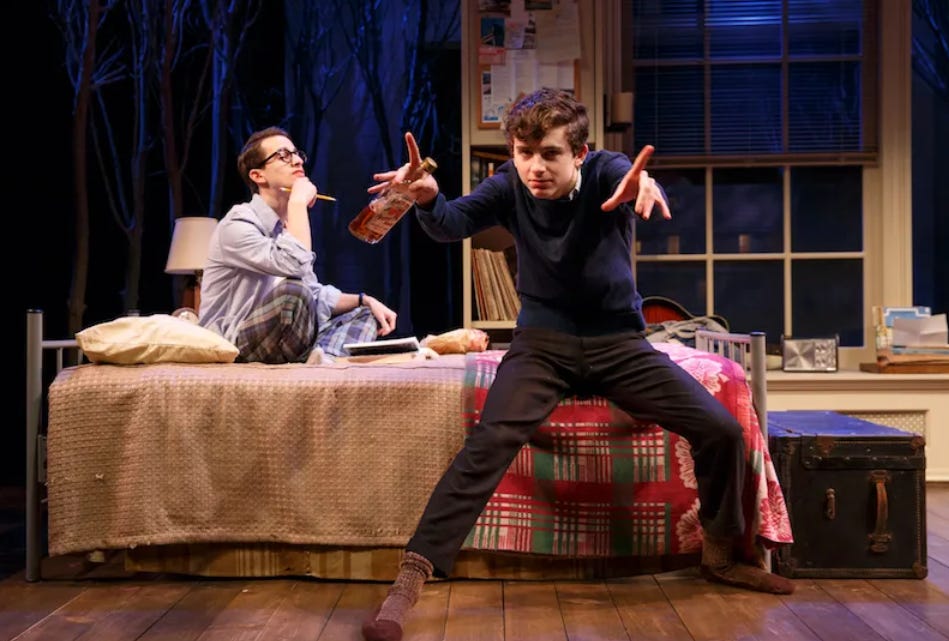
Jim uses art as a crucible for working through thorny issues of war, nationalism, and morality, commenting directly on WWII and indirectly on Vietnam, where his brother is stationed. We can hear Dylan taking the same approach in songs like “John Brown” and “With God on Our Side.” Later in the play, when Louise (another Dylanesque name) defends Jim to her husband, she asserts, “He’s using poetry like a ladder to climb out of some terrible place” (43). You probably find yourself humming along to “Forever Young”: “May you build a ladder to the stars / And climb on every rung / And may you stay / Forever young.”

Chalamet delivers some great speeches in Prodigal Son, and you can find several video clips from his performance online. In the penultimate scene of the play, he is confronted by the exasperated headmaster who is considering expelling Jim for his repeated violations of school policies. “You know what I don’t understand?” asks Mr. Schmitt. “You’re a cheat. You’re close to incapable of telling the truth. But your work, there you have areas where it’s clear to me that you’re driven by the very highest ideals. How can that be?” (55). The student pleads with the headmaster not to kick him out. But Jim has too much Holden Caulfield, Marlon Brando, James Dean, and Bob Dylan in him to obediently defer to authority or piously conform to expectations.
Schmitt thinks of Thomas More School the way Alan Lomax thinks of the Newport Folk Festival: “It’s my school. You’re here because I’ve given you an opportunity” (59). Jim Quinn answers him like Jim Stark in Rebel Without a Cause, or like Bob Dylan at Newport ’65:
Why is it your school? Why am I always in the wrong? Why do I have to listen to you when you have zero to say? Because I’m young? All my life I’ve been young. So I never get a turn? This school is lost, if you ask me. You’re lost. But everybody talks to me like I’m the one. I should change. Why should I change? I’ve never even gotten to find out who I am and you want me to change? That’s crazy! You tell me I’m bad before I even get to be anything? What the hell is that? Original sin or something?
Why are you the headmaster and I’m the student? Do you understand? I have to earn your respect but you don’t have to earn mine? What is that? It’s you that wants the A before you even start. But when I say I want the same thing, I’m nuts, right? I’m not going to cry. I’m going to find my place in this world. Count on it. This school has been a miracle for me, but not because of you. Because somebody, Mr. Hoffman, finally saw me. And more than that. Somebody, a grown person, decided I was good before I was good. You want to throw me out of that? Then you know what I say: I’ve never met your God and I don’t want to. (59-60)
When the headmaster leaves the classroom to let Jim finish his makeup final exam, the student scrawls “Fuck You” on the blackboard (61). Jim ain’t gonna work on Schmitt’s farm no more!
Jim credits Mr. Hoffman with truly seeing him and valuing him when no one else did. But it’s more complicated than that. The scene ends with the English teacher making a pass at his student, and when Jim spurns his advances, Hoffman switches from champion to traitor: “Fine. You think I’m cold? You haven’t seen cold. I’ll show you cold” (68). What’s an apprenticeship in electric Dylan without a Judas, right? Hoffman blows the whistle on Jim’s transgressions to the headmaster, handing Schmitt all the ammunition he needs to expel the miscreant.
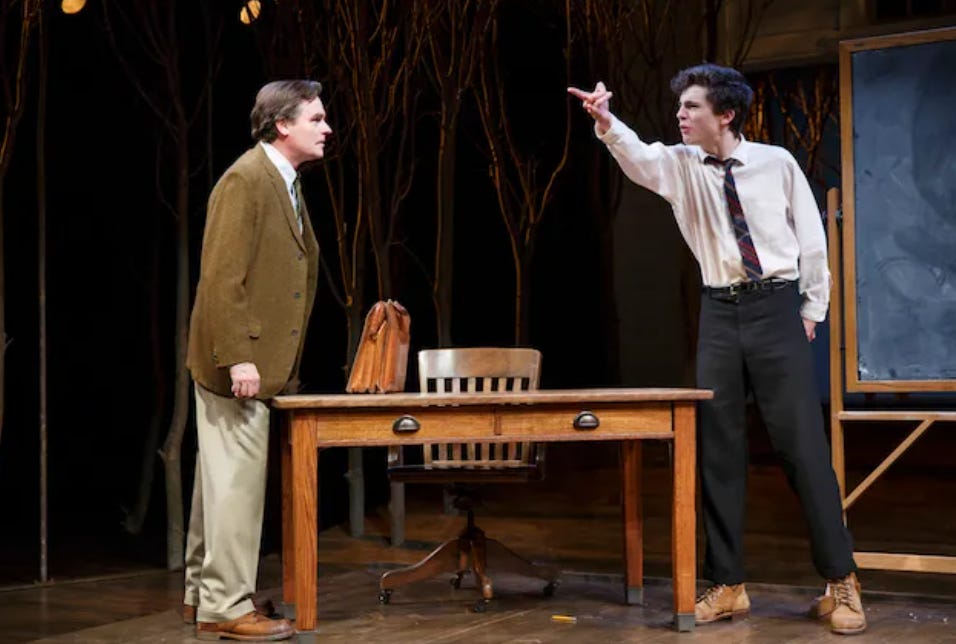
Shanley’s most famous play Doubt is subtitled “A Parable.” Prodigal Son needs no subtitle to mark it as a parable. The play’s final scene is where the prodigal son dimension really comes into focus. Before Hoffman puts the moves on Jim, he reveals a secret about the headmaster: two years ago, during a snowstorm, Schmitt accidentally struck his son with a plow and killed him. The son’s name? James.
This trauma complicates the psychodynamics for the grieving parents, who seemingly view Jim as a substitute son returned home. The moral choice is clear: justice or mercy. The father figure can dole out the punishment Jim has earned and banish him, or he can embrace the prodigal son and forgive his past transgressions. Which side are you on, Mr. Schmitt?
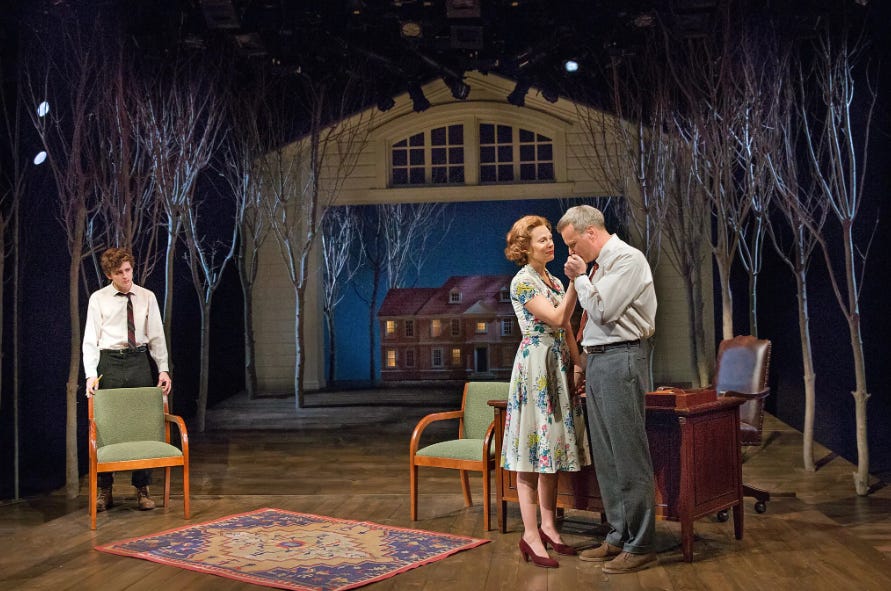
Things get strange in the final scene. The headmaster’s clock stops, and he becomes unstuck in time. John Patrick Shanley speaks through his avatar Jim across the chasm of years: “I’m sixty-four, Mr. Schmitt, and you’re dead, but I have a time machine and I can speak to great people who are gone. That’s the gift I have been given and I thank God for it. We’re all dead or about to be dead or we will never die because the human mind is a leaping spark. I know it!” (72). Schmitt has unsettled moral debts of his own, namely the accidental killing of his son. “How can you forgive me?” he asks his wife. Louise replies, “Please. In the name of God. Let me forgive you” (73). She challenges her husband to do the same by forgiving Jim.
And that’s exactly what he does. He chooses mercy over justice: “Mister Quinn, understand I have no idea, not the slightest idea why I’m doing this. I’ll die without understanding it. Jim, I’m going to let you graduate” (74). The prodigal son replies with the same rapturous praise that Dylan sings about in “Saved”: “Thank you. This is the moment that made me, sir. Thank you. Thank you, madam. A lifetime of thanks. Thank you for everything” (74).
Hey, hey, Mr. Schmitt, I wrote you a play. What a touching gesture of gratitude on Shanley’s part. He experienced saving grace and it changed his life. He commemorates this salvation in Prodigal Son and extends it across the footlights, inspiring the same spirit of forgiveness to audiences through his art. I think the role of Jim Quinn also helped teach Chalamet how to embody Bob Dylan in A Complete Unknown—which also ends with a loving father bestowing his blessing upon the prodigal son.
A Complete Unknown
I’m a big admirer of Elijah Wald’s Dylan Goes Electric!: Newport, Seeger, Dylan, and the Night that Split the Sixties. This book was the initial inspiration for the film that became A Complete Unknown. To the extent that Wald draws upon a familial framework for his story, it’s more like Seeger as the Father, Dylan as the Son, and Guthrie as the Holy Ghost. Maybe that’s why I was slow to pick up on the prodigal son angle. But it’s definitely there once you start looking for it.
If I had been keeping up with the press coverage, I could have seen it from the start. The day A Complete Unknown had its nationwide release, James Mangold was quoted in the New York Times describing the film as a family drama, “‘a kind of Thanksgiving blowup, a holiday dinner gone awry in which a prodigal son comes out and won’t toe the family line anymore, and tries to demonstrate his independence.’” Mangold applies the term “prodigal son” loosely in this quotation, but the concept is deeply embedded in the script that he and Jay Cocks wrote.
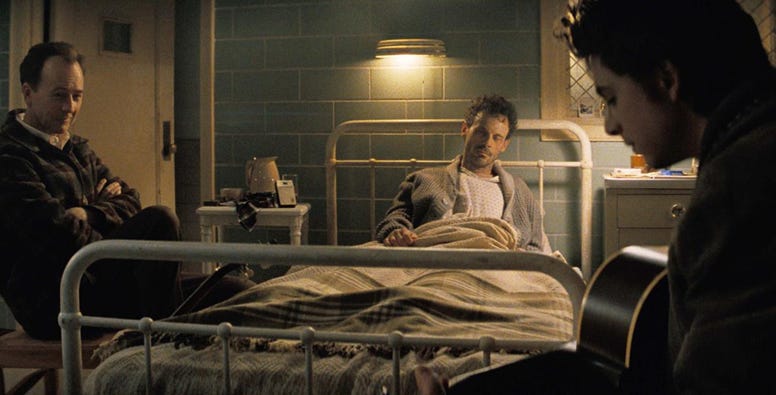
In the first scene set in Guthrie’s room at Greystones Hospital, the screenplay sets up a father-son dynamic between Guthrie and Seeger: “Pete, singing, tired, but he loves this man as one loves their father. Woody’s eyes smile, alive. Pete sings ‘So long, it’s been good to know ya…’” (6). That same song heralds the arrival of the younger son Dylan at the film’s beginning, and it will play a pivotal role again in the final scene set in this same hospital room.
There are a couple scenes near the middle of the film that I didn’t pay much attention to the first few times I saw A Complete Unknown, but which now strike me as significant in light of the prodigal son theme. As Dylan’s folk celebrity is blasting off, he plays “A Hard Rain’s A-Gonna Fall” at Carnegie Hall, receiving a rapturous reception from the audience. Pete stands in the wings watching Bob perform, much as Bob had watched Pete a couple years earlier from the same position. They’ve essentially switched places. An elated Albert Grossman marvels backstage: “It’s happening, Pete. You did it. This was your dream. Folk music reaching everyone” (54).
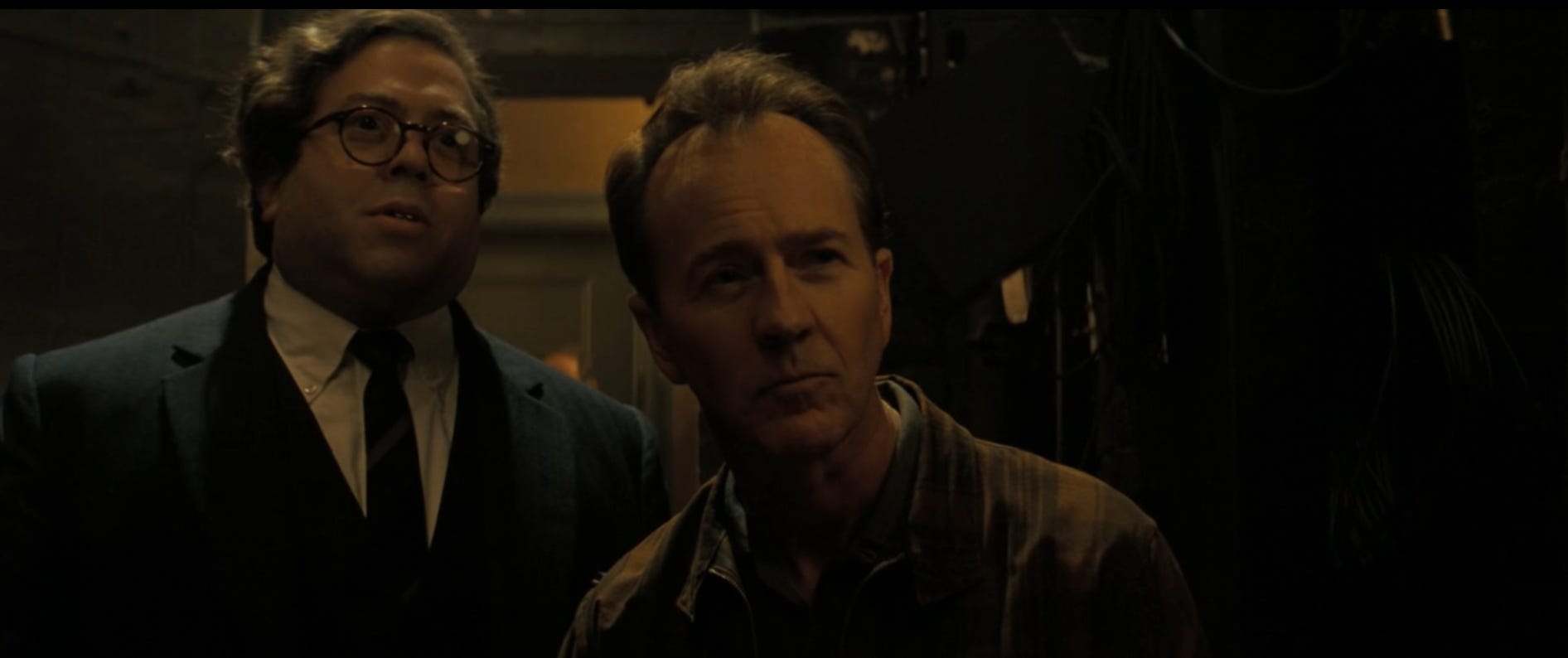
Cut to Greystone. Pete visits Woody in his dark hospital room. Bob has sent Woody a record player as a gift, and Pete plays him The Freewheelin’ Bob Dylan. Pete informs Woody that he’s going to be making a world tour. Norton plays Pete as fidgety in this scene. The first few times I watched it, I figured this was because the dutiful caretaker would be traveling abroad for an extended period and was worried about leaving his friend alone. But now I think it’s more complicated than that.
Pete: “Little Boxes” got itself on the charts. Number seventy.
Woody: (grunts approvingly)
Pete: That’s a first for me, solo-wise. Had a few hits with The Weavers. But they don’t tumble out of me like for some.
(Pete notices Woody’s hand has touched his.)
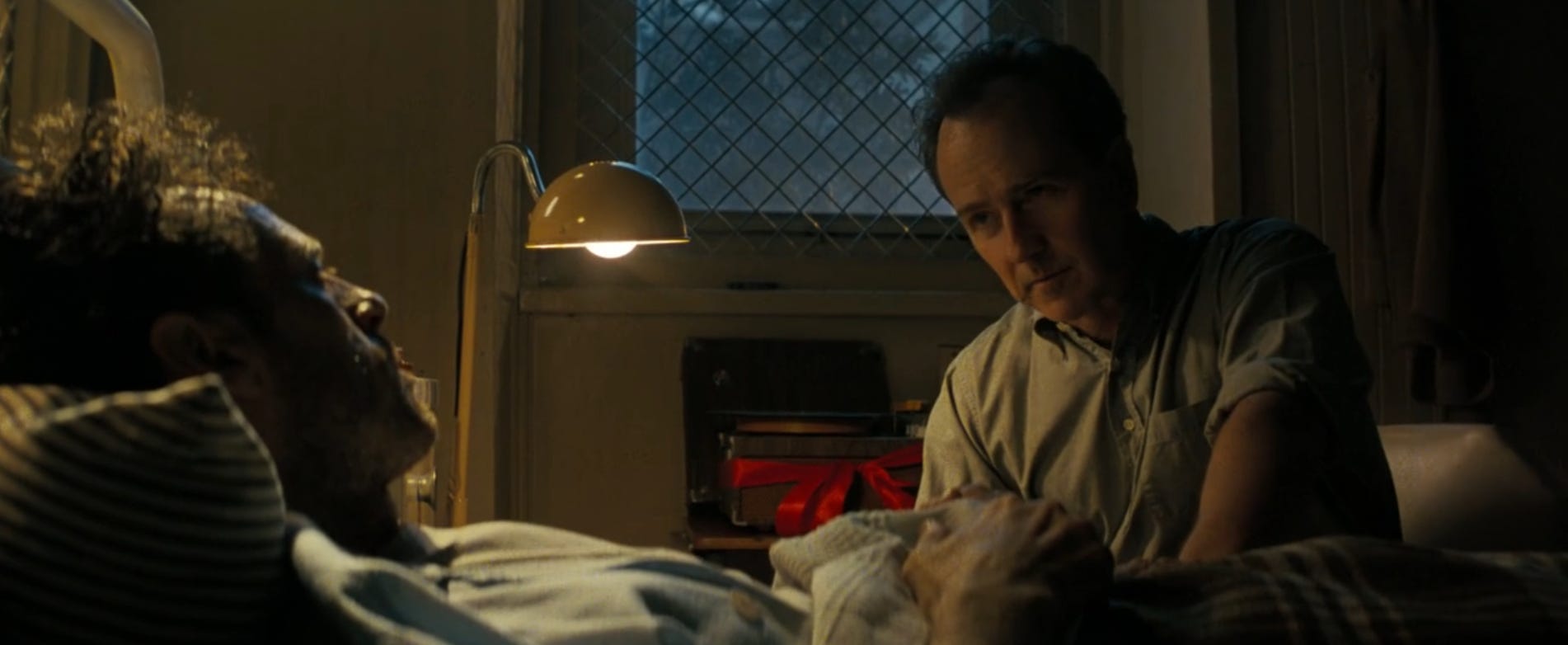
Pete: Got me thinking about doing a tour after Newport. A world tour. Africa. Australia. India. Visit Toshi’s family in Japan. Take the kids. Would that be okay? Can you hold on, take your medicines and get some rest while I’m out spreading the word?
(Woody tightens his hand around Pete’s. He nods.) (54-55)
Woody then hands Pete a harmonica and struggles to speak. He finally gets out, “F-f-f-r ..B-b-b..” The directions read, “Pete takes this in. Pockets the harp.” Then he simply says, “Okay. I’ll make sure he gets it” (55).
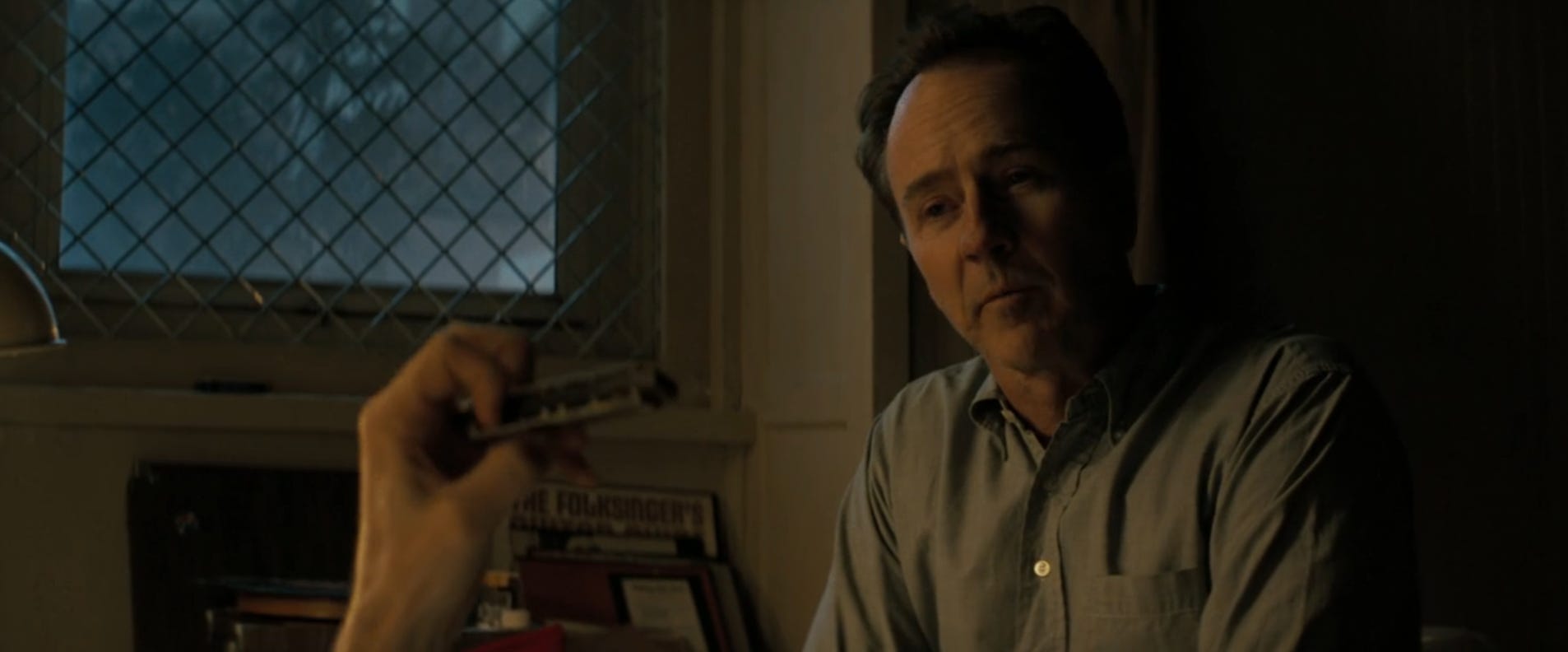
Now I can see what I missed before: Pete envies Bob. Pete was here to tell Woody about his own recent success with a modest hit and upcoming tour. He was seeking his father’s approval. And he thought he had it when Woody touched his hand and handed him the harmonica as a congratulatory gift. But no—he just wants to use Pete to pass along another prize to Bob, the son who never comes to visit anymore.
Don’t get me wrong: I don’t doubt Pete Seeger’s sincere appreciation for Bob Dylan’s enormous talent and his genuine appreciation for the good Bob did for folk music, in real life and in A Complete Unknown. Nevertheless, in this subtle but revealing little scene, the harmonica is to Pete what the fatted calf is to the elder brother in the parable. Pete was looking for Woody’s blessing, and instead the he felt underappreciated by a father who reserved his greatest love for the younger, more flamboyant, less loyal son.
The morning after the Newport fiasco, there’s an interesting exchange between Pete and Bob that’s in the screenplay but was left out of the final cut. In the released film, when Bob drives by on his motorcycle and sees Pete helping breakdown the festival setup, the two don’t speak with each other. However, there was actually a spoken encounter that had been scripted between them (122-23). Pete shows Bob that he listened to Highway 61 Revisited by quoting lyrics from “Desolation Row.” He also hands over the harmonica that Woody had given him earlier as a gift for Bob. This becomes an important plot point for the following scene at Greystone, where Bob tries to give the harmonica back to Woody.
The ensuing encounter between Bob and Woody is invented. There is no evidence that Dylan visited Guthrie after going electric at Newport in 1965. He had paid his final respects to his hero years earlier, and in any case, Guthrie had relocated to Brooklyn State Hospital by this point. So why make up this fictional scene? I suspect that Mangold felt it was necessary to complete the prodigal son trajectory of A Complete Unknown.
The scene feels like the culmination of an acting apprenticeship that Chalamet had begun in 2016 on Prodigal Son. The final scene comes full circle with the first meeting between mentor and protégé in this same hospital room. In that earlier scene, as I’m sure you remember, Chalamet delivered a very moving rendition of “Song to Woody”:
It’s a great performance. But have you noticed that he actually skips the last verse? I don’t think that’s an accident. Dylan hadn’t earned that last verse yet. He had to live it first. By the end of the film, he knows what he’s talking about:
I’m a-leavin’ tomorrow, but I could leave today
Somewhere down the road someday
The very last thing that I’d want to do
Is to say I’ve been hittin’ some hard travelin’ too
The final scene effectively reenacts the last verse of “Song to Woody.” Bob first arrived at Greystone as Woody’s biggest fan, but when he returns it’s as the prodigal son.
In the script, Dylan exchanges a few words with a hospital orderly and there is some additional business involving Woody’s “I AIN’T DEAD YET” cards (123-24). But the film dispenses with all that and keeps the final encounter simple and non-verbal, other than the record playing in the background. Chalamet mumbles along with the lyrics, “This dusty old dust is a getting’ my home / And I’ve got to be driftin’ along.” That’s it: no more words. The creative team takes Dylan’s advice from the Masked and Anonymous script by allowing the silence to speak more than words could ever say.
A helluvalot is communicated in this wordless scene. Dylan was defiant and unapologetic on the Newport stage the previous night. Boo me? Screw you! “You’ve got a lotta nerve to say you are my friend.” But he cares very much what Woody thinks. His gesture of handing back the harmonica is weighted with significance, like he had been handed the torch as Woody’s chosen successor but failed to live up to his responsibilities. To put it in terms of the parable, the prodigal son returns after having squandered his father’s inheritance.
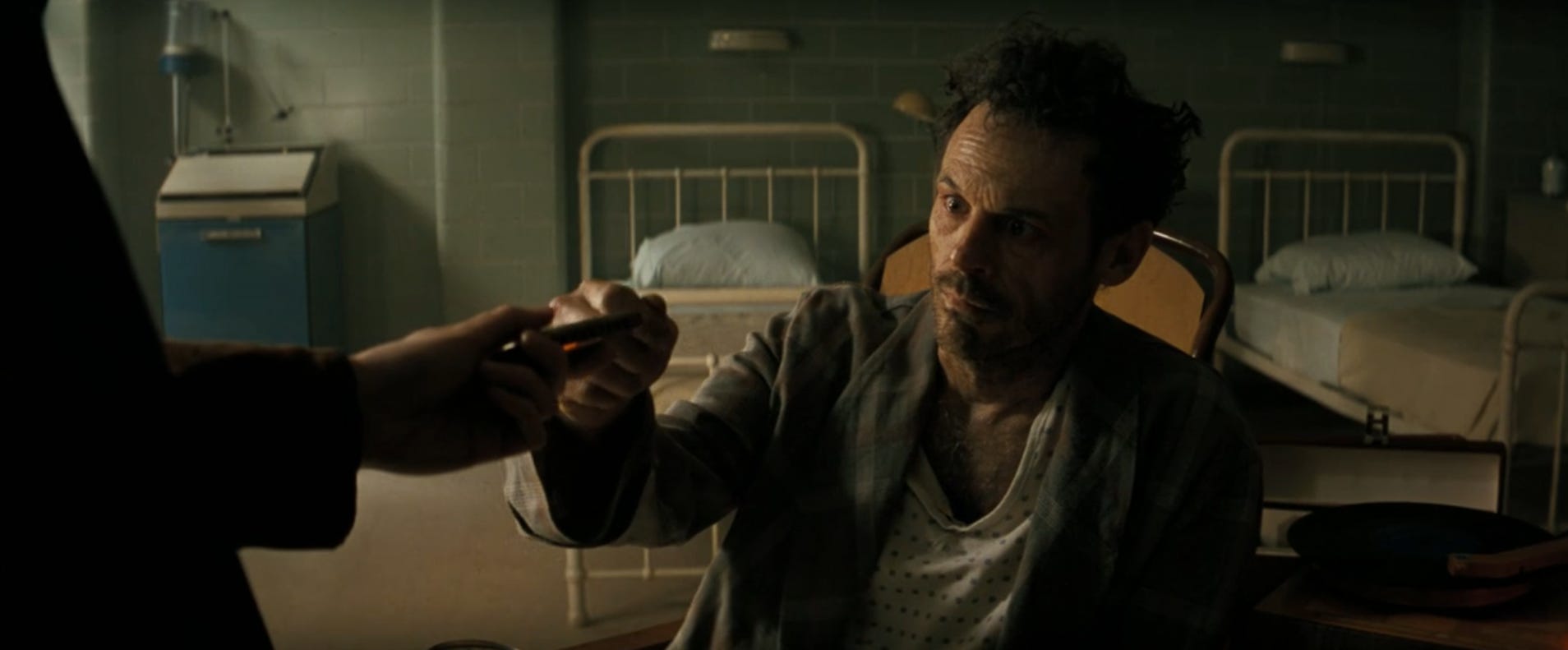
When Chalamet proffers the harmonica, the mute Scoot McNairy pushes it back. This gesture is equally weighted with significance. There’s no anger in it and no disappointment. The vibe I get is something like: “This belongs to you now. You deserve it. Use it however you see fit.”
The quality of mercy is not strained;
It droppeth as the gentle rain from heaven
Upon the place beneath. It is twice blest:
It blesseth him that gives and him that takes. (Merchant of Venice 4.1.180-83)
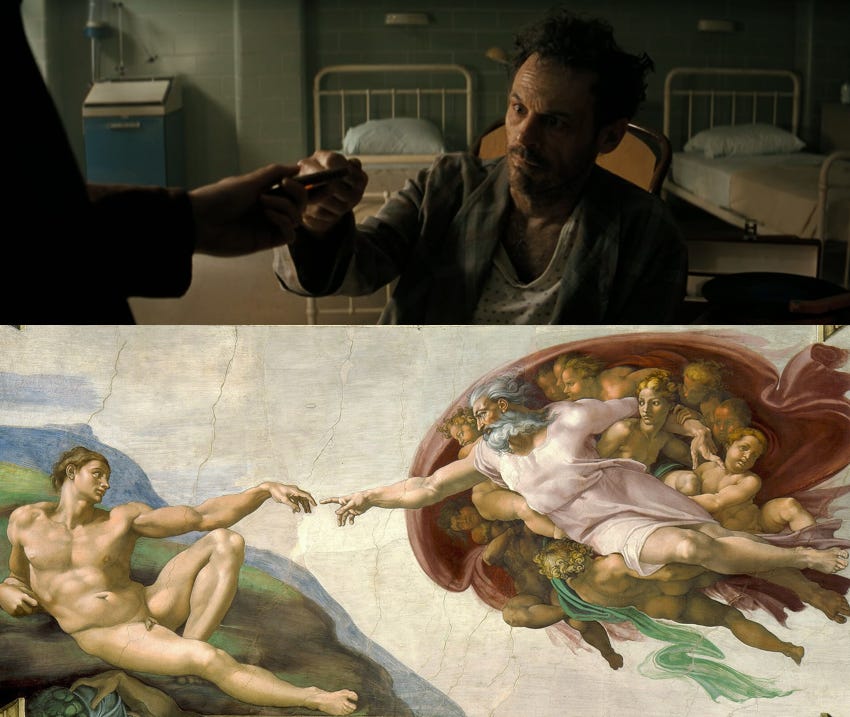
What we witness on screen is the father’s blessing, a blessing that the son desperately needs but doesn’t feel worthy of receiving. This is the miraculous power of mercy and forgiveness which lies at the heart of the prodigal son parable.
In the face of this saving grace, the grateful son can hardly believe his eyes. He takes off his hipster Wayfarers so he can see more clearly and receive the father’s blessing unobstructed. “I once was lost but now I’m found / Was blind but now I see.” Chalamet doesn’t say anything verbally. Instead he says it with touch. The script calls for them to touch hands, recalling the scene between Pete and Woody when the harmonica first changed hands. But Chalamet instead gently touches McNairy’s head.
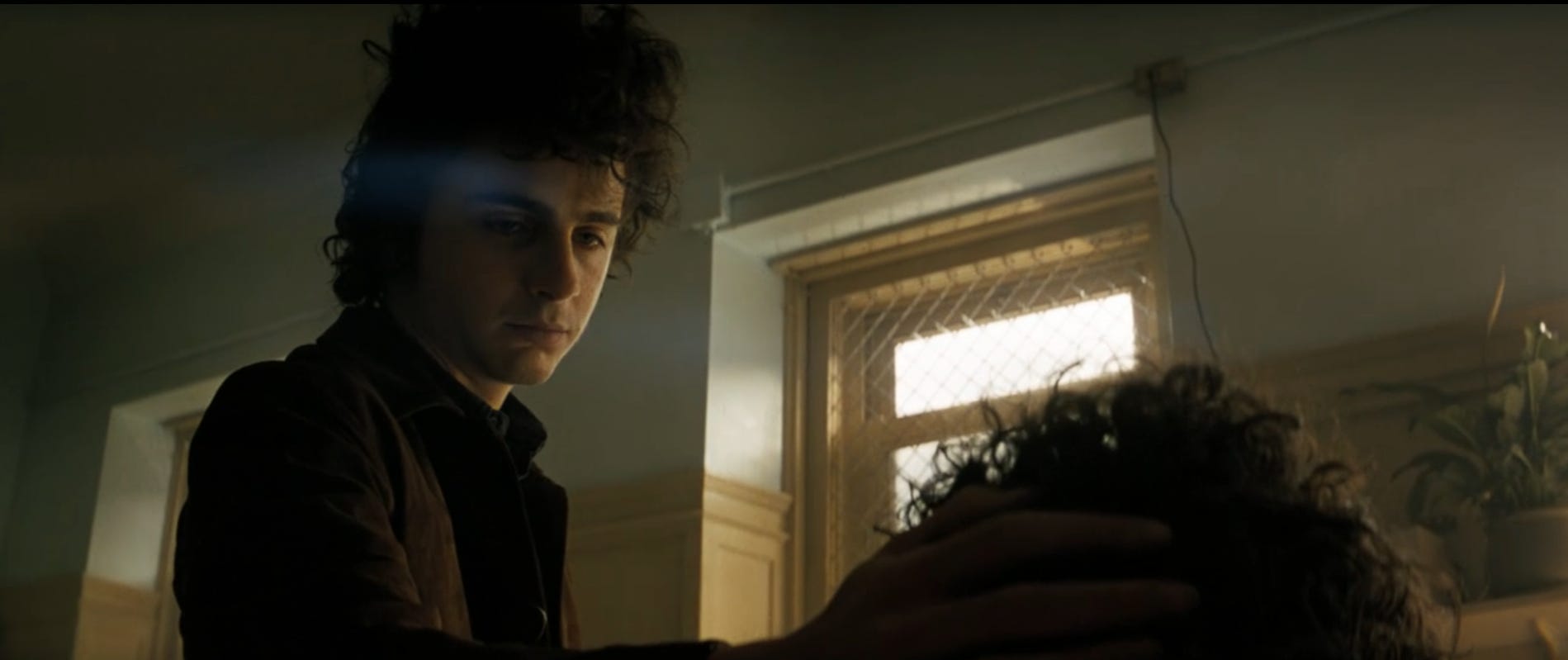
It’s striking how closely Bob’s shaggy locks resemble Woody’s unkempt hospital hair. The effect is to accentuate the family resemblance between this prodigal son and his musical father. Bob hasn’t betrayed Woody, not at all. In following his own path, he is doing exactly what Woody did, and what the father implicitly advises the son to keep on doing for as long as he can.
Chalamet’s Bob reveals fathomless depths of pathos as he looks down at McNairy’s Woody. He knows this will be their last goodbye. The loss is enormous. But he also manages a hint of a smile as he leaves. He has promises to keep, and miles to go before he sleeps. When Bob hops on his Triumph and roars down the road at the end of A Complete Unknown, we should not view this as the son abandoning the father. Quite the contrary. Bob takes the harmonica with him, and he takes Woody’s spirit with him, too, wherever he goes. The torch has been passed.
In Chronicles, Dylan describes a sense of destiny binding him to Guthrie long before the two men met in persona, a bond secured by Woody’s songs: “One by one, I began singing them all, felt connected to these songs on every level. They were cosmic. One thing for sure, Woody Guthrie had never seen nor heard of me, but it felt like he was saying, ‘I’ll be going away, but I’m leaving this job in your hands. I know I can count on you’” (246).

There is something so beautiful about the fact that we can now go to Tulsa and find the Bob Dylan Center situated right beside the Woody Guthrie Center. Like A Complete Unknown, these two shrines make manifest the prodigal son’s reconciliation with the father. Now we can all follow in their footsteps on the journey back home. What once was lost is found again: a shared musical legacy and perfect finished plan.
Works Cited
A Complete Unknown. Directed by James Mangold. Searchlight Pictures, 2024.
Cohn, Greg. “Who’s Who in ‘A Complete Unknown’: A Guide to the Characters and Stars.” New York Times (25 December 2024), https://www.nytimes.com/2024/12/25/movies/complete-unknown-bob-dylan-character-guide.html.
Dylan, Bob. Chronicles, Volume One. Simon & Schuster, 2004.
---. Official Lyrics. The Official Website of Bob Dylan,
https://www.bobdylan.com/.
---. The Philosophy of Modern Song. Simon & Schuster, 2022.
Garber, Marjorie. Shakespeare After All. Pantheon Books, 2004.
Griffin, Sid. Million Dollar Bash: Bob Dylan, The Band, and the Basement Tapes, 2nd edition. Jawbone Press, 2014.
The Holy Bible. King James Version.
Lowe, Zane. “Timothée Chalamet: Becoming Bob Dylan | Apple Music.” YouTube (11 November 2024),
.
Masked and Anonymous. Directed by Larry Charles. Sony Pictures Classics, 2003.
The King. Directed by David Michôd. Netflix, 2019.
Shakespeare, William. King Henry IV, Part 1. Ed. David Scott Kastan. Arden Shakespeare. Methuen, 2002.
---. The Merchant of Venice. Ed. John Drakakis. Arden Shakespeare. Bloomsbury, 2010.
Shanley, John Patrick. Prodigal Son. Theatre Communications Group, 2016.
What a beautiful piece. Thank you.
Another very fine piece! Your discussion of Shanley's play and teasing out the Hal – Henry IV parallels in The King are brilliantly done. But I particularly appreciated your sensitive reading of A Complete Unknown. The dynamics of the Woody – Seeger – Dylan relationship are subtly unravelled.
One text I would add to your piece are the words Bob spoke when presented with his Grammy Lifetime Achievement Award on 20 February 1991.
Accepting the award from a beaming Jack Nicholson, Dylan made this speech:
"Well, um... yeah... my daddy, he didn't leave me much, you know he was a very simple man, but what he did tell me was this, he did say, son, he said…
[long pause, nervous laughter from the crowd]
He said so many things you know. [laughter]
He said, you know it's possible to become so defiled in this world that your own father and mother will abandon you, and if that happens, God will always believe in your own ability to mend your own ways."
Dylan scholars have connected Dylan's words with Rabbi Shimshon Rafael Hirsch (the mid 19th century spiritual leader of traditional Jewry in Germany) commentary on Psalms 27:10. Hirsch wrote:
"Even if I were so depraved that my own mother and father would abandon me to my own devices, God would still gather me up and believe in my ability to mend my ways."