
Positively O'Connell Street
Yeats & Dylan, Part 2

Bob Dylan concludes the latest leg of his Rough and Rowdy Ways Tour tonight with a concert in Dublin. For those of you lucky enough to attend, I hope you’ll find time before or after the show to wander the city. If you do, you’re certain to spend time on O’Connell Street, the main thoroughfare through the heart of Dublin. When you’re walking that street, you’re following in the footsteps of William Butler Yeats.
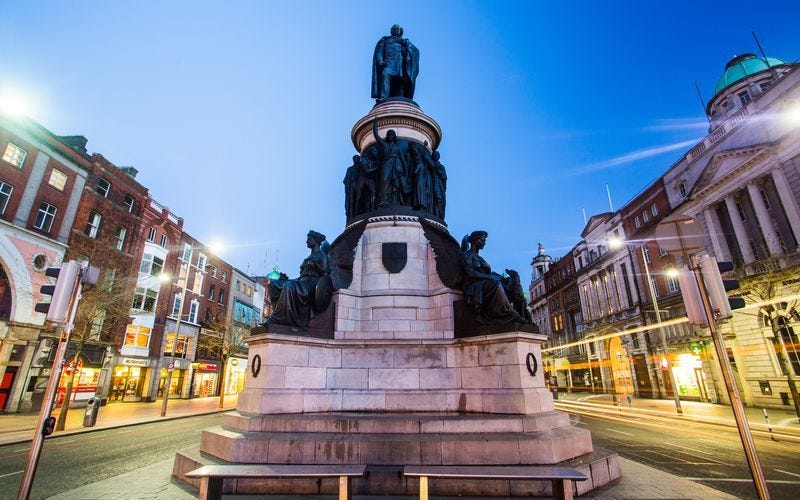
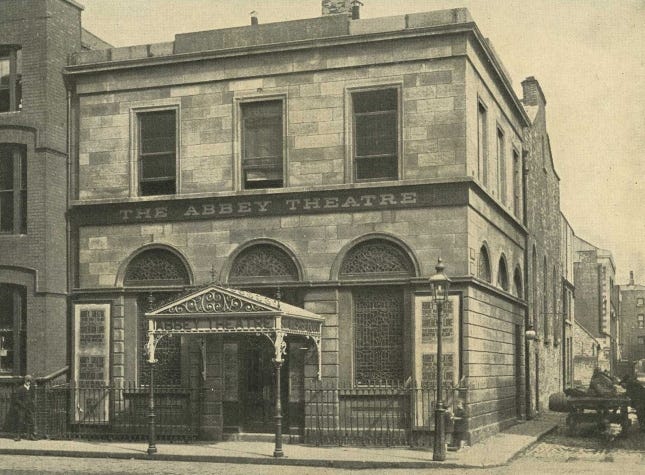
After you’ve finished shopping in the Grafton Street markets, head north on O’Connell Street, past Trinity College, and across the bridge. Hang a right onto Abbey Street and you’ll find the National Theatre of Ireland, co-founded by Yeats.

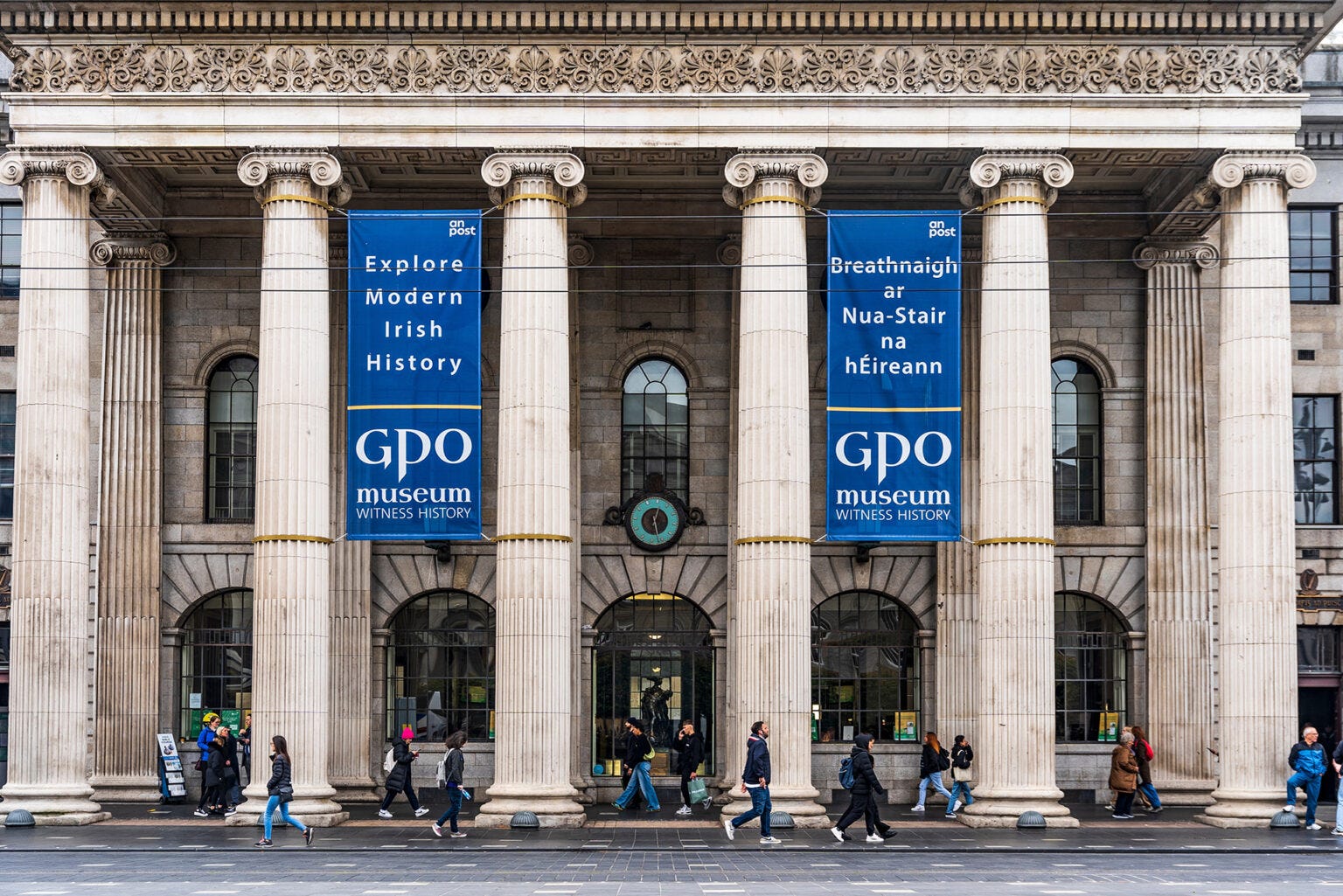
Or continue straight and you’ll pass the General Post Office on your left, which served as headquarters for the Easter Rising. You can still see bullet holes in the pillars where Pádraic Pearse publicly issued the Proclamation of the Irish Republic on April 24, 1916.
Keep going north and you’ll arrive at Parnell Square, named after the “Uncrowned King of Ireland” who presided over Yeats’s youth and whose downfall prompted the Celtic Revival we focused on in the first installment. While you’re there, catch a glimpse of the Hugh Lane Gallery, which is currently closed for refurbishment. The fate of Lane’s collection was a source of great angst for Yeats in 1913.


Yeats experienced a great deal of anxiety, frustration, disillusionment, and rage during the period we’ll be discussing in this second installment, as a series of clashes with the Dublin public led to souring relations between Yeats and his audience.
As you know, Dylan experienced a comparable falling out with his audience, beginning with the Tom Paine Award debacle in December 1963, continuing with his creative swerve away from “finger-pointing songs” and toward rock music, and boiling over when he went electric at the Newport Folk Festival and embarked on contentious tours in 1965-66. I have already written about these events extensively, and I trust that you’ve seen No Direction Home and A Complete Unknown and read other accounts like Elijah Wald’s excellent book. So I’m going to focus primarily on the Irish side of this story: more Yeats & Dublin than Yeats & Dylan.
But as you can tell from my title, there are interesting similarities between the two artists’ experiences. Yeats could relate to Dylan’s venomous reply to his disgruntled audience in “Positively 4th Street”:
You’ve got a lot of nerve
To say you are my friend
When I was down
You just stood there grinning
You’ve got a lot of nerve
To say you’ve got a helping hand to lend
You just want to be on
The side that’s winning
Quick caveat: if I were being completely accurate, I would have called this piece “Positively Sackville Street,” since that was the road’s name during the period we’re covering. It was renamed after “the Liberator” Daniel O’Connell under the Irish Free State government in 1924. The revised story of modern Ireland was still being drafted in the first two decades of the 20th century, and Yeats was a leading author, painstakingly substituting English inscriptions for Irish ones. As a character in a film by the great Irish-American director John Ford exclaims, “When the legend becomes fact, print the legend.” So be it: “Positively O’Connell Street” it is.
Cathleen ni Houlihan
In 1897, Yeats, his good friend Lady Augusta Gregory, and her neighbor Edward Martyn hatched a plan for the Celtic Theatre, soon rechristened the Irish Literary Theatre. Their idea was to regularly perform in Dublin plays by Irish playwrights on Irish themes for Irish audiences. Cultural nationalists supported the concept in theory, but none of the founders had much experience writing or producing plays, and their early efforts were not very successful.
In a pointed critique published in May 1901 in the United Irishman, Frank Fay diagnosed what was wrong with Yeats’s drama and what might set it right:
They do not inspire; they do not send men away filled with the desire for deeds. Before he will be even on the road to achieving greatness as a dramatic poet, Mr. Yeats must tackle some theme of a great, lasting and living interest. In Ireland we are at present only too anxious to shun reality. Our drama ought to teach us to face it. Let Mr. Yeats give us a play in verse or prose that will rouse this sleeping land. […] This land is ours, but we have ceased to realise the fact. We want a drama that will make us realise it. We have closed our ears to the piercing wail that rises from the past; we want a drama that will open them, and in no uncertain words point out the reason for our failure in the past and the road to success in the future. (qtd. Foster I 249)
Yeats and Gregory answered Fay’s call. The pair huddled up that summer at Coole Park (her plush estate in Gort, County Galway) and collaboratively wrote Cathleen ni Houlihan. This short but powerful one-act folk play premiered in April 1902 at St. Teresa’s Hall on Clarendon Street. Cathleen ni Houlihan was an instant smash hit. The boost in popularity and ticket sales attracted sponsorship from Annie Horniman, which in turn gave Yeats and company the funds needed to acquire their own performance space in downtown Dublin: the Abbey Theatre.
Yeats stamped his nationalist passport with Cathleen, and he would flash those impeccable credentials whenever his allegiances were later called into question. But Cathleen’s gift also proved a heavy burden, particularly after the flame it ignited grew into an uncontrollable wildfire in the following decade. After seeing the original production, Stephen Gwynn prophetically wrote: “‘I went home asking myself if such plays should be produced unless one was prepared for people to go out to shoot and be shot’” (qtd. Foster I 262).
Let’s start with the title figure. Yeats had long been fascinated with Cathleen ni Houlihan, an allegorical representation of Ireland. In 1894, he wrote the poem “Red Hanrahan’s Song about Ireland” in which Cathleen bolsters the faith of those who suffer and sacrifice for Irish freedom: “Our courage breaks like an old tree in a black wind and dies, / But we have hidden in our hearts the flame out of the eyes / Of Cathleen, the daughter of Houlihan.”
Yeats and Gregory conflate Cathleen with another familiar personification of Ireland, the Shan Van Vocht [Sean-Bhean bhocht], translated as “the poor old woman.” There is a famous rebel ballad called “The Shan Van Vocht” which supplies the general contours for Cathleen ni Houlihan. The song begins,
“Oh, the French are on the sea,” says the Shan Van Vocht
“Oh, the French are on the sea,” says the Shan Van Vocht
“Oh, the French are in the bay, they’ll be here without delay
And the Orange will decay,” says the Shan Van Vocht
This opening refers to the 1798 Rising led by Wolfe Tone and his United Irishmen. France was at war with Great Britain at the time and so agreed to support the Irish rebellion. Yeats and Gregory set their play in 1798 in Killala, the site where the French landed in County Mayo. Their arrival is celebrated as an auspicious omen by the Shan Van Vocht:
“And will Ireland then be free?” says the Shan Van Vocht
“And will Ireland then be free?” says the Shan Van Vocht
“Yes, old Ireland will be free from the center to the sea
And hurrah for liberty!” says the Shan Van Vocht
At the beginning of the play, the Gillane family is excitedly preparing for the wedding of the eldest son Michael to a prosperous local girl, Delia Cahel. They are interrupted by a visit from a poor old woman, who is going door to door recruiting young men to join the rising. Questioned by the Gillane parents, Cathleen declares, “Sometimes my feet are tired and my hands are quiet, but there is no quiet in my heart. When the people see me quiet, they think old age has come on me and that all the stir has gone out of me. But when the trouble is on me I must be talking to my friends” (136). Asked what set her wandering, she answers, “Too many strangers in the house” (136). Asked the source of her troubles, she answers, “My land that was taken from me. […] My four beautiful green fields” (136), a reference to the four ancient provinces of Ireland.
In the original 1902 production, the lead role of Cathleen was played by none other than Maud Gonne, the firebrand nationalist who had enchanted Yeats ever since he met her in 1889. Gonne formed a very intimate connection with Yeats, but she continually spurned his proposals for marriage. His love’s labour’s loss was his art’s gain, however, as the elusive Maud served as Muse for some of Yeats’s finest poems. By all accounts, her performance as Cathleen was spellbinding, for both the characters in the play and the audience.

Cathleen’s chief motive for visiting the Gillanes is to lure Michael away from Delia by convincing him instead to fight for Irish freedom. She levels with him that the sacrifices will be severe and that he may not survive:
It is a hard service they take that help me. Many that are red-cheeked now will be pale-cheeked; many that have been free to walk the hills and the bogs and the rushes, will be sent to walk hard streets in far countries; man a good plan will be broken; many that have gathered money will not stay to spend it; many a child will be born, and there will be no father at its christening to give it a name. (139)
What could possibly be appealing about such a hard bargain? Cathleen sings the answer as she leaves the Gillane house:
They will be remembered for ever,
They shall be alive for ever,
They shall be speaking for ever,
The people shall hear them for ever. (139)
Her followers will join the pantheon of Irish martyrs who made the ultimate blood sacrifice for Ireland. Cathleen wins Michael over to her cause. He chases after her, presumably on his way to losing his life but gaining his renown in the 1798 Rising.
The memorable final line of the play belongs to the younger son Patrick. Asked by his father if he saw the poor old woman walking down the path, Patrick replies, “I did not, but I saw a young girl, and she had the walk of a queen” (140). Ah, Cathleen was so much older then, she’s younger than that now. The implication is that she has been revitalized by the transfusion of new blood sacrificed in her name.
In light of Yeats’s later ambivalence over directions his country took, it’s tempting to read a critique of Cathleen/Ireland as a vampire who feeds on the blood of young men, generation after generation. But that’s definitely not how Dublin audiences responded at the time. Cathleen proclaims, “I have good friends that will help me. They are gathering to help me now. I am not afraid. If they are put down to-day they will get the upper hand to-morrow” (138). That message crashed across the footlights, challenging spectators to enlist in the militant cause. The 1798 Rising failed to achieve independence, but the sacrifice was not in vain. The current generation of Irish men and women had both the opportunity and the obligation to pick up the blood-stained banner and carry it forward.
In Chronicles, Dylan surprised readers by confessing to his boyhood fantasy of becoming a war hero: “I had even wanted to go to West Point. I’d always pictured myself dying in some heroic battle rather than in bed. I wanted to be a general with my own battalion and wondered how to get the key to open this wonderland” (41-42). But when he became a man, he put away childish things, including those dangerously romantic illusions about war.

As a young singer-songwriter, Dylan adamantly rejected saber-rattling patriotism. Beginning in his early twenties, he wrote songs exposing nationalist violence as ideological brainwashing (e.g., “John Brown”), denouncing the greed and cruelty of the military industrial complex (e.g., “Masters of War”), challenging his generation to break America’s addiction to perpetual warfare (e.g., “Blowin’ in the Wind,” “With God on Our Side”), and praising “warriors whose strength is not to fight” (“Chimes of Freedom”). Young Dylan had little stomach for the rhetoric of blood sacrifice bandied about in Cathleen ni Houlihan. To be fair, though, Yeats would soon have cause to regret the genie he helped release from the Irish bottle.
The Playboy Riots
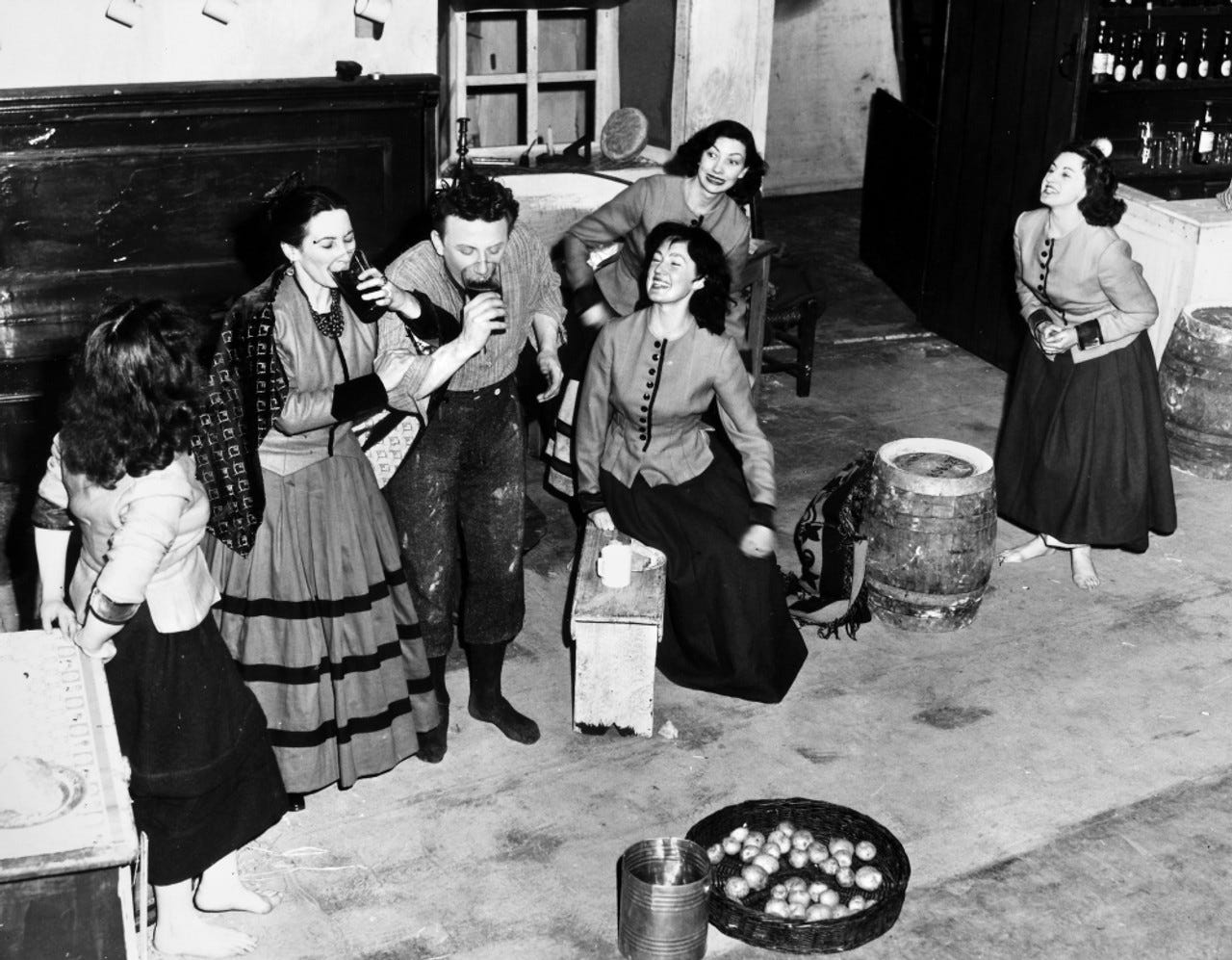
In the early years of the Abbey Theatre, a new playwright emerged as the most significant dramatic voice of the movement: John Millington Synge. His established his reputation with short folk plays, but his first full-length play made the biggest impact. The Playboy of the Western World premiered on January 26, 1907. It was tremendously controversial and seemed deliberately designed to unsettle nationalist audiences.
The play is set in an isolated rural pub in County Mayo. A young stranger, Christy Mahon, arrives on the scene and eventually confesses to the awful crime of killing his father. You might expect the locals to be appalled by this news, but instead they are impressed: “Bravery’s a treasure in a lonesome place, and a lad would kill his father, I’m thinking, would face a foxy divil with a pitch-pike on the flags of hell” (76).

Rather than expelling Christy, the publican Michael James Flaherty offers him a job. The locals are fascinated by the newcomer, celebrating his brash behavior and lyrical eloquence. The women of the community are especially attracted to this romantic stranger, and Christy develops a budding romance with the pub owner’s daughter Pegeen Mike. Meanwhile, we discover that his father is not dead after all. He tracks his son down to Mayo and confronts him near the end of the play.
Once the truth is exposed, the locals turn violently against Christy, physically assaulting him while they attempt to arrest him and turn him over to the police. He tries to redeem himself by attacking his father again, making the legend come true, but there is no salvaging the situation by then. The same crowd that raises Christy up as a hero turns against him and tears him down in the end. Synge knew what he was up to in naming his protagonist after Christ.
Playboy’s conclusion prophetically anticipated the play’s reception. The original production was met with hostile protests from Abbey audiences and nationalist groups in Dublin, a notorious episode in Irish theatrical history known as the Playboy Riots. Audiences in the urban East had come to expect idyllic depictions of characters from the romanticized West. Synge’s play exploded nationalist pieties about Irish rural peasantry, offering instead a satire much closer to the buffoonish “Stage Irishman” stereotype popular on the English stage.
Furthermore, and even more incendiary, Playboy was denounced as a slur against the sanctity of Irish womanhood, depicting the women of Mayo as panting with lust for Christy. Late in the play, he makes a derogatory reference to women’s undergarments—“It’s Pegeen I’m seeking only, and what’d I care if you brought me a drift of chosen females, standing in their shifts itself, maybe, from this place to the Eastern World?” (109). That line lit the spark on a powder keg. Yeats was out of town at a speaking engagement in Scotland the night Playboy opened at the Abbey. Lady Gregory sent him an urgent telegram: “Audience broke up in disorder at the word shift.”
Yeats returned immediately to Dublin, entering the fray and whipping it into further frenzy. He gave an interview to the Evening Standard, blaming rowdy republicans for causing disruptions and smugly suggesting that “so far as he could see the people who formed the opposition had no books in their houses” (qtd. Foster I 360). Yeats’s biographer Roy Foster offers this blow-by-blow account of the most tumultuous week in the Abbey’s history:
Disturbances continued throughout the week, reported at gleeful length in all the Irish papers. On several occasions WBY harangued the audience from the stage. There were several arrests and fines. By the end of the week he believed “opinion had turned in our favour”; on 4 February he celebrated with a public debate in the theatre—an idea he had announced, to Synge’s evident surprise, as soon as he returned. This, together with his readiness to give newspaper interviews, proved his appetite for public confrontation. Gregory’s line was that people who came to the theatre “must take what is provided for them”; Synge’s, equally characteristic, that he “didn’t care a rap.” But for WBY the issue was one of artistic freedom and liberation from a censorship, not imposed by the Church but by dictatorial “societies, clubs and leagues”—in other words, by [Arthur] Griffith’s Sinn Féinners. (Foster I 361)

It must be conceded that Yeats doesn’t always come across sympathetically in his clashes with the Irish public. Sometimes he sounds precisely like his caricature as a chauvinist snob who fancied himself superior to the majority of Abbey audience members, or for that matter the majority of Irish citizens. One cannot imagine Dylan saying some of the things or sharing some of the values of Yeats when he stamps his foot, squints through his pince-nez, and lectures his disgruntled audiences about their uncouth literary tastes.
But Dylan could have related to the chaos of the Playboy Riots. Imagine Dylan’s experience of going electric at Newport, but then repeated night after night. Come to think of it, that’s pretty much what he did during the tempestuous tours of fall 1965 and spring 1966: The Rolling Riots Revue.
Dylan could also relate to Yeats’s fierce defense of artistic freedom. And he shares the Irish bard’s defiant refusal to bend to the will of the masses by compromising his vision. The Dylan who kept going out there, getting heckled throughout his electric set, but refusing to budge on his commitment to playing the songs he wanted to play the way he wanted to play them—that pugnacious attitude is completely consistent with Yeats’s stance during the Playboy Riots.

In both Dylan and Yeats’s cases, the pressure was coming from audiences who had been, up until these public splits, their most ardent supporters. And in both cases, audiences were essentially telling the artists that they wanted more of the old stuff they liked, and less of the new stuff that they disliked.
In his poetry, lectures, and manifestoes for the Celtic Revival, Yeats fed his audience a steady diet of heroic mythology about Ireland, and he created a cultural space for airing grievances. Now that the Abbey was producing work that questioned, undermined, or mocked nationalist excesses, the Dublin audience forcefully let the directors know that they preferred the mirror held up by Cathleen to the cracked looking-glass held up by Playboy. Likewise, Dylan’s dissatisfied audiences let him know that they preferred acoustic communal singalongs like “Blowin’ in the Wind” and “The Times They Are A-Changin’” to blaring individualist rock numbers like “Maggie’s Farm” and “Like a Rolling Stone.”
The Hugh Lane Controversy
Burned but undaunted by the Playboy Riots, Yeats wrote a very revealing letter to Gregory in June 1907, the week he turned 42 years old:
I am not young enough to change my nationality—it would really amount to that. […] I understand my own race and in all my work, lyric or dramatic, I have thought of it. If the theatre fails I may or may not write plays—but I shall write for my own people—whether in love or hate of them matters little—probably I shall not know which it is. (qtd. Foster I 369-70)
If you study Yeats’s writings between 1907 and 1916, it sometimes feels like he hates his fellow Irish citizens more than he loves them. During this period, he repeatedly gets drawn into squabbles with the Dublin middle class, the press, the clergy, and local business and civic leaders. One small dispute that had much larger implications for Yeats had to do with the Hugh Lane bequest.
Lane was a wealthy art collector, as well as the nephew of Lady Gregory. He had acquired a considerable collection of modern art that he was willing to donate to Dublin, so long as the city council agreed to build a permanent gallery adequate for its public display. After mixed signals and repeated delays from local politicians, and a rising tide of public resentment over the costs of the proposed project, Lane withdrew his bequest and decided to place the paintings elsewhere.
Yeats was flabbergasted by what he saw as the philistinism, short-sightedness, and parsimony of Dubliners. He vented his ire in two poems, both published in the Irish Times. The first was called “The Gift,” though he later gave it the cumbersome title “To a Wealthy Man who promised a Second Subscription to the Dublin Municipal Gallery if it were proved the People wanted the Pictures.” The second and better poem is “September 1913.”
Yeats confronts the Dublin bourgeoise, accusing them of crass materialism and timid piety:
What need you being come to sense,
But fumble in a greasy till
And add the halfpence to the pence
And prayer to shivering prayer, until
You have dried the marrow from the bone;
For men were born to pray and save.
In the poem’s famous refrain, Yeats contrasts the prevailing mediocrity of his age with the heroism of bygone generations: “Romantic Ireland’s dead and gone, / It’s with O’Leary in the grave.” The reference here is to John O’Leary (1830-1907), the old Fenian, a veteran of Young Ireland’s 1848 Rising, and the revered mentor of young Yeats and Maud Gonne in the hallowed tradition of Irish nationalism.

They don’t make ’em like O’Leary anymore, not in this age, not in this country, not according to Yeats:
Yet could we turn the years again,
And call those exiles as they were,
In all their loneliness and pain
You’d cry “Some woman’s yellow hair
Has maddened every mother’s son”:
They weighed so lightly what they gave,
But let them be, they’re dead and gone
They’re with O’Leary in the grave.
Why did Yeats get so worked up over this tempest in a teapot? He saw the Lane kerfuffle as emblematic of a much larger problem, and he feared what it augured for the future intellectual and artistic life of Ireland. He spells out these concerns most clearly in a fundraising lecture for Lane’s gallery in July 1913. He told his audience at the Court Theatre in London:
There is a moment in the history of every nation when it is plastic, when it is like wax, when it is ready to hold for generations the shape that is given to it. Ireland is not plastic, and will be for a few years to come. […]. If Hugh Lane is defeated, hundreds of young men and women all over the country will be discouraged—will choose a poorer idea of what might be. […] If the intellectual movement is defeated, Ireland will for many years become a little huckstering nation, groping for halfpence in a greasy till. It is that, or the fulfillment of her better dreams. The choice is yours and ours. (qtd. Foster I 494)

By 1913, after devoting his entire adult life to fostering Irish pride as a precondition to Irish freedom—political freedom, yes, but also independence of the mind and the imagination—48-year-old Yeats believed that it had all come to naught. When he looked around contemporary Dublin, he saw little cause for confidence that the Free Ireland he imagined in his youth had any chance of being realized by his narrow-minded, faint-hearted, and weak-kneed neighbors. A few years later, he would be proven spectacularly wrong.
Easter 1916
On April 24, 1916—Easter Monday—several hundred members of the Irish Volunteers led by Pádraic Pearse and the Irish Citizen Army led by James Connolly seized control of key sites in Dublin and staged an armed revolution. The choice of 1916 was strategic, since British armed forces (including thousands of Irish soldiers) were fighting abroad in the Great War. The choice of Easter was symbolic, invoking Christ’s blood sacrifice and resurrection, and blessing the Rising as a holy cause. The choice of Easter Monday was practical, too, since it’s much easier to seize government buildings when they’re closed for the holiday.
Keeping control of the buildings proved much harder once British troops were sent in. They brought their big guns up the River Liffey and bombarded the city center, destroying much of downtown Dublin in the process.
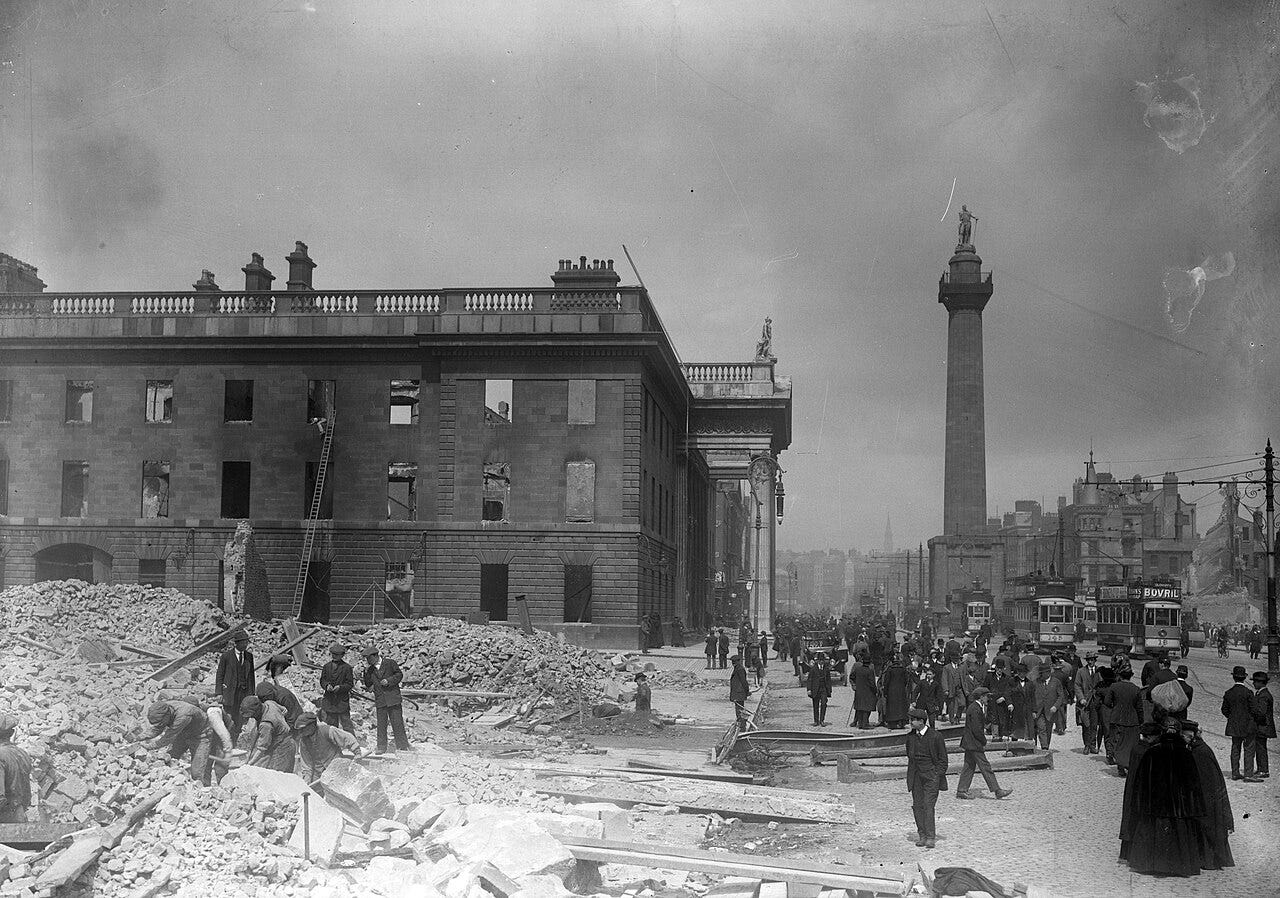
After six days, the Rising had fallen. In the immediate aftermath, the majority of Dubliners regarded the insurrection as a complete disaster. However, the tide quickly turned in the rebels’ favor after British officials rounded up the surviving leaders, summarily tried and convicted them of treason, and quickly executed them, mostly by firing squad in Dublin’s most notorious prison, Kilmainham Gaol.
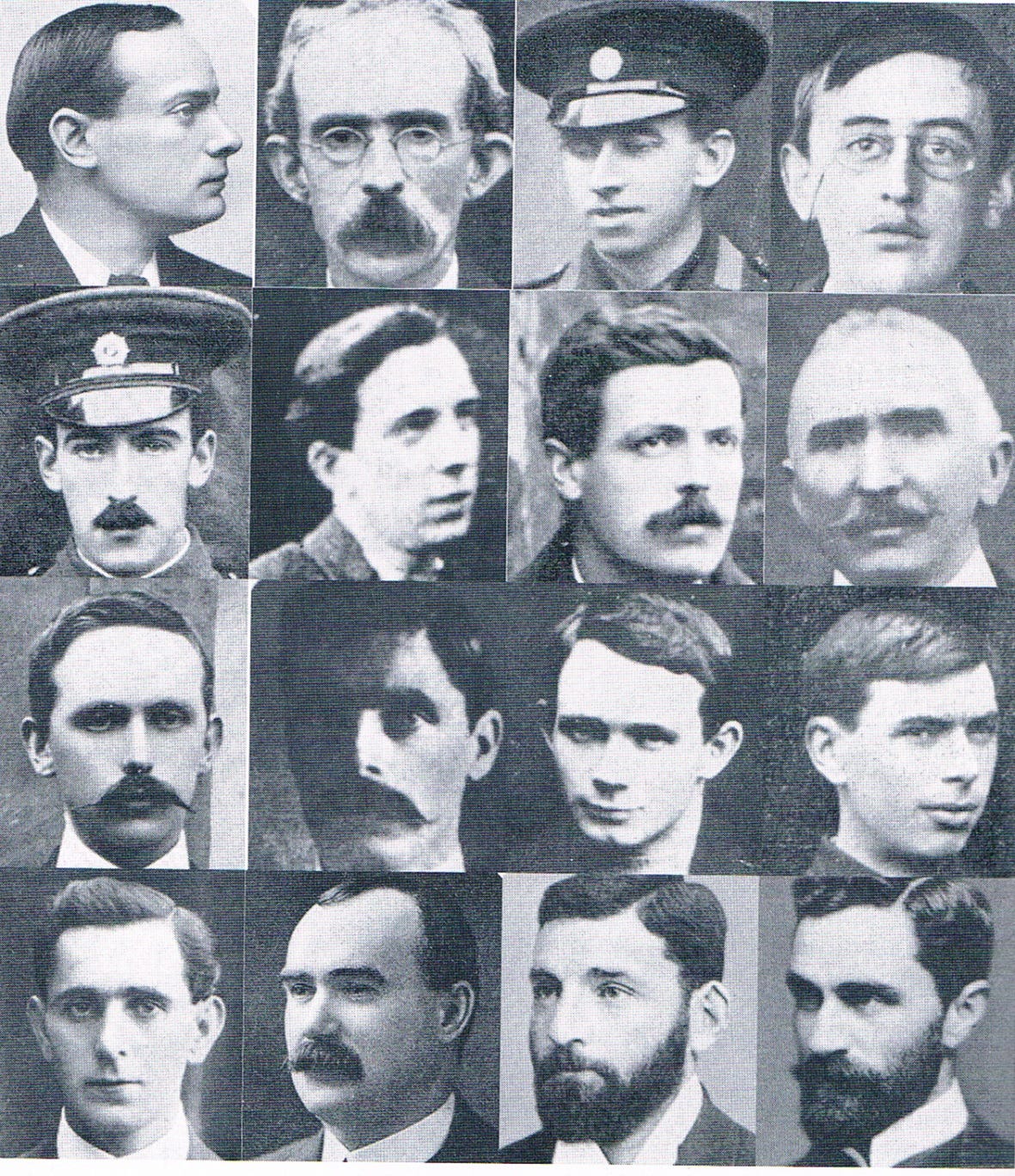
It had finally happened. Yeats’s generation had joined those before it in taking up arms and rebelling against British domination. This was seemingly the moment that Yeats had been preparing for, the bold and noble blood sacrifice that Cathleen ni Houlihan demanded. Homer had his Trojan War, and now Yeats had his Easter Rising.
When the Irish bard set his pen to paper in September to write “Easter, 1916,” however, what flowed from his troubled mind was not a heroic epic, but rather an ambivalent elegy for nationalists whom he feared had died for the wrong reasons. And yet, for all that, it’s probably also the best poem Yeats ever wrote.
Far from depicting the republican rank-and-file as heroes, Yeats begins by disparaging them—and himself—as fakes and fools. He replays a typical pre-1916 encounter on the street between the dandy artiste and the Dublin rabble:
I have met them at close of day
Coming with vivid faces
From counter or desk among grey
Eighteenth-century houses.
I have passed with a nod of the head
Or polite meaningless words,
Or have lingered awhile and said
Polite meaningless words,
And thought before I had done
Of a mocking tale or a gibe
To please a companion
Around the fire at the club,
Being certain that they and I
But lived where motley is worn:
All changed, changed utterly:
A terrible beauty is born.
Let’s unpack that first stanza. Yeats personally knew many men and women who fought and died in the Easter Rising. Before the rebellion, he had casually dismissed most of them as unserious or inconsequential. He had little patience or compassion for such people. He admits to previously seeing them as nuisances and clowns, the sort he smiled at, exchanged brief and shallow pleasantries with, and then mocked contemptuously behind their backs at the first opportunity. That is absolutely Yeats, so totally Dublin—Positively O’Connell Street.

Dylan depicts a very similar vibe in “Positively 4th Street,” the diatribe he wrote in response to being booed by his fair-weather fans at Newport. He sets the song on 4th Street in the heart of the Village, and recounts a likeminded encounter with a typical folkie frenemy.
You see me on the street
You always act surprised
You say, “How are you?” “Good luck”
But you don’t mean it
Polite meaningless words. Meanwhile, Dylan accuses the smiling schemers of feasting on schadenfreude and stabbing him in the back:
When you know as well as me
You’d rather see me paralyzed
Why don’t you just come out once
And scream it
Dylan’s 4th Street in the heart of the Village runs emotionally parallel to Yeats’s O’Connell Street in the heart of Dublin. Both are places where fools (“motley” is the costume of a jester) pretend to like each other but in fact harbor secret grudges and jealous rivalries and deviously delight in each other’s misfortunes.
But after the events of Easter 1916, Yeats was forced to reconsider everything he thought he knew about his neighbors and his nation. “All changed, changed utterly: / A terrible beauty is born.” The most famous oxymoron in modern poetry.
Why beauty? Because these dead comrades have now joined the pantheon of Irish martyrs who died fighting to free Ireland. As Cathleen sang,
They will be remembered for ever,
They shall be alive for ever,
They shall be speaking for ever,
The people shall hear them for ever. (139)
Why terrible? Because the city lay in ruin. Because this risky gambit seemed at the time like a catastrophic miscalculation that could set the independence movement back many years. Because some very good people (as well as some rogues and rascals) died brutally, and perhaps needlessly. Because war poems are beautiful but actual warfare is ugly. Because, as Pegeen Mike put it in Playboy, “there’s a great gap between a gallous story and a dirty deed” (Synge 110).
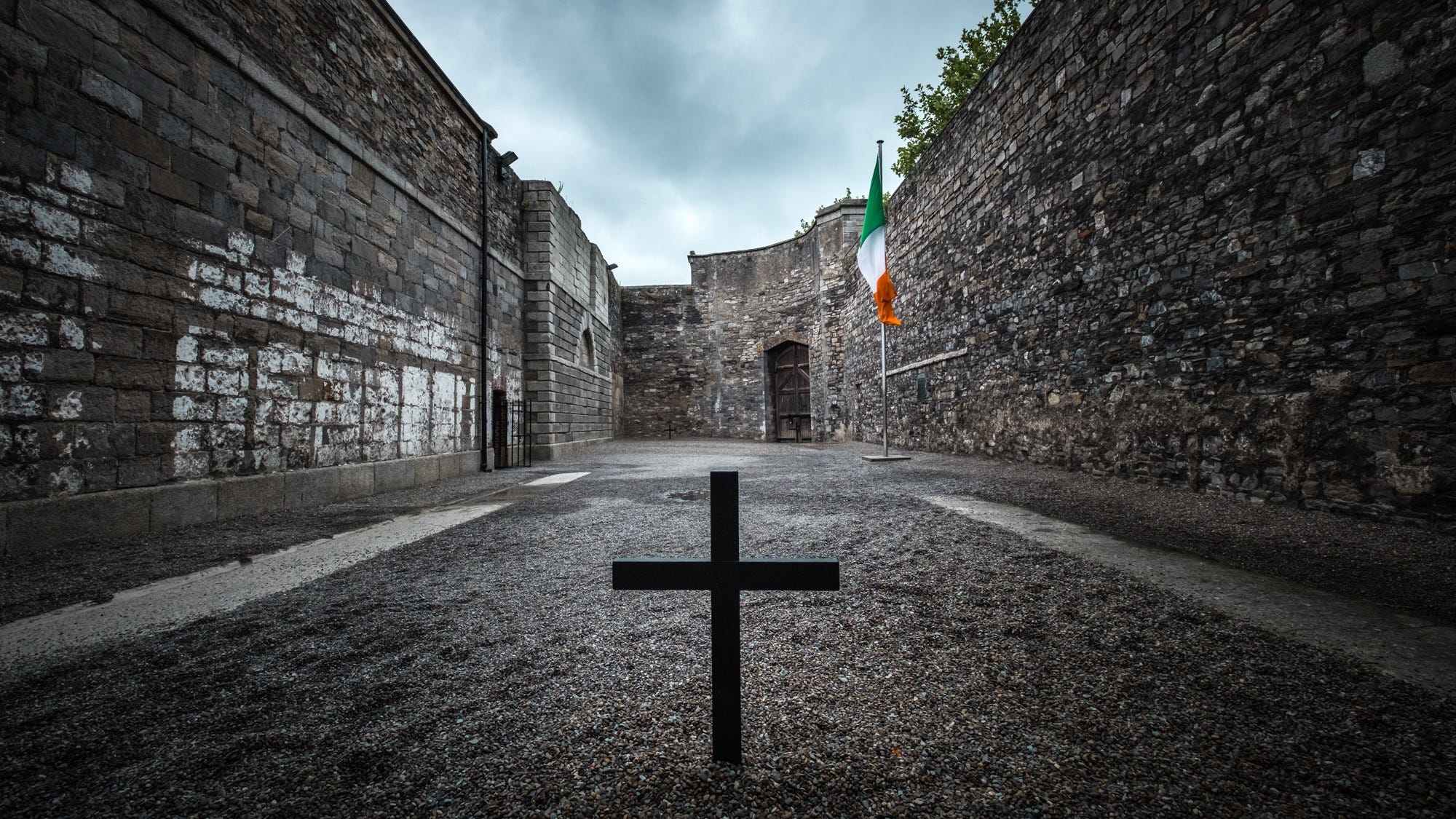
Yeats had been working for decades writing the gallous story of Ireland, but Easter 1916 forced him to confront the unnerving possibility that, in the process, he had inspired followers to commit dirty deeds. He was haunted by the deaths in the Easter Rising, the executions that followed, the ensuing guerilla combat of the Irish War of Independence (1919-21), and the heartbreaking blood feud of the Irish Civil War (1922-23). What had he done? In the final months of his life, he was still asking that question. In “Man and the Echo,” published posthumously in 1939, he wonders,
All that I have said and done,
Now that I am old and ill,
Turns into a question till
I lie awake night after night
And never get the answers right.
Did that play of mine send out
Certain men the English shot?
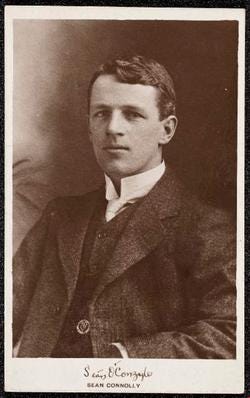
Yes, it did. In fact, to name only one, the first rebel killed in the Easter Rising was Sean Connolly, an actor with the Abbey Theatre.

When Yeats finally gets around to eulogizing his fallen comrades in the second stanza, he can’t quite bring himself to praise them in the exalted terms that a Homer owes his heroes. He damns Pádraic Pearse with faint praise, suggests that Thomas MacDonagh would have been better off writing literature, and accuses his old friend Countess Markievicz (née Constance Gore-Booth) of growing “shrill” with “ignorant good will” ever since she became radicalized by nationalism.
He reserves his harshest criticism for John MacBride, the man who stole his beloved Maud Gonne away:
This other man I had dreamed
A drunken, vain-glorious lout.
He had done most bitter wrong
To some who are near my heart.

MacBride deserved these insults and worse. He was a physically abusive husband to Maud, and he sexually molested her young daughter Iseult. Yeats wasn’t sad one bit to see him dead. MacBride’s corpse was barely cold when Yeats proposed marriage (again) to the recent widow, which she declined (again). It must have been difficult choking down the gall to praise that dirty scoundrel, but Yeats swallowed his pride enough to pen this epitaph for MacBride:
Yet I number him in the song;
He, too, has resigned his part
In the comedy;
He, too, has been changed in his turn,
Transformed utterly:
A terrible beauty is born.
With each passing stanza, the poem gets harder to write, as the ratio of terror to beauty rises.
By the final stanza, Yeats can no longer suppress his misgivings about the Easter Rising. “Too long a sacrifice / Can make a stone of the heart. / O when may it suffice?” The rebels had hearts of stone? No one would ever confuse that for a compliment. You’ll recall that Dylan used that same image in “Property of Jesus,” lashing out against those who mocked his Christian conversion:
He’s the property of Jesus
Resent him to the bone
You’ve got something better
You’ve got a heart of stone
You’ve got a lot of nerve, Mick Jagger, to say you are my friend.
Yeats’s worries just keep mounting: “Was it needless death after all?” How can the Irish bard dare to ask such a question about the martyrs of 1916? And he’s not done crossing lines and breaking taboos: “And what if excess of love / Bewildered them till they died?” One cannot overstate how inflammatory such questions would have been in the wake of the Easter Rising, and what a fundamental abdication of responsibilities this would have seemed for Yeats.
When Maud Gonne read “Easter, 1916,” she was outraged. Yeats composed the poem in September, and Gonne responded with a harsh letter in November:
No, I don’t like your poem, it isn’t worthy of you & above all it isn’t worthy of the subject—Though it reflects your present state of mind perhaps, it isn’t quite sincere enough for you who have studied philosophy & know something of history know quite well that sacrifice has never turned a heart to stone though it has immortalised many & through it alone mankind can rise to God—You recognize this in the line which was the original inspiration of your poem “A terrible Beauty is born.” (qtd. Foster II 63)
Gonne believed that MacDonagh, Pearse, and Connolly deserved much more generous praise. She even defended MacBride: “As for my husband he has entered Eternity by the great door of sacrifice which Christ opened & has therefore atoned for all so that praying for him I can also ask for his prayers & ‘A terrible beauty is born’” (qtd. Foster II 63). Cathleen ni Houlihan couldn’t have said it better herself.

To translate Yeats into Dylanese, “Easter, 1916” was his Newport moment. Let me be clear: I’m certainly not attempting to equate the magnitude of the two events. Hundreds of people died in the Easter Rising, downtown Dublin was destroyed, and the bloody reprisals that followed took a tragic toll on countless casualties for years to come. By comparison, Newport seems little more than a bunch of touchy folk purists getting their feelings hurt and their eardrums strained. But in terms of the artistic impact on two major “voices of their generations” and the evolution of their art, there is something to be learned by juxtaposing Newport ’65 with Dublin ’16.
Declan Kiberd reads “Easter, 1916” in terms that resonate perfectly with Dylan’s transformative apotheosis in 1965. He argues that Yeats’s poem “brought his waverings in the role of national bard to crisis-point. It enacts the quarrel within his own mind between his public, textual duty (to name and praise the warrior dead) and his more personal urge (to question the wisdom of their sacrifice)” (Kiberd 213). We routinely think of Newport ’65 as Dylan’s public resignation as “voice of his generation.” Up to that point, he had functioned effectively as bard for the civil rights movement, writing inspirational anthems about martyrs for the cause like Emmett Till, Medgar Evers, and Hattie Carroll. But after the Kennedy assassination, we can see him increasingly resisting this role as spokesperson, culminating in his declaration of independence at Newport.
We see Yeats making a similar pivot in “Easter, 1916.” Kiberd observes that the poem is written in two distinct voices,
and sometimes enacts in single phrases (“terrible beauty”) their contestation. The sanction of the first voice from bardic tradition was strong; but the force of the second was becoming more apparent to Yeats who increasingly defined freedom in terms of self-expression. He was abandoning the rather more programmatic nationalism of his youth for a more personal version of Irish identity. (213)
What a Dylanesque move by Yeats; what a Yeatsian turn by Dylan. In Maud Gonne’s acerbic letter, she endorsed the first voice of the Irish bard, but denounced the second voice as unworthy, self-indulgent, and insincere. She prefigures the booing “Judas!” crowd of Dylan detractors with pitch-perfect accuracy.
In “Easter, 1916,” Yeats’s calls into question his long-standing role as “voice of his generation.” If this is what the fight for Irish freedom really looks like, if this massive scale of individual and collective trauma is the necessary price to be paid, then maybe it’s time for the movement to find a different spokesman. He could not summon the voice required to praise this armed rebellion. The best he could do by the end was to list the names and pay his sorrowful respects to the dead:
I write it out in verse—
MacDonagh and MacBride
And Connolly and Pearse
Now and in time to be,
Wherever green is worn,
Are changed, changed utterly
A terrible beauty is born.
Importantly, the last line of the poem is the date of completion: “September 25, 1916.” Yeats is providing a snapshot in time, recounting how he felt about the Easter Rising in those first cataclysmic months. Likewise, Newport ’65 was a snapshot in time. Both events marked crucial turning points for Yeats and Dylan, epoch-shifting moments of change and costly personal growth. But neither artist was done changing, not by a long shot.
Furthermore, the rifts between the artists and their audiences were not irreparable or permanent. Both Yeats and Dylan sustained long-term love-hate relationships with their respective publics, periodically breaking up (“It ain’t me you’re looking for, babe”) and reuniting (Tangled Up in Green?). Despite very public disagreements and mutual recriminations, both artists kept the conversations going, with their audiences and with themselves.
Dylan has continued to speak for his generation in many ways since the height of his influence in the mid-sixties, regularly issuing “state of the union” songs, and increasingly serving as the “eulogist for his generation” as more and more of his friends and collaborators have passed away. For his part, Yeats continued to play a very active role in the cultural life of Ireland, and he did his bit for the Irish Free State (formed in 1922) by serving as a senator and “smiling public man” for many years. Although he quit in a huff several times, Yeats kept coming back to work on Cathleen’s Farm. And of course, the two artists also received a medal from the Swedish Academy in Stockholm that we’ll want to talk about. But we’ll save that discussion for the final installment of this series.
Works Cited
Dylan, Bob. Chronicles, Volume One. Simon & Schuster, 2004.
---. Official Lyrics. The Official Bob Dylan Website,
https://www.bobdylan.com/.
Foster, R. F. W. B. Yeats, A Life: Vol. I, The Apprentice Mage. Oxford University Press, 1997.
---. W. B. Yeats, A Life: Vol. II, The Arch-Poet. Oxford University Press, 2003.
Kiberd, Declan. Inventing Ireland: The Literature of the Modern Nation. Harvard University Press, 1995.
Synge, J. M. The Playboy of the Western World. Modern and Contemporary Irish Drama, 2nd ed. Norton Critical Edition. Ed. John P. Harrington. W. W. Norton, 2009, 68-112.
Yeats, W. B. “Easter, 1916.” Yeats’s Poetry, Drama, and Prose. Norton Critical Edition. Ed. James Pethica. W. W. Norton, 2000, 73-75.
---. “Man and the Echo.” Yeats’s Poetry, Drama, and Prose. Norton Critical Edition. Ed. James Pethica. W. W. Norton, 2000, 127-28.
---. “Red Hanrahan’s Song about Ireland.” Yeats’s Poetry, Drama, and Prose. Norton Critical Edition. Ed. James Pethica. W. W. Norton, 2000, 33.
---. “September 1913.” Yeats’s Poetry, Drama, and Prose. Norton Critical Edition. Ed. James Pethica. W. W. Norton, 2000, 44-45.
--- and Augusta Gregory. Cathleen ni Houlihan. Yeats’s Poetry, Drama, and Prose. Norton Critical Edition. Ed. James Pethica. W. W. Norton, 2000. 133-40.
The play "Resurrection" by Yeats, depicts a "Great Wheel" of history that turns. A Syrian, a Greek, and a Hebrew are in a room and the figure of Christ appears to them. The Greek says it's only a phantom, not flesh and blood; but when he touches the "ghost", the doubter declares "The heart of the phantom is beating!"
In a hotel room by himself, Bob Dylan takes on the mask of the Greek above:
""Jesus put His hand on me. It was a physical thing. I felt it all over me. I felt my whole body tremble. The glory of the Lord knocked me down, and picked me up".
In his aristocratric search for stability, Yeats turns to the poetry of his associate Ezra Pound. Pound moved on from Vortex poetry where there is energy all around but stillness at the centre to Imagism with the focus on a central figure, linked to the East, especially to Japanese art:
Seventy years have I lived
No ragged beggar-man
Seventy years have I lived
Seventy years man and boy
And never have I danced for joy
Dylan is aware of Pound's sympathy for Nazi Germany; nevertheless, a number of Dylan's songs show the influence of Pound's poetic styles.
But Dylan seldom expresses the degree of blackness as there is in Yeats' poem above.